

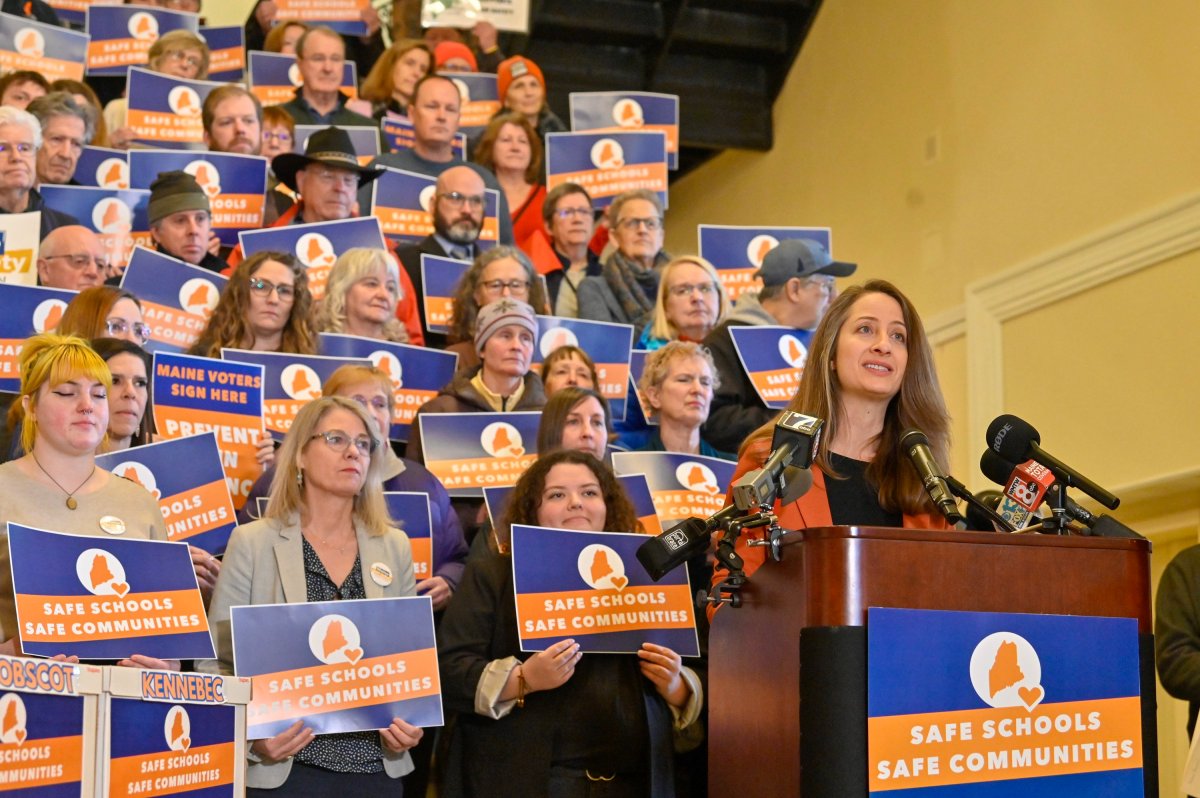
A new gun safety law that was pushed by advocates in the aftermath of the 2023 Lewiston mass shooting takes effect Saturday.
The so-called red flag law was approved by voters 63% to 37% in November following a referendum campaign that came after lawmakers failed to pass a similar proposal.
“Last November, Maine voters rejected repeated false claims from the gun lobby and opponents and overwhelmingly voted in favor of this commonsense law that will save lives,” said Nacole Palmer, executive director of the Maine Gun Safety Coalition, in a written statement Friday.
Maine is now among 22 states nationwide that have adopted a red flag law. The measures allow for quick intervention and the removal of weapons in cases where people pose serious risks to themselves or others, according to the anti-gun violence organization Everytown.
Maine’s new law allows police and family or household members of the person in crisis to petition a judge for a temporary weapons removal order. Unlike Maine’s yellow flag law — which has been in effect since 2020 and will remain on the books — it does not require a mental health evaluation before the order can be approved.
Supporters of the law say it will simplify the process for removing weapons from a person in crisis, and that it provides an important avenue for family members to take action if law enforcement can’t or won’t. Critics have said the law isn’t necessary, citing an increase in the use of the yellow flag law following the Lewiston shooting in October 2023.
Eighteen people were killed in the shooting, which came after police said they were unable to use the yellow flag law because they couldn’t take shooter Robert Card into custody, a necessary step for the mental health evaluation. An independent state commission found the yellow flag law could and should have been used.
Opponents have also argued that the evidence standards in the red flag law make it too easy for a person’s weapons to be taken.
“I’m continuing to hear over and over again this is confusing,” said David Trahan, executive director of the Sportsman’s Alliance of Maine, a leading opponent of the law, in an interview Friday. “It’s dangerous and it wasn’t well thought-out. I think it was an out-of-state effort to rush something through because they wanted a victory on guns.”
Supporters of Question 2, the referendum that put the red flag law on the books, far outraised opponents leading into last November’s election, with about 40% of their nearly $900,000 raised coming from out of state.
Trahan said at the time the proposal passed that his group would be looking into the possibility of a legal challenge, though he said Friday nothing has been filed.
“We are going to continue to closely monitor it, and nothing is off the table,” he said.
It remains to be seen how often police will use the new law, given past opposition from law enforcement — and that the yellow flag law remains in effect.
Last spring, the Maine Department of Public Safety submitted testimony to lawmakers against a red flag law, saying it would be more dangerous for law enforcement to remove weapons under the new law, and that parts of it seemed to overlap with existing statutes, which could lead to confusion.
Shannon Moss, a spokesperson for the department, said in an email Friday that Maine State Police have hosted six training sessions on the new law that have been open to law enforcement around the state. More than 1,000 members of the law enforcement community have attended.
Other training efforts have also been underway across the state, Moss said.
“We anticipate that as it is implemented, we will gain a better understanding of how the process will work,” she said. “Therefore, changes or refinements will be made along the way based on the feedback we receive.”
Moss did not respond to a follow-up question asking what kind of guidance state police have been given about when to use the red flag as opposed to the yellow flag law.
Mike Edes, executive director of the Maine Fraternal Order of Police, said in a radio interview on WVOM Friday that he believes most officers will prefer to continue using the yellow flag law and will also encourage families to use the older law.
“We’re very used to it,” he said. “We know what the next steps are. It’s a controlled environment. We’re going to try and steer them towards that … I think you’re going to find most police officers are going to try and stick with the yellow flag.”
Implementing the new law is expected to cost about $1.1. million annually. The state says six new positions in the court system are needed to handle additional work associated with the red flag process. About $76,000 in one-time costs is also anticipated.
Gov. Janet Mills has included the funding in her supplemental budget proposal now before lawmakers.
An official with the court system said Friday the lack of approved funding will not interfere with courts’ ability to implement the law, and that they are ready for it to take effect.
While the law technically takes effect Saturday, Moss, the public safety spokesperson, noted that because the red flag process involves the courts, it can’t actually be implemented until courts open Monday.
“We have forms and a public-facing webpage with an explanation of the procedure ready to go live as soon as the law goes into effect,” said Barbara Cardone, director of legal affairs and public relations for the Maine Judicial Branch.

Comments are not available on this story. Read more about why we allow commenting on some stories and not on others.
We believe it's important to offer commenting on certain stories as a benefit to our readers. At its best, our comments sections can be a productive platform for readers to engage with our journalism, offer thoughts on coverage and issues, and drive conversation in a respectful, solutions-based way. It's a form of open discourse that can be useful to our community, public officials, journalists and others.
We do not enable comments on everything — exceptions include most crime stories, and coverage involving personal tragedy or sensitive issues that invite personal attacks instead of thoughtful discussion.
You can read more here about our commenting policy and terms of use. More information is also found on our FAQs.
Show less