

Have you heard? Bird songs are filling the landscape as we progress through spring and migrating songbirds return to their breeding grounds. Songs can range from simple and short, like the loud clear paired whistles of a tufted titmouse, to long and complex, like the bubbly musical trills from a winter wren.
One of the families that I look forward to the most, as their sounds return and fill the forests, is the thrushes. In Maine, we have seven breeding species of thrushes that are in the Turdidae family. This family also includes eastern bluebirds, which from a vocal perspective come up short (by comparison) with their soft “chew-wee” notes, often described as plaintive with a mournful quality. On the other end of the spectrum (and literally the other end of the Turdidae taxonomy) is the loud American robin, often the first bird to be singing in the morning with loud “cheerily, cheer-up, cheerily …” notes oft-repeated. Between these two are the five catharus thrushes, with a variety of flute-like songs that you are likely to hear in the evenings, as well as during the dawn chorus.
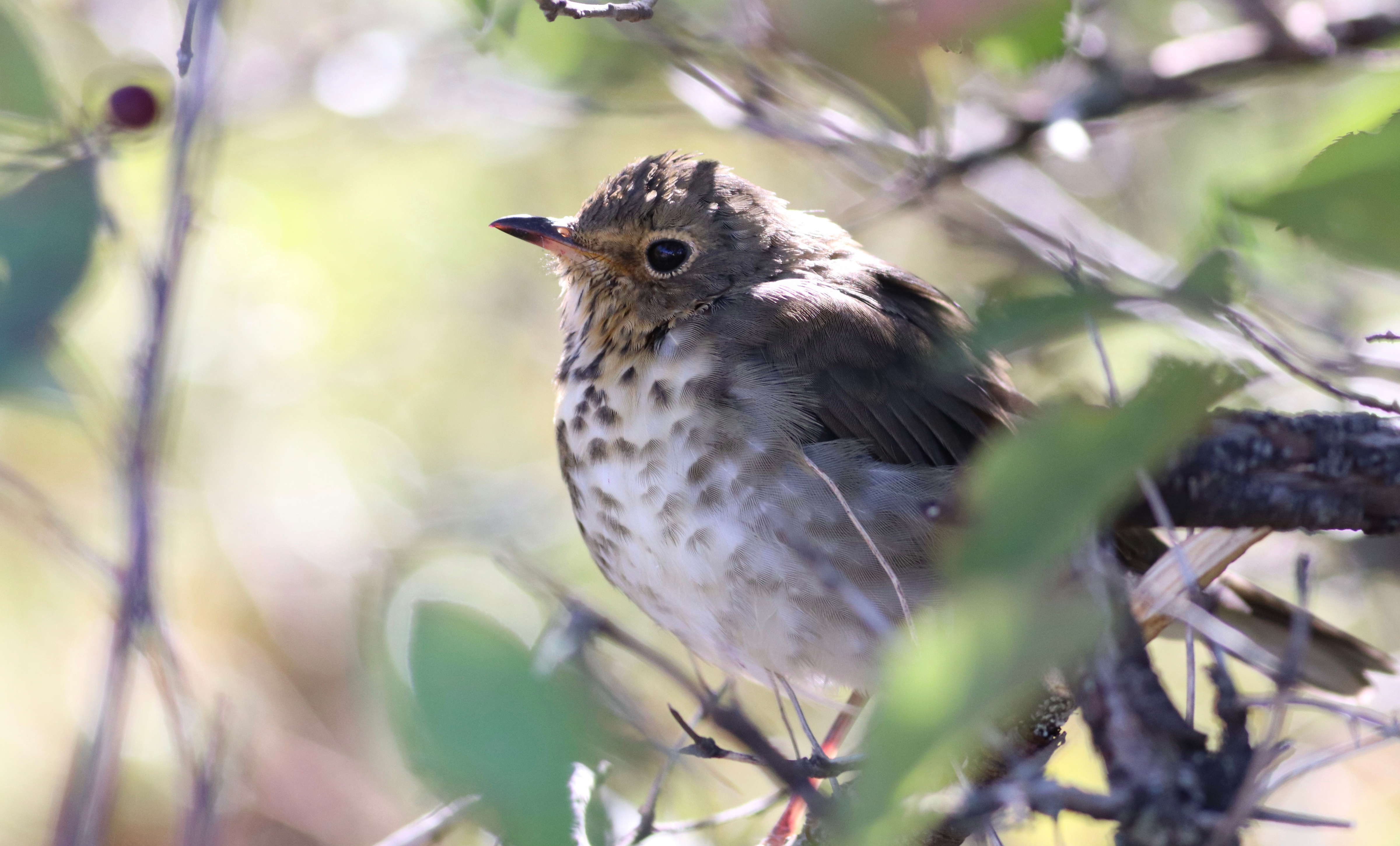
Thrushes, like many of the songbirds we hear in Maine, have very complex and specialized muscles around their syrinx (the avian voice box) that allows them to produce some amazing songs. Add in the fact that they can independently control the noise out of both sides of their bronchial tubes, and they can sing songs more complex that any single-voice-boxed human could dream of. Swainson’s thrush has an up-rising song, while veerys (yes, they are one of the catharus thrushes, even though they don’t have “thrush” in the name) have a downward spiral that my buddy Michael best describes as sounding like an old-school (8-bit) video game character dying. The most common catharus thrush is the hermit thrush, which spends the winter the farthest north (most staying in the U.S. and Mexico), so they are the earliest to return. They have a sweet if slightly sad song.
Wood thrushes, which are all by themselves in the monotypic genus Hylocichla, have a song as complex as any catharus. A difference to my ear is the inclusion of more “twangy” notes, making wood thrushes more likely to be in a blue-grass band than the others.
The species that is the hardest to see is the Bicknell’s thrush. They migrate through Maine around the same time as other thrushes, but their low population means they’re less abundant, and less likely to be encountered. Their lovely song rises at the end, but it’s often hard to hear them. They are also habitat specialists, nesting in spruce-topped mountains in the northeast, primarily above 4,000 feet. In Maine, this typically means hiking up a mountain early in the morning and trying to catch a glimpse before the warmth of the day kicks in. Some birders go to New Hampshire and drive up Mount Washington where you can sometimes spot them from the auto road, but that kind of feels like going to a zoo to see a penguin.
These birds are often inaccessible to people because of that physical barrier, so I recommend considering the Rangeley Birding Festival (rangeleybirdingfestival.com) where you’ll have a great opportunity to see one of Maine’s rarest birds. At the festival, we work with Saddleback Mountain to arrange rides up the mountain access roads on ATVs. You’ll get dropped off in prime Bicknell’s habitat; the hard work is done for you! Once we’ve had our thrushy fill, we’ll spend the morning walking down the mountain, often using those dirt access roads, to appreciate the other boreal forest birds like blackpoll warblers and winter wrens.
The Rangeley Birding Festival is June 5-7, with daily trips up Saddleback (I’ll be leading the one on Sunday morning!). We time this festival to be on the breeding grounds just as birds are settling in and starting to nest. This often results in some great viewing experiences, and we see diverse birds (including lots of warblers), and see them doing cool behaviors associated with nesting. I hope to see you up there for the Saddleback hike, a Kennebago River paddle, or our free “Beginning Birding” outing along Rangeley Lake shores on Saturday afternoon.
Have you got a nature or wildlife question? It doesn’t have to be about birds! Email questions to [email protected] and visit www.maineaudubon.org to learn more about birding, native plants, and programs and events focusing on Maine wildlife and habitat. Maine Audubon Staff Naturalist Doug Hitchcox and other naturalists lead free bird walks on Thursday mornings starting at 8 am, at Maine Audubon’s Gilsland Farm Audubon Sanctuary in Falmouth.
We invite you to add your comments. We encourage a thoughtful exchange of ideas and information on this website. By joining the conversation, you are agreeing to our commenting policy and terms of use. More information is found on our FAQs. You can update your screen name on the member's center.
Comments are managed by our staff during regular business hours Monday through Friday as well as limited hours on Saturday and Sunday. Comments held for moderation outside of those hours may take longer to approve.
Join the Conversation
Please sign into your CentralMaine.com account to participate in conversations below. If you do not have an account, you can register or subscribe. Questions? Please see our FAQs.