

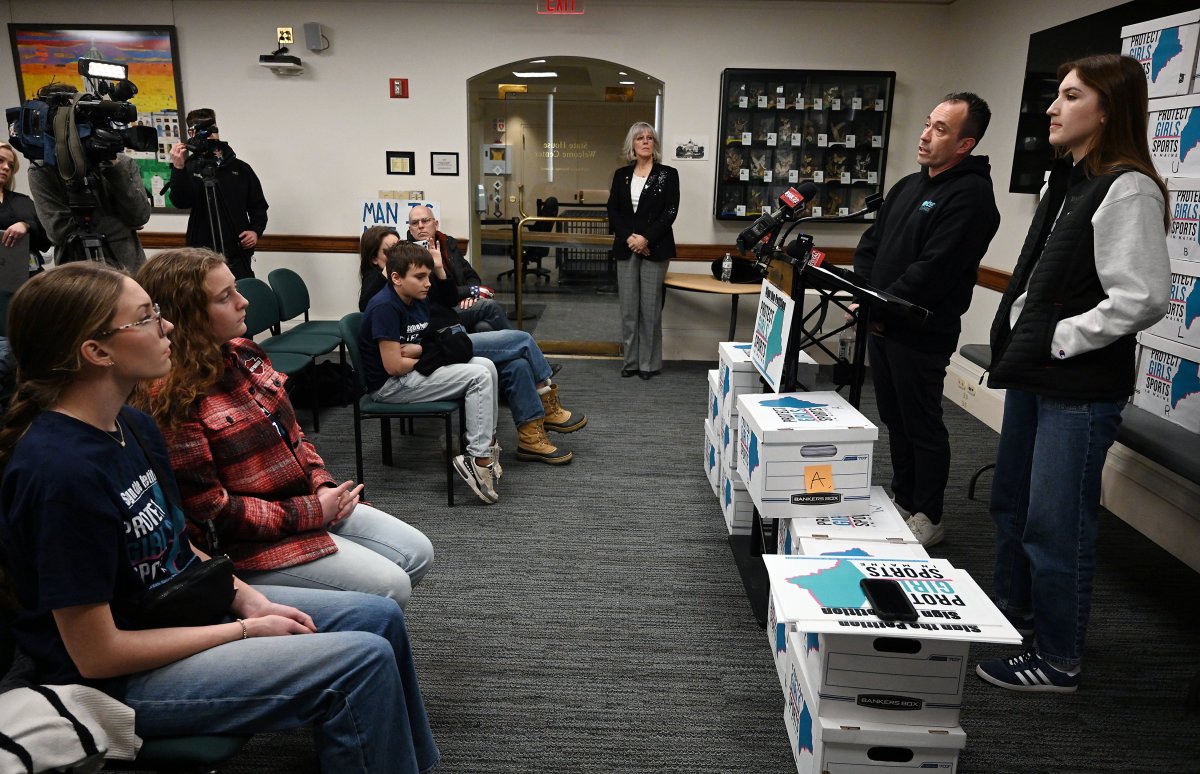
A Maine official is recommending that a proposed referendum seeking to ban transgender athletes from competing in a way that aligns with their gender identity not appear on the November ballot.
The rebuke Thursday came from Chief Deputy Secretary of State Katherine McBrien, the designated hearing officer in a case that has pitted supporters of the referendum against opponents. McBrien found that organizers of the referendum fell roughly 500 valid signatures short of qualifying for the ballot.
Secretary of State Shenna Bellows, a Democrat, initially found in March that the referendum supporters had gathered enough valid signatures. But now that ruling is in question.
The referendum’s organizers have until the end of Saturday to file an objection, according to Bellows’ office. She will make a final determination on the referendum’s validity Tuesday morning, after which each side could also file an appeal in court.
Thursday’s update is a major blow to Protect Girls’ Sports in Maine, the group behind the referendum effort. The ballot initiative also would have required Maine schools to have separate bathrooms and locker rooms for students based on the sex they were assigned at birth.
Leyland Streiff, a Brunswick resident who has led the referendum effort, said Wednesday afternoon the group is reviewing the recommended decision.
“We are continuing our defense of the Protect Girls’ Sports ballot measure and will be filing our objections to the recommended decision before the (Saturday) deadline,” Streiff said.
A group of Maine residents had filed a lawsuit in March that sought to keep the referendum off the November ballot by arguing organizers did not collect the required minimum of 67,682 valid signatures from registered voters.
McBrien, whom Bellows designated as the presiding officer after a Cumberland County Superior Court judge remanded the case to the secretary of state, said in her recommendation that the referendum’s organizers collected 67,150 valid signatures and 12,542 invalid signatures — falling a little more than 500 valid signatures short of the threshold.
Attorney General Aaron Frey’s office, representing Bellows, initially defended the referendum organizers in court by arguing that even though a little more than 3,000 signatures should have been invalidated, petitioners had still cleared the required threshold by more than 300.
But Wednesday’s opinion from McBrien found additional problems with signatures. Among other problems, she found that more than 5,000 signatures should be invalidated because they were not certified as belonging to a registered voter in the listed municipality. Another 1,930 signatures were duplicates, McBrien wrote.
She found other issues, too: circulators not filing valid affidavits when the petitions were filed with the secretary of state, circulators’ oaths not being completed in time and more than 275 signatures being crossed out on a petition form. Some 233 submissions did not actually have a voter’s signature, McBrien said.
The referendum effort has drawn massive support and significant opposition from outside groups. Conservative megadonor and Illinois businessman Richard Uihlein put forward $800,000 to support the referendum effort.
At the same time, the Campaign for Free and Fair Schools has campaigned against it. That group welcomed Wednesday’s recommendation in a statement from campaign manager David Farmer.
“The paid, out-of-state signature gathers and the billionaire who paid to try to put this question on the ballot failed to follow the rules,” Farmer said.
The decision is the latest turn in Maine’s debate over the small number of transgender athletes competing in the state. The Democratic-led Legislature has defeated numerous Republican-led proposals over the years that sought to keep transgender athletes out of women’s and girls’ sports.
The issue came to the forefront last year when President Donald Trump singled out Gov. Janet Mills during a White House meeting with other governors. Trump demanded that Maine change its long-standing inclusive transgender athlete policy. Mills went viral for the testy exchange with Trump, and for saying “see you in court” to the Republican president.
Trump followed up by targeting federal funding for various Maine programs. His Justice Department also sued the state, arguing the federal Title IX law requires states to ban transgender athletes from competing in sports based on gender identity. The case is ongoing.
Editor’s note: This story was updated on May 21 to correct the spelling of Chief Deputy Secretary of State Katherine McBrien’s name.

We invite you to add your comments. We encourage a thoughtful exchange of ideas and information on this website. By joining the conversation, you are agreeing to our commenting policy and terms of use. More information is found on our FAQs. You can update your screen name on the member's center.
Comments are managed by our staff during regular business hours Monday through Friday as well as limited hours on Saturday and Sunday. Comments held for moderation outside of those hours may take longer to approve.
Join the Conversation
Please sign into your CentralMaine.com account to participate in conversations below. If you do not have an account, you can register or subscribe. Questions? Please see our FAQs.