


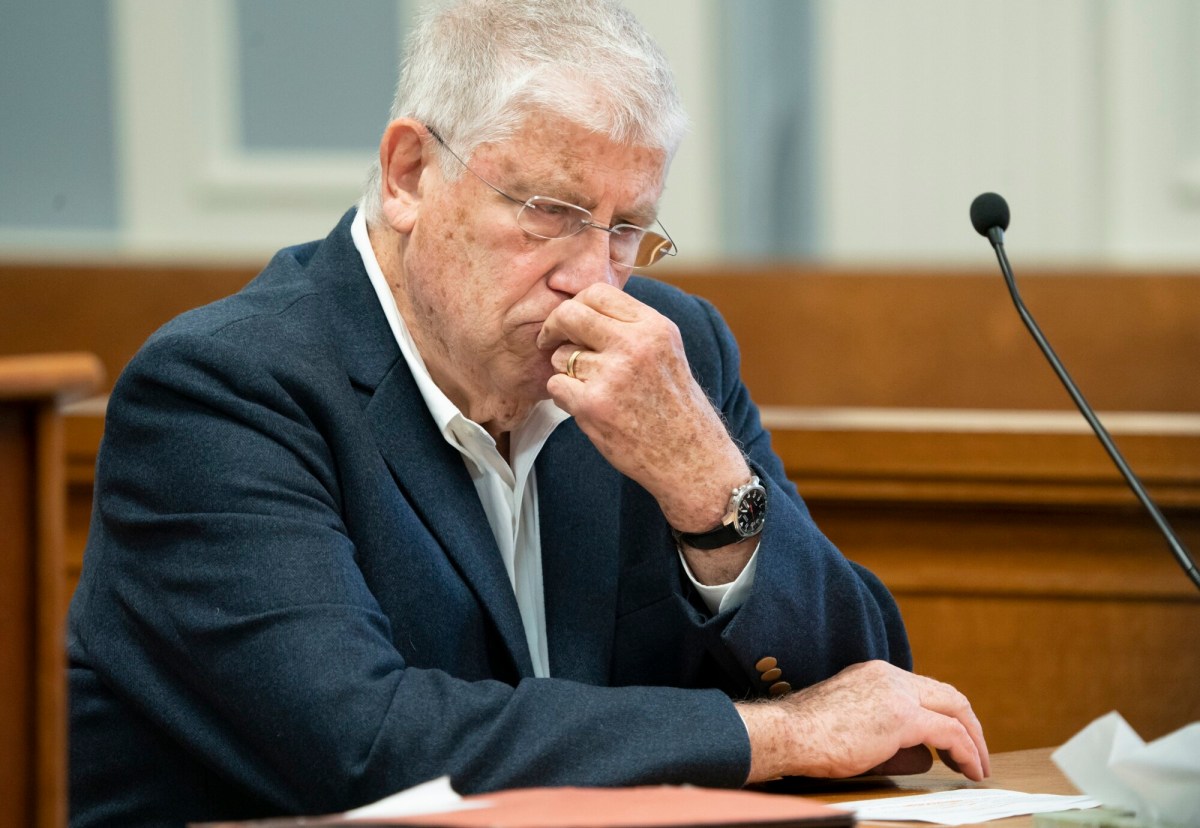
Eliot Cutler is being released from jail, at least until the continuation of a court hearing in June.
The disgraced two-time Maine gubernatorial candidate and convicted sex offender took the stand Friday afternoon at a probation revocation hearing in Hancock County Superior Court and argued that he should be let out in order to seek treatment for pornography addiction.
Superior Court Justice Patrick Larson ordered that until the hearing resumes on June 1 Cutler be released on the $10,000 bail that he posted in January.
In the past several months, the 79-year-old Cutler has been accused of five separate violations of his release conditions, including allegations that he sought an escort, had unauthorized electronic devices and possessed pornography he’s not allowed to have. Prior to Friday’s hearing, Cutler had denied all those accusations.
He’s been in custody since his February arrest at a South Portland hotel, where he had a chance encounter with state police officers while in possession of pornographic DVDs. In the wake of that arrest, his probation officer called on the courts to put Cutler back behind bars for more than three years.
Cutler admitted Friday to having an unmonitored phone, accessing a “strip tease video” and possessing the pornographic materials that led to the February arrest.
But he and his attorney, Walter McKee, contested the allegations that he failed to provide investigators with all passwords to his electronic devices, as required, and that he had encrypted devices that he isn’t allowed to possess.
An allegation that Cutler violated his probation by not attending mandated counseling while he was in custody was dismissed.
Hancock County District Attorney Robert Granger did not immediately respond to a request for comment Friday evening. McKee clarified some details of Friday’s developments but declined to comment further, citing the ongoing hearing.
Cutler was convicted in 2023 for possessing thousands of sexually explicit images of children and sentenced to nine months in jail and six years of probation. He was released in January 2024, two months before his scheduled release date, because of “good behavior.”
In January, after Cutler’s second alleged probation violation, a judge tightened his release conditions, banning him from accessing the internet or possessing any electronic devices that can do so, and from having pornography. His previous conditions already prevented him from accessing sexually explicit materials and required his electronic devices to be monitored.
‘A TRAGIC MISTAKE’
On the stand Friday in Ellsworth, Cutler said that he has been grappling with a pornography addiction “for the better part of six decades,” viewing pornography a few times per week, sometimes for hours at a time. While fighting back tears, he said keeping his addiction a secret all that time “was a tragic mistake.”
He said that, when he was first arrested, “it all had come down on me in this sort of terribly ironic way, because everything that happened to me was what I feared would happen if I reached out for help.”
Cutler argued that after spending months in jail, he knew “all I wanted to do” was to continue treatment and try to restore his self-respect and his family’s belief that he can recover.
“To do that, you have to be in treatment,” Cutler said, but he hasn’t been in treatment since being jailed.
Cutler also detailed his side of a number of the alleged probation violations, some of which he fessed up to. That included the events leading to the Feb. 9 arrest in South Portland.
On that day, he testified, he was in Portland to meet with a family member and later sought out a store on Congress Street to buy a copy of the New York Times. That’s when he spotted another store he “frequented before I was arrested” and ended up buying a trove of pornographic DVDs.
He also admitted to going to Walmart to buy the DVD player that officers discovered in his room at the DoubleTree Hotel. According to court paperwork from his arrest, police found the Walmart receipt in Cutler’s pocket.
‘NO CONTROL’
Ahead of Cutler’s testimony, prosecutors continued to argue for the revocation of his probation.
Probation officer Sam Payson argued that Cutler should not be allowed access to the internet.
“The internet is too much of a temptation. He’s shown absolutely no control,” Payson said, though he added that if Cutler is in appropriate treatment, using the internet could be a possibility later.
But he also contended that treatment has been ineffective for Cutler, an observation Payson also made after Cutler’s arrest at the South Portland hotel.
“Mr. Cutler has demonstrated that he has no intent of following his ordered conditions and is simply searching for ways to circumvent them,” Payson wrote to the courts in February. “It is obvious that he does not intend to take advantage of probation and treatment, and therefore probation will not be a benefit.”
In testimony Friday, Dawn Ego of the Maine State Police Computer Crimes Unit outlined what investigators found on Cutler’s surrendered devices.
At one point, Granger, the Hancock County district attorney, honed in on a 192-page PDF file that Ego said contained links to sexually explicit material, some involving children.
McKee, the defense attorney, contended there is no proof that Cutler accessed those links while he was on probation.
Granger also argued that investigators were unable to access all of Cutler’s electronic devices, including a laptop, with the passwords directly provided to them.
In his testimony, Cutler said he gave police access to an application containing his passwords.
Prosecutors did not get a chance to question Cutler before Friday’s proceedings were paused when the court closed for the day.
The hearing is scheduled to resume at 9 a.m. on June 1.


Comments are not available on this story. Read more about why we allow commenting on some stories and not on others.
We believe it's important to offer commenting on certain stories as a benefit to our readers. At its best, our comments sections can be a productive platform for readers to engage with our journalism, offer thoughts on coverage and issues, and drive conversation in a respectful, solutions-based way. It's a form of open discourse that can be useful to our community, public officials, journalists and others.
We do not enable comments on everything — exceptions include most crime stories, and coverage involving personal tragedy or sensitive issues that invite personal attacks instead of thoughtful discussion.
You can read more here about our commenting policy and terms of use. More information is also found on our FAQs.
Show less