


The town manager’s office has become something of a revolving door in dozens of communities across Maine.
The Cumberland County town of Raymond has had three managers in the last two years. Winslow, in Kennebec County, has churned through four since 2023.
Others have had difficulty finding managers at all. Patten, a town of less than 1,000 people located deep in rural Penobscot County, operated without a full-time manager for nearly four years. Gardiner has been manager-less since 2024.
Altogether, more than 25 communities across the state have seen their top administrator vacate the role in the last three years, a Portland Press Herald analysis of newspaper excerpts and municipal notices revealed — though that review was not exhaustive.
Specific reasons for the manager turnover vary. Some were pushed out over high taxes and property revaluations. Others were victims of local politicking. A few were under criminal investigation.
Experts and municipal administrators, however, say the same undercurrents have contributed: Increasingly vitriolic discourse, a shifting political landscape, expanding job requirements and a widening generational divide.
“Even if it’s a small town of just a couple hundred people, or a medium-sized town here in the state with two to three thousand, you’re still the one in charge,” said Nicholas Jacobs, an associate professor of political science at Colby College. “That creates some pressures in Maine that are distinct.”
Turnover among managers can have downstream effects on residents and municipal employees. A sudden departure can signal instability within the town office or tumult with members of the public, especially if multiple happen in quick succession.
And when towns embark on searches for new managers, they’re now often faced with a shrinking pool of applicants. As a result, municipalities are increasingly hiring managers with less experience or those “from away,” who move from out of state to manage small communities they may not have intimate knowledge of.
“The state as a whole seems to be at this weird inflection point in terms of generational churn,” Jacobs said. “It’s tough to know how much of the difficulties new town managers are facing are because systems that have worked seemingly fine for decades are not easily transferred.”
“Or,” he added, “If what really kept a town humming was not somebody’s formal credentialing with a master’s in public administration, but knowing everybody in the town.”
ALL POLITICS IS LOCAL?
For decades, American political science has been guided by a universal maxim – all politics is local. It means voters care more about things that affect them locally (budgets, roads, schools, etc.) than issues that are debated nationally.
But over the last decade or so, that adage seems to have flipped.
Local politics are increasingly dominated by national culture wars. Debates about transgender athletes and stunts designed to garner national media attention have come to define school board discussions in Augusta. A national spotlight on allegations of fraud among Somali immigrants has roiled city council meetings in Lewiston.
“The national discourse trickles down, and we all feel it,” said Ella Bowman, who served for more than a decade as town manager in Oakland and Winslow. “I have friends, managers, who have had heart attacks during meetings.”
Bowman has seen the culture wars play out in each of those communities. Her first managing role was in Oakland, where she served for seven years before coming out as transgender in 2021. She was the only openly trans manager in Maine — possibly the country — a fact that Bowman said was her undoing.

She resigned from her post in Oakland in 2023 because she felt certain councilors and town employees were transphobic. Later that year, Bowman took over managing the town of Winslow, across the Kennebec River. She lasted only a few months before leaving that post, again citing “hateful” rhetoric and a “smear campaign” from conservative councilors upset with her gender identity.
“They are trying to change the dynamic in this country. There’s no more being courteous,” Bowman said. “Some of these councilors just want someone as crass as them. Not someone who’s good at their job.”
Being a town manager has always been a political job. When employment can hinge on the majority vote of a select board or city council, it’s important to keep those officials and the public who elect them happy.
But that’s become harder with the rise of social media. In many towns, political discourse happens almost exclusively in Facebook groups, which provide a fertile ecosystem for pot-stirring and misinformation.
“There’s a real disconnect between what’s actually happening and what people are seeing on Facebook,” said Pat Lyons, a city councilor in Ellsworth who also provides legal counsel to dozens of municipalities across the state. “People sometimes show up at a meeting saying ‘I can’t believe you’re doing this,’ and we have to tell them ‘We’re actually not doing this and we have no clue where you heard that.'”
Indeed, American politics have become unrelentingly negative and polarized over the last 15 years. As social media has become the primary way Americans find information and news, studies have found those platforms are playing a major role in that trend.
More than any individual issue, it’s that greater sense of cynicism among voters that is heightening tensions and fueling turnover at the local level, said Mark Brewer, chair of the University of Maine’s political science department.
Differing views are natural and necessary in politics, he said. But the level of vitriol and open conflict now is making it harder for managers and other municipal officials to actually conduct the business of local government.
“You have to work with, and ultimately answer to, a group of people who in some cases are bitterly divided and constantly fighting,” he said. “I can see why people wouldn’t want to subject themselves to that.”
‘THE NATURE OF THE WORK HAS CHANGED’
The responsibilities of managing a municipality have ballooned over the last couple of decades.
Historically, the role has mostly entailed drafting budgets, managing municipal departments and overseeing council meetings. But Maine is a home rule state, meaning municipal governments have sweeping control over local rules and regulations.
Towns retain any and all powers not explicitly delegated to the state or federal governments, which seldom make sweeping legislation that affects everyone — recent exceptions being a cellphone ban in schools and laws requiring towns to allow accessory dwelling units.
Home rule was designed to keep the inherent sense of community found in nearly all of Maine’s small towns intact. But over time, it has meant municipal governments now handle nearly every issue, from homelessness to addiction to climate change.
Managers are also tasked with writing and filling out lengthy applications for grants from state and federal agencies to fund those local initiatives.
“The nature of the work changed,” said Kate Dufour, advocacy director for the Maine Municipal Association. “The role of municipal government as a backstop to everything has become a stressing point. Everyone expects everything from municipal government.”
The widening scope of managers’ responsibilities and the time-consuming nature of the job, coupled with the overall state of public discourse, have made managing a community more difficult than ever, according to Sandra Fournier, president of the Maine Town, City and County Management Association.
Fournier simultaneously manages the three Aroostook County towns of Mapleton, Castle Hill and Chapman. It’s an unusual arrangement which Fournier said was brought about in response to the difficulties of administering government services in tiny rural communities.
“Municipal managers today are navigating heightened public expectations, workforce challenges, economic pressures, evolving state and federal regulations, and increasingly demanding service delivery needs,” Fournier wrote in an email. “Those realities can create challenging environments for both elected officials and professional administrators.”
AGING OUT
Maine’s population is, on average, the oldest in the country. The median age is about 45 and nearly a quarter of residents are over 65.
Many of the state’s political leaders and elected officials are already at retirement age, and as they age out, municipalities are finding it difficult to bring new people into the profession.
“Many of the city managers and town managers, they’re 30 years into their career already,” said Dufour. “They’re graying and saying ‘I put in my time and now’s the perfect time to retire.'”
Many local officials and political scholars said that trend has been fueled in large part by the declining prevalence of public administration as a college major. The University of Maine stopped offering it in 2011, citing “consistently low enrollment.”
That’s led to fewer Mainers applying for local municipal manager jobs.
At least one community is bucking that trend. In April, the Somerset County town of Madison appointed Cheyenne Stevens as its manager. At just 24-years-old, Stevens is among the youngest managers in Maine history.
“I know that I’m definitely one of the youngest in our office and in this profession, but it’s not something I think about daily,” she said. “It’s more about the tasks at hand.”
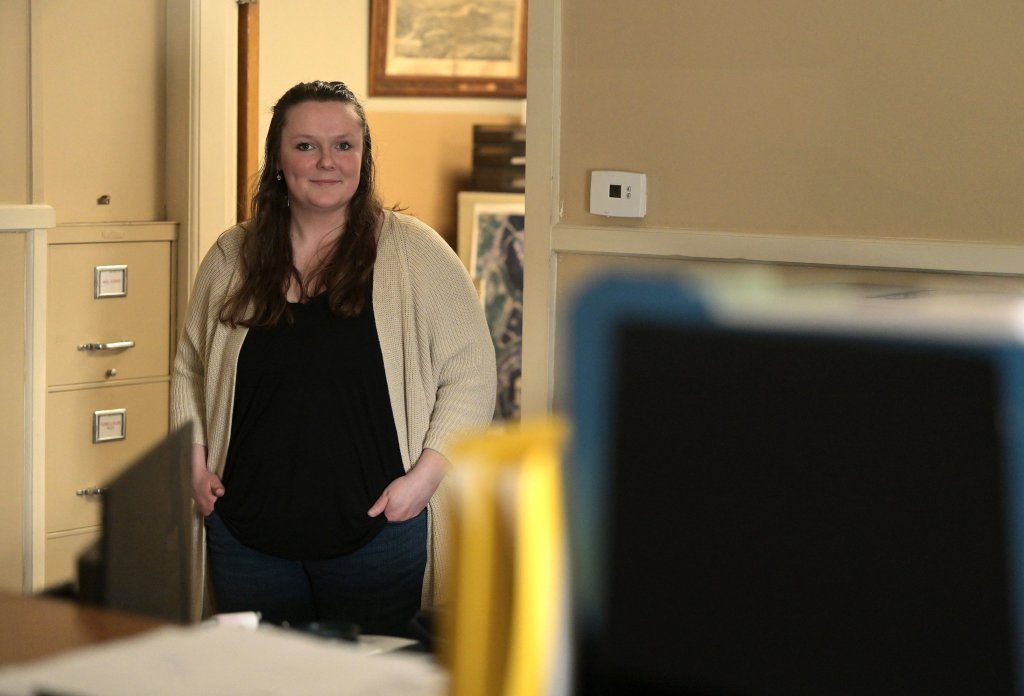
She studied public administration at the University of Maine at Augusta and has worked in municipal governments since graduating. She began as an intern under Madison’s former town manager before being hired as the clerk, treasurer and registrar of voters in 2023. Stevens said her career has been shaped by a deep connection to Madison’s community and a passion for public service.
Still, Stevens seems to be a rarity.
Bill Bridgeo served as Augusta’s city manager for nearly 25 years. When he applied for that role, he was one of nearly 100 applicants. After he retired in 2021 and the town began looking for his successor, the pool of candidates was 14.
He’s not convinced that’s a sign of young people caring less about local politics. In his view, it speaks to how managing a community is harder now than it was when he first got into the field nearly 50 years ago.
“These are really good jobs, really rewarding careers,” Bridgeo said. “But they’re also not easy jobs.”

We invite you to add your comments. We encourage a thoughtful exchange of ideas and information on this website. By joining the conversation, you are agreeing to our commenting policy and terms of use. More information is found on our FAQs. You can update your screen name on the member's center.
Comments are managed by our staff during regular business hours Monday through Friday as well as limited hours on Saturday and Sunday. Comments held for moderation outside of those hours may take longer to approve.
Join the Conversation
Please sign into your CentralMaine.com account to participate in conversations below. If you do not have an account, you can subscribe here. Questions? Please see our FAQs.