
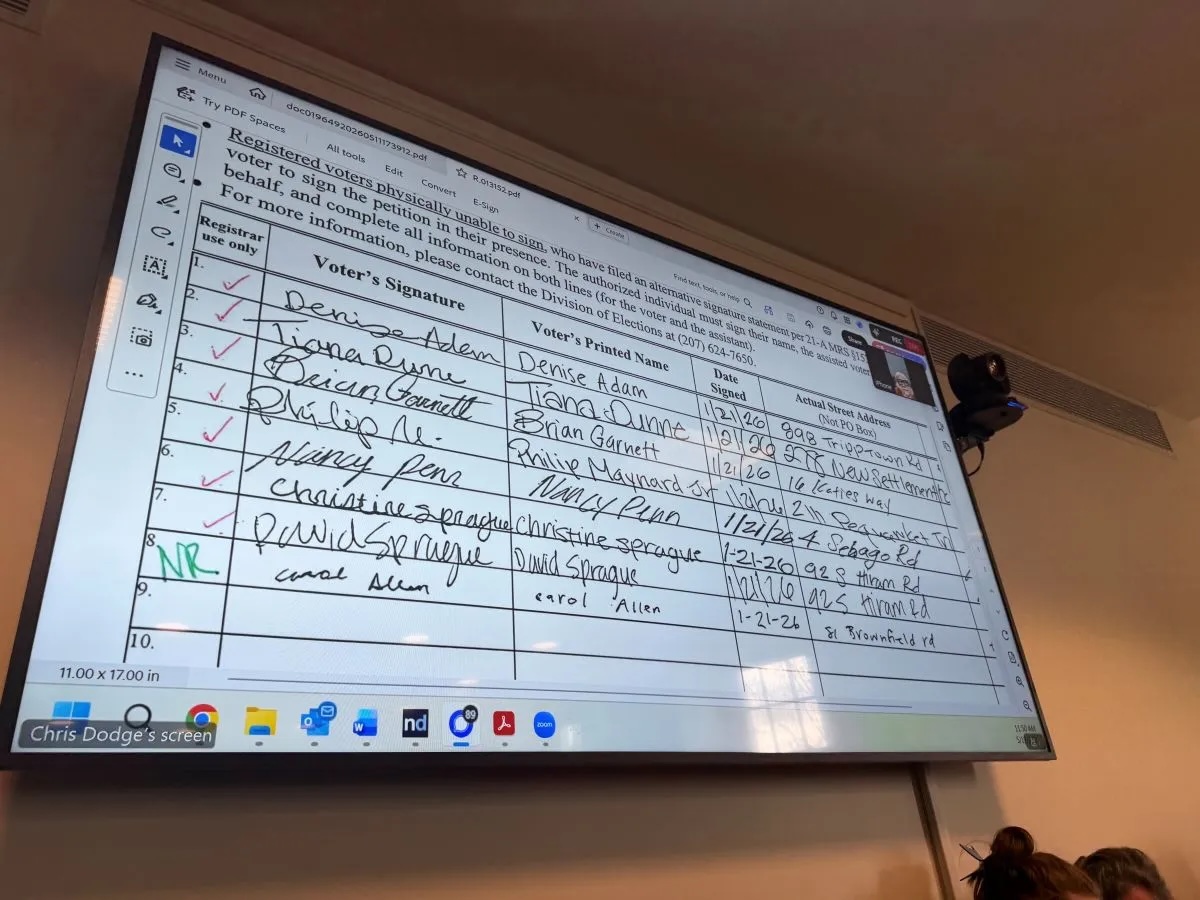
Most laws in Maine are made by the Legislature at the State House in Augusta. But since the early 1900s, Maine voters have also been able to pass new legislation or overturn lawmakers at the ballot box.
This process, which includes both citizen initiatives to make new laws and people’s vetoes to override laws made by the Legislature, has become a familiar feature of Maine government since it was added to the state Constitution in 1908. It has resulted in more than 70 ballot questions that have appeared before Maine voters.
Statewide elections, especially in the last few decades, often feature at least one citizen-led referendum question on the ballot. This is how Mainers signed off on gay marriage, recreational marijuana and ranked-choiced voting — just to name a few such citizen-initiated changes in recent history.
This fall, Maine voters could be weighing in on a question about transgender inclusion in school sports and private spaces. If approved, that citizen-initiated legislation would limit participation in school sports and the use of bathrooms and locker rooms to a student’s sex at birth rather than considering their gender identity.
But it remains unclear whether the question will make it to Maine voters this year. The answer will likely come from the courts, and will center around whether the group behind the citizen initiative followed the correct procedures while collecting the necessary signatures to get the question on the ballot.
Maine Secretary of State Shenna Bellows had initially validated this “Protect Girls Sports in Maine” initiative petition in March, but she reversed course on Tuesday and determined that it did not actually include enough valid signatures after a legal challenge had been made to her initial determination. Now the debate heads back to the judicial branch, where both the Maine Superior Court and Maine Supreme Judicial Court could review it.
This ongoing administrative and legal fight has thrust Maine’s referendum process into the limelight. So it’s worth taking a closer look at the path a ballot question must take in order to become law.
HOW DOES A CITIZEN INITIATIVE GET ON THE BALLOT?
A citizen initiative, which allows Mainers to put forward a new proposed law for approval at the ballot box, starts with just a handful of voters. To start, a Maine voter submits an application to the secretary of state that must include the text of the proposed legislation, a summary of its purpose and signatures from five other Maine voters.
If the secretary of state determines that the application checks those boxes, then supporters can begin circulating the citizen initiative petition to get signatures from Maine voters. The state Constitution requires that 10 percent of the number of Mainers who voted in the previous election for governor sign a petition for the question to get on the ballot. Currently, that means a citizen initiative needs 67,682 valid signatures.
A people’s veto, in which voters can overturn recent legislation passed in Augusta, follows this same general process.
A citizen initiative effort has 18 months to amass the necessary signatures after the petition is issued for circulation; people’s veto efforts must submit the signatures within 90 days from the end of the legislative session in which the measure being challenged was passed.
Once the signatures are gathered, the citizen initiative leaders submit the signed petition to the secretary of state’s office. The secretary of state has 30 days to review the validity of the petition, including its signatures, notarization and timing. If valid, the petition then goes to the Legislature where lawmakers can pass it, develop a competing measure that also goes on the ballot, or take no action.
If lawmakers do not enact the initiative legislation, then it goes to referendum.
WHO CAN SIGN A PETITION?
Any Maine voter can sign a petition. The voter’s address and municipality must be included on the petition along with their signature. Either the voter or the person collecting signatures — the petition circulator — can write the address and municipality information on the form, but the voter themself must sign except in cases when a voter cannot physically sign due to a disability.
WHO CAN COLLECT SIGNATURES?
While the state Constitution and state law require petition circulators to be voting residents of Maine, that language has essentially been rendered unenforceable by the courts.
A federal judge in Maine ruled in 2020 that the state’s ban on out-of-state petition circulators likely violated the First Amendment of the U.S. Constitution. That led to a consent order between the state and a political action committee that wanted to use out-of-state circulators for a ballot initiative.
The agreement allowed out-of-state circulators to collect signatures for Maine ballot questions, and it still applies today. Circulators, both from in and out of state, can also be paid for their efforts as long as their information is registered with the secretary of state’s office.
Out-of-state circulators are factoring prominently in the review of the “Protect Girls Sports in Maine” initiative.
WHAT ARE THE REQUIREMENTS FOR SIGNATURE GATHERING?
Petition circulators must ensure voters have an opportunity to read the draft legislation, the initiative summary and the accompanying financial impact statement, which shows how much the proposal could cost taxpayers. They must sign an oath before a notary or other authorized official saying that they followed the rules.
While circulators do not have to verify the identity of each person who signs their petition forms, they must witness the person signing the form and pledge that, to the best of their knowledge, “each signature is the signature of the person whose name it purports to be.”
It is a Class E crime for a circulator to falsely swear that a signature was made in their presence when it wasn’t, or to submit and swear to a petition that they know has any false signatures.
WHO DETERMINES THE WORDING OF A CITIZEN INTIATIVE?
While the proponents of a ballot question submit the proposed legislative text and summary, Maine law tasks the secretary of state with formulating the final language for the question that appears on the ballot. Statute requires that the secretary “write the question in a clear, concise and direct manner that describes the subject matter of the people’s veto or direct initiative as simply as is possible.”
Supporters of the “Protect Girls Sports” effort have taken issue with the draft question wording developed by Bellows and her office. Bellows accepted public comment on the draft wording and was slated to finalize the language by Thursday.
WHO REVIEWS A CITIZEN INITIATIVE?
The secretary of state’s office conducts the primary review of a citizen initiative petition. Once signatures have been collected and submitted, the secretary of state has 30 days to review and decide whether or not a petition has amassed the requisite number of valid signatures.
But the secretary of state’s office is not alone in the review process. Local municipal clerks and registrars also play an important role in reviewing the signatures provided from their cities and towns, to compare them with the voter signatures that election officials already have on file.
And the Maine District and Supreme Judicial courts also play a role in reviewing and adjudicating challenges that might arise during the process, as is currently happening with the transgender sports initiative.
WHAT HAPPENS ONCE THE QUESTION GOES TO VOTERS?
Once on the ballot, a referendum question needs to pass by more than 50 percent of the vote to be enacted into law. If it passes it typically takes effect 30 days after the governor declares the results of the election. But that timeline can be extended if the new law requires certain funding.
The governor cannot veto the citizen-initiated law, but lawmakers can choose not to fund its implementation or to change it after enactment.
This story was originally published by The Maine Monitor, a nonprofit and nonpartisan news organization. To get regular coverage from The Monitor, sign up for a free Monitor newsletter here.
We invite you to add your comments. We encourage a thoughtful exchange of ideas and information on this website. By joining the conversation, you are agreeing to our commenting policy and terms of use. More information is found on our FAQs. You can update your screen name on the member's center.
Comments are managed by our staff during regular business hours Monday through Friday as well as limited hours on Saturday and Sunday. Comments held for moderation outside of those hours may take longer to approve.
Join the Conversation
Please sign into your CentralMaine.com account to participate in conversations below. If you do not have an account, you can subscribe here. Questions? Please see our FAQs.