
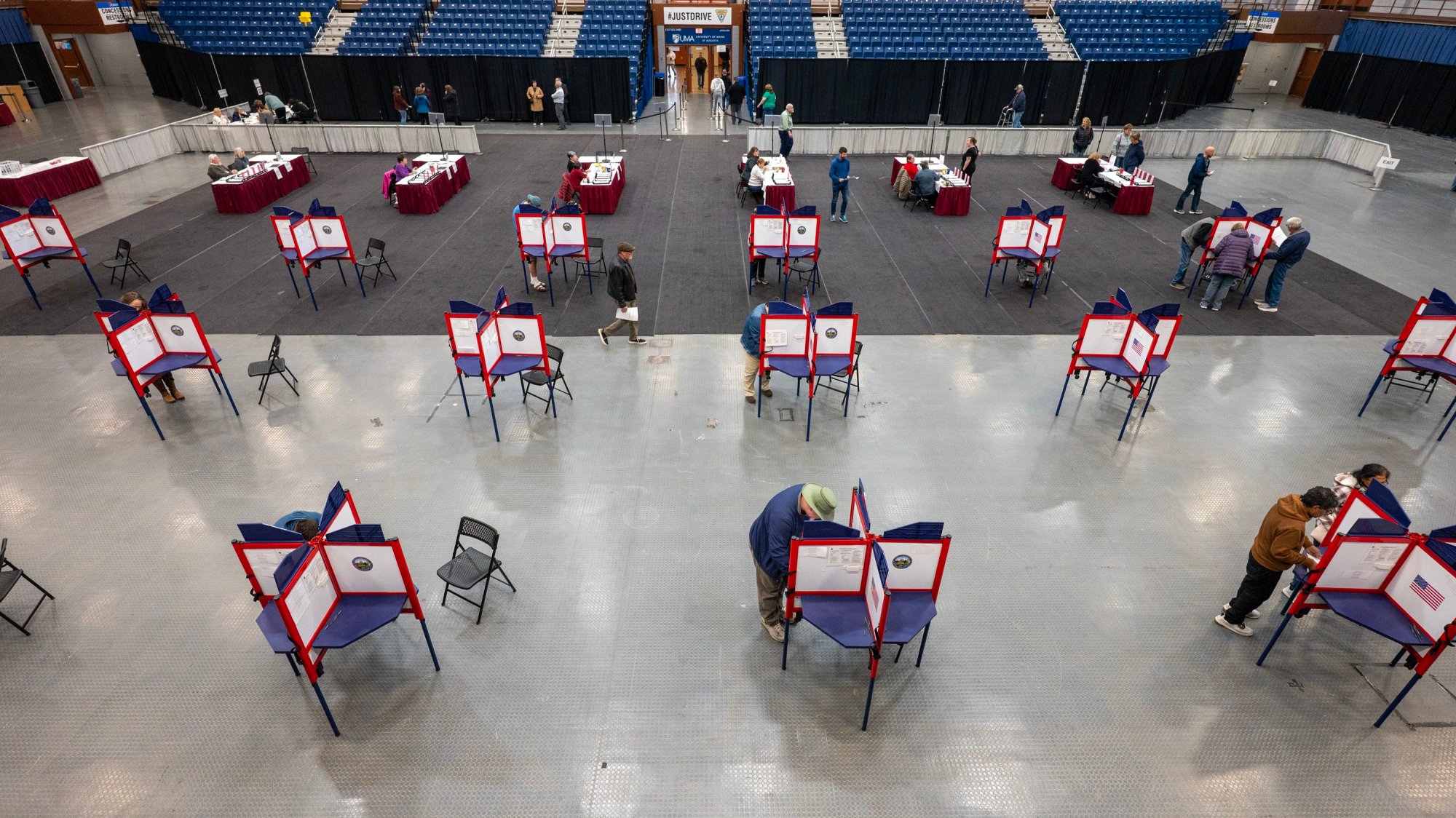

Daniel Morrissette always votes, even in the local elections — the ones with one or two races on the ballot.
His neighbors in Sidney? Not so much. Residents of the rural Kennebec County town chronically pass on voting in the local election each March. Last year, just 1.5% of the town’s 3,600 registered voters cast a ballot. In 2024, it was 5%.
Morrissette was elected to the board in March via a write-in campaign in one of the highest turnout elections in Sidney’s recent memory: 6.4% of registered voters participated. Morrissette got 68 votes.
“When the big elections come up, they go and vote,” Morrissette said.
But the little ones, he said, don’t draw the same interest.
Sidney’s low turnout numbers reflect results in Kennebec County’s other rural towns. Albion and Vassalboro and Monmouth and Farmingdale and Vienna — the list goes on — have regularly struggled to recruit more than a tenth of their registered voters to the polls in recent years. Maine has historically strong turnout in November elections, but local races often get fewer than 100 votes.
It’s a nationwide problem, Mark Brewer, chair of political science department at the University of Maine, said; a lack of information and interest can have serious implications for local oversight of policy decisions.
“It could very well be that the public is keeping an eye on this elected body, and they’re happy with what they’re doing, and they’re happy to delegate that authority,” he said. “But it might not be that. It might be that they just aren’t paying attention.”
WHY SO FEW VOTERS?
C. Douglas Ludewig has served on the Monmouth Select Board since 2000. He was already involved in town affairs — he was a teacher, police officer, EMT and regular voter — when the town manager asked him to run for office.
But voters have never seemed particularly interested in Monmouth’s local elections, he said. The rural but growing town of about 3,200 registered voters has tallied turnout below 10% in two of its last three municipal elections.
Monmouth voters have less face-to-face involvement with local politics than they used to, he said. In-person annual town meetings were dropped in favor of the secret ballot format, where residents vote on budgets like they do for their elected officials: in a booth with a pen.
Both Ludewig and Morrissette said neighbors have told them that their lives — caring for their children and aging parents, working tough jobs with long hours — get in the way of being involved in local politics.
That was true for Linda Richards in her younger years.
Richards — who lives in Vassalboro, where local election turnout has dived into the single digits in recent years — had five children by age 24. She barely had time to bathe them all, let alone care about local elections in June.
She said she couldn’t have said with any certainty who the governor was. Voting was simply not a priority amid caring for her children, returning to classes to get her high school diploma and managing her blindness.
Richards’ friends cared, though. And they made sure she knew it, she said.
“They’re like, ‘You don’t vote?'” Richards said, recalling a conversation from her late 30s. “I said, ‘No, I don’t.’ They pretty much shamed me into it.”
Municipal policy, despite its immediate impact on roads, public safety and more, just isn’t top of mind for voters, Morrissette and Ludewig said.
Brewer said voters not having direct interactions with municipal politics can be the first step down a cascade of disinterest. When voters aren’t engaged during the rest of the year, he said, they’re often not as informed about candidates or issues when the annual municipal election comes around.
“We know that most voters get their information from the media — not from direct interaction with public officials or discussions with their neighbors about local goings-on,” Brewer said.
Ludewig has been posting notes from each select board meeting on Facebook to keep residents informed. But, even though the information is more digestible, it can be vulnerable to misunderstanding and misinterpretation.
Morrissette said a lack of information impacts involvement in Sidney, too.
He said neighbors have told him they’re turned off by what they perceive as a bias in media, both local and national, and that has disengaged them from politics altogether.
“They’re just like, ‘I don’t care what they’re doing. I’ll go vote for the big ones, and that’s it,'” Morrissette said. “The rest of it, they don’t know which way to go.”
IS THAT SO BAD?
This month in Monmouth, candidates for select board held a forum ahead of June’s election — the first, Ludewig said, since he joined the board in 2000.
More candidates are running than in any local election in recent history, he said, partially in response to a property tax revaluation that shifted tax burden from businesses and industrial sites onto residences and hiked tax bills.
“In Monmouth, (we haven’t had) anything that sparks people’s interest,” Ludewig said. “Like, something that would get people interested or unhappy — probably unhappy — to cause people to come out and vote.”
That has been true elsewhere in Maine, too. During a budgeting crisis in Washington County last year, for instance, residents turned out to reject a bond referendum and have remained engaged in the months following.
In fact, Ludewig said, low turnout could be a sign of solid local leadership.
“I guess it’s probably not a bad thing,” he said. “I would suggest that people are happy with the direction that things are going in town.”
But a lack of engagement is a slippery slope, Brewer said, even if voters are genuinely content. Whether voters care or not, select boards, school boards and other local leaders are acting on matters that affect the average voter: road paving, snow plowing, general assistance and providing education services
“That’s really the issue here, is the public foregoing its opportunity to provide either direct oversight in the case of town meeting or, in the case of a local election, to really kind of have their say in who they want to hold those seats,” Brewer said.
Richards has been especially involved in Vassalboro government in recent years as the sewer district struggles to pay its bills. She’s seen rate increase after rate increase and has voted in every local election she can recall in recent years.
She’s trying to pass down a more positive attitude about voting to her grandchildren, she said. Older voters are already overrepresented nationwide among voters in local elections, but Richards said she wants her family to buck that trend.
“I’m on my grandkids’ butts to vote,” she said. “As soon as they turned 18, I’m like, ‘Don’t do what I did.’ ‘Well, Gram, I don’t care about that.’ And I’m like, ‘Nope, neither did I, but you really should.’ You’d be surprised how many young people don’t care.”
WHAT CAN BE DONE ABOUT IT?
The best solution to improving turnout in municipal elections is staring towns in the face, Brewer said: moving elections to November.
“If we want to increase local turnout, everybody can move their municipal elections to November,” he said. “Get rid of March. Get rid of June. Your local, general municipal elections are going to be in November. Turnout will go up.”
Many Maine towns still hold annual town meetings and municipal elections in their traditional springtime setting, during March or April. Five towns in Kennebec County — Albion, Pittston, Sidney, Rome and Vienna — stick to this schedule.
But West Gardiner is among towns rethinking when its elections are held. This year, the town moved its select board election, which had been held the morning of its town meeting, to June to align with the state primary election, encourage more turnout and match its fiscal year with the state and other local governments.
That’s a step in the right direction, Brewer said, but not ideal, especially because Maine voters have such a strong turnout record in November elections.
“The March election comes and goes, and they don’t even know there was an election,” Brewer said. “But people think about November as, ‘OK, that’s the time we vote.'”
Data from Kennebec County’s municipal elections since 2023 show this trend clearly. November elections, on average, have much higher turnout than those held in the spring. Even municipal elections held in June, but on the same day as the state primary election, have significantly higher turnout than those with local-only elections.
Even bigger municipalities that have held special elections to fill vacant seats have struggled to draw voters to the polls in months other than November. In June 2023, only 3.1% of Augusta voters participated in a special election.
Morrissette said ideally, his Sidney neighbors would be more interested in a standalone local ballot around the same time as the annual March town meeting. He is concerned, though, about residents not participating in their local government.
On a personal level, he said, he’s not interested in listening to thoughts on town politics from residents who don’t vote. But because he earned 68 write-in votes, he serves on the select board.
There, he said, he must listen.
___
Do you vote in your town’s local elections?
If so, why is it important to you to be involved? Do you participate in local politics during the rest of the year?
If not, what, if anything, would make you more likely to turn out? More access to candidates? A November election instead of March or June?
Email [email protected] with your thoughts.

We invite you to add your comments. We encourage a thoughtful exchange of ideas and information on this website. By joining the conversation, you are agreeing to our commenting policy and terms of use. More information is found on our FAQs. You can update your screen name on the member's center.
Comments are managed by our staff during regular business hours Monday through Friday as well as limited hours on Saturday and Sunday. Comments held for moderation outside of those hours may take longer to approve.
Join the Conversation
Please sign into your CentralMaine.com account to participate in conversations below. If you do not have an account, you can subscribe here. Questions? Please see our FAQs.