

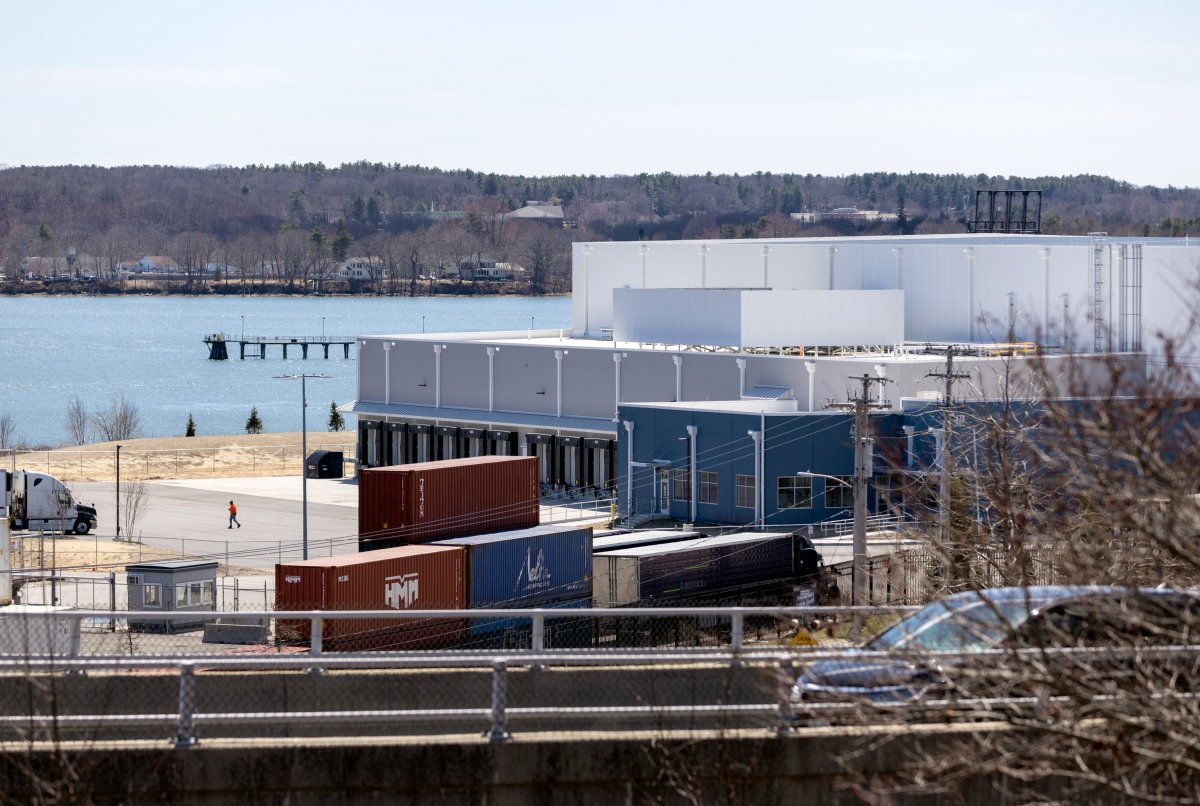
Unpaid for more than 500 days, Maine companies that built a refrigerated shipping warehouse on Portland’s waterfront are asking state lawmakers to close a loophole that may leave them without legal power to demand payment for private projects located on state property.
Subcontractors who poured the facility’s foundations and put up the steel issued a stark warning Wednesday: unless the state changes a law that currently treats public-private developments as a legal “dead zone,” local firms will stop building them.
The dispute has laid bare a paradox in Maine law. On a typical private project, an unpaid builder can file a claim that places a legal hold on the building, potentially forcing a sale to pay a debt. On a public project, the state requires an insurance-style payment bond to protect workers.
While built by a private developer, Maine International Cold Storage Facility sits on Maine Port Authority land. In Maine, the state cannot be sued without its consent, and its property can’t be seized. A judge ruled in February that the unpaid builders cannot place a legal hold on property.
“You ever see Charlie Brown and Lucy?” asked Mark Curtis, owner of Gorham Sand and Gravel, one of about a dozen contractors who claim they are owed money for work on the project. “They feel like Lucy. I feel like Charlie Brown.”
His company is owed roughly $1.5 million for excavation work that grew in scope when the soil conditions proved more difficult than anticipated. He and other contractors describe a pattern of being paid just enough to keep working until their portion of the project was finished.
“Contractors like us cannot be treated as the bank for large development projects,” Curtis said at a Wednesday news conference next to the facility. “We can’t be expected to front labor, fuel and equipment for months or years, only to be left holding the bag when there’s a dispute upstream.”
The dispute is a multimillion dollar finger-pointing match between the developer, the London-based Amber Infrastructure, and the general contractor, Illinois-based FCL Builders. FCL could not be reached for comment Wednesday.
An Amber Infrastructure representative, Tom O’Shaughnessy, the head of the company’s North America operations, said that Amber had not signed contracts with the unpaid firms, and that the dispute was between those companies and FCL.
“FCL has told us the figures don’t add up, but that is between them,” he said. “We are not a party.”
While the giants litigate over change orders and cost overruns, local firms are reeling.
Scotty Linscott, the owner of H.B. Fleming, a 70-year-old foundation contractor based in South Portland, said he fronted nearly $700,000 to buy steel for the project out of his own pocket. His company is owed a total of nearly $2 million when including interest and legal fees.
“I never agreed to finance the project, but this is effectively what’s happened,” Linscott said.
The financial strain reaches down to the smallest players. Andy Leconte, the general manager of Maine Line Fence in Cumberland, said his company is owed its entire $60,000 contract for the perimeter fence and gates installed 18 months ago.
“We were out more than a week’s payroll,” Leconte said. “We have paid our employees … but we have nothing to show for it.”
Now, these contractors are calling on Maine lawmakers to close the public-private loophole by allowing subcontractors to place legal holds on state-owned property or hold public authorities liable when a private partner defaults.
State Sen. Brad Farrin, R-Norridgewock, joined the contractors in calling for the state to stop hiding behind tort law and sovereign immunity. He argued the Maine Port Authority holds significant contractual leverage, including the threat of defaulting on the developer’s long-term lease.
“The state of Maine has a seat at this table,” Farrin said. “They should be executing those rights.”
The stakes go beyond a few unpaid invoices. Industry leaders warned Wednesday of a “chilling effect” that could see local firms refuse to bid on future state projects if the current framework remains.
“If the people who actually move the dirt and pour the concrete cannot trust they will be paid, fewer local firms will be willing to step up,” Curtis said. “It will drive up costs, drive work to out-of-state firms, and ultimately hurt the very communities these projects are supposed to benefit.”
In response to this call for action, Maine Department of Transportation, the parent agency of the Port Authority, issued a statement maintaining a position of cautious neutrality, citing the active litigation associated with the dispute.
“MaineDOT is aware of the concerns raised by contractors and subcontractors associated with this project,” a spokesman said. “Our focus remains on protecting the public interest, ensuring continued operation of this important economic asset, and monitoring the ongoing legal proceedings.”
The spokesman said MaineDOT recognizes the “important contributions” of local tradespeople and looks forward to a resolution.
For now, the facility continues to operate, its cold rooms filled with product. The builders wait for their legal efforts demanding payment to wind their way through the state court system, but a lawyer hired by some of the bigger contractors says they won’t go to trial until at least early 2027.
“It makes you feel small,” Curtis said. “Clearly, they don’t see what we do as valuable.”
The Maine International Cold Storage Facility opened in February 2025, a decade after the idea was floated. The 106,000-square-foot refrigerated warehouse can reach temperatures as low as minus 10 degrees Fahrenheit and is equipped to store 22,000 pallets.
It was highly anticipated, charted as Maine’s tool to expand freight through Portland. That includes capturing some of the nearly $2 billion in frozen seafood that’s exported from the East Coast but does not pass through Portland.
Amber leased land from Maine Port Authority on Commercial Street, next to the International Marine Terminal, to bolster the growth. The state invested $8 million to prepare the site for construction. Amber has said the project cost $56 million in total.

We invite you to add your comments. We encourage a thoughtful exchange of ideas and information on this website. By joining the conversation, you are agreeing to our commenting policy and terms of use. More information is found on our FAQs. You can update your screen name on the member's center.
Comments are managed by our staff during regular business hours Monday through Friday as well as limited hours on Saturday and Sunday. Comments held for moderation outside of those hours may take longer to approve.
Join the Conversation
Please sign into your CentralMaine.com account to participate in conversations below. If you do not have an account, you can subscribe here. Questions? Please see our FAQs.