

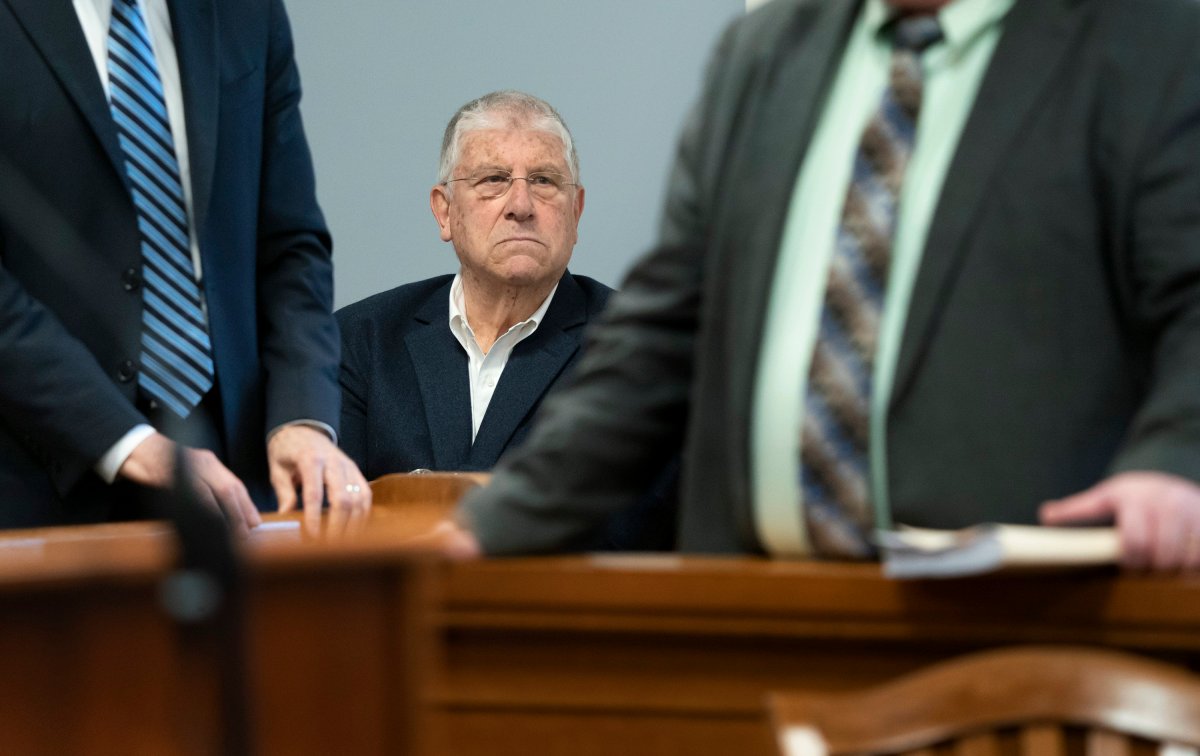
Eliot Cutler is back in jail.
A Penobscot County Jail official confirmed that Cutler was there Thursday but declined to disclose the charges. According to the jail’s online inmate search, he was booked around 2 p.m. for violating his probation.
His attorney, Walt McKee, said he’s been informed that Cutler was arrested for failing to sign a probation treatment plan document “that had internet restrictions that were completely inconsistent” with a court order from last week.
“If this in fact (is) what the violation was, it will be hotly contested,” McKee wrote in an email Thursday afternoon.
Hancock County District Attorney Bob Granger said Cutler was taken into custody by a probation officer Thursday afternoon, but that he was unable to comment further on the matter.
The convicted sex offender and disgraced gubernatorial candidate was let out of jail by a judge last month while a probation revocation hearing over several alleged probation violations was ongoing.
Cutler took the stand that afternoon in Hancock County Superior Court and argued that he should be let out in order to seek treatment for pornography addiction.
In January, after Cutler’s second alleged probation violation, a judge tightened his release conditions, banning him from accessing the internet or possessing any electronic devices that can do so, and from having pornography. His previous conditions already prevented him from accessing sexually explicit materials and required his electronic devices to be monitored.
After the probation revocation proceedings resumed last week, a judge permitted Cutler to have limited access to the internet while he remained out of jail awaiting his next court date. Cutler was to be allowed to use the internet between 9 a.m. and 5 p.m., Monday to Friday, under supervision from his wife and brother, but would also have to contact his probation officer each time he logs in.
McKee said on Thursday that the plan Cutler failed to sign would have permitted internet access at the discretion of his probation and treatment providers, “which is directly contrary to his revised conditions.”
The judge also agreed last week to delay further proceedings on the probation revocation so that investigators could have time to search Cutler’s computer. Prosecutors said investigators could not access the computer previously because Cutler didn’t provide all of his passwords — which he and his attorney have contested.
Until the May hearing, Cutler had been in custody since his February arrest at a South Portland hotel, where he had a chance encounter with state police officers while in possession of pornographic DVDs. In the wake of that arrest, his probation officer called on the courts to put Cutler back behind bars for more than three years.
In the past several months, the 79-year-old Cutler has been accused of five separate violations of his release conditions, including allegations that he sought an escort, had unauthorized electronic devices and possessed pornography he’s not allowed to have.
At the hearing last month, Cutler admitted to having an unmonitored phone, accessing a “strip tease video” and possessing the pornographic materials that led to the February arrest. He contested other alleged violations, such as failing to provide investigators with all passwords to his electronic devices, as required, and that he had encrypted devices that he isn’t allowed to possess.
An allegation that Cutler violated his probation by not attending mandated counseling while he was in custody was dismissed.
Cutler was sentenced to nine months in jail and six years of probation in 2023 after pleading guilty to possessing thousands of sexually explicit images of children. He was released in January 2024, two months before his scheduled release date, because of “good behavior.”
Cutler previously worked in Washington, D.C., as a public servant, attorney and co-founder of an environmental law firm. He also ran twice for Maine governor, in 2010 and 2014, as an independent candidate. Following his guilty plea, he was disbarred in both New York and Maine.

Comments are not available on this story. Read more about why we allow commenting on some stories and not on others.
We believe it's important to offer commenting on certain stories as a benefit to our readers. At its best, our comments sections can be a productive platform for readers to engage with our journalism, offer thoughts on coverage and issues, and drive conversation in a respectful, solutions-based way. It's a form of open discourse that can be useful to our community, public officials, journalists and others.
We do not enable comments on everything — exceptions include most crime stories, and coverage involving personal tragedy or sensitive issues that invite personal attacks instead of thoughtful discussion.
You can read more here about our commenting policy and terms of use. More information is also found on our FAQs.
Show less