

Editor’s note: This story was updated Dec. 31 to include new information about the attempted rescue.
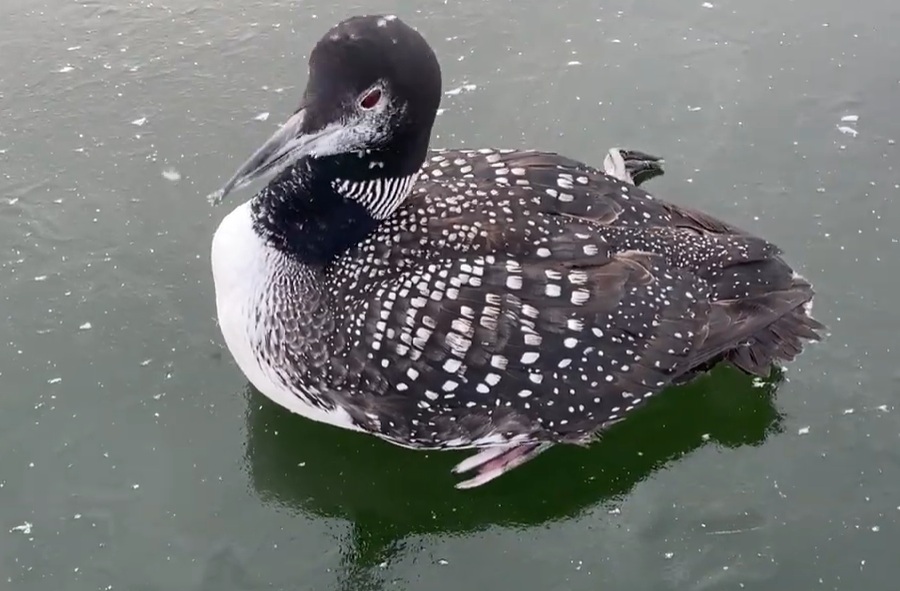
It was a sad ending to an otherwise uplifting tale about a loon rescued earlier this month on East Pond in Smithfield.
The loon, taken to Avian Haven, a wildlife rehabilitation center in Freedom, died seven days later after the Dec. 7 rescue. It was emaciated, suffering from a lung infection and had the beginnings of frostbite, according to Avian Executive Director Barb Haney.
Loons frequently contract the lung infection, aspergillosis, a fungus found in the environment, Haney said Monday.
Loons are more susceptible to the infection when the become stressed and experience a traumatic event, she said.
“It’s a sad story, frankly, because I know the rescuer was trying to do a kind thing,” Haney said.
John Picone, the rescuer, was skating alone on the pond just after noon Dec. 7 when he passed a rock outcropping known as Loon Island. He spotted the loon stuck in a tiny pool of water surrounded by ice about 800 feet from shore. Loons need a long stretch of water to be able to fly away, and the pond froze over before the loon could escape.
A retired surgeon at Redington-Fairview General Hospital in Skowhegan, Picone, 66, of South Portland, used his ski pole handles to nudge the loon to shore where an Avian Haven volunteer placed it in a laundry basket and drove it to the rehabilitation center. Picone is a member of Maine and New Hampshire Skating and Ice Report, a group of skaters who watch weather and ice conditions and share information about good places to skate, always with a focus on safety first.
Picone responded to a request for comment late Tuesday in an email, writing he was sad to learn the loon did not survive.
“She was such a cute little creature,” he said. “I kind of felt a bond with Loony. But I know how caring and experienced Avian Haven is, and I’m sure they did what was best for her. The frostbite part makes me wish I had wrapped her up in a coat: but for the only time ever, I was wearing my dry suit without a coat, and that came back to haunt me several times that day.”
Picone said he had wanted to pick the loon up in a coat, move it across the ice in it and then wrap the bird in the coat.
“As it is she had to sit on the shore for over an hour, which was well under 32 degrees (the water was definitely warmer). I guess the good is that myself and many other people learned so much about helping trapped loons, and that may well help other birds in her circumstances.”
Haney said it was not determined whether the loon was male or female. Avian Haven staff were hopeful the loon would recover, but it eventually exhibited open-mouthed breathing, a sign of the fungal infection, according to Haney. The infection is contracted by breathing in a mold found close to the ground. After a few days, the bird was humanely euthanized, Haney said.
While the outcome wasn’t as everyone had hoped, Haney acknowledged it is important to talk about it.
“I run into this all the time, of course,” she said. “It is important, as a nonprofit, to tell the stories.”
The loon, she said, probably would not have survived had it not been discovered.
While she said she doesn’t want to encourage people to go out onto frozen lakes, a better way to collect a stranded loon would be to put a blanket in a laundry basket, carefully pick up the loon and place it inside with another blanket over it and slide the basket across the ice, she said.
She described loons as “highly stressed animals.”
“These birds are so sensitive,” she said. “To their advantage, they don’t like human contact.”
Haney said she doesn’t want the rescuer to feel badly. The bird, she said, had three strikes against it: its emaciated state, the infection and the beginnings of frostbite.
“All we really know is that it got aspergillosis,” she said. “It could have happened before (the rescuer) got there. The stress of being grounded on that pond could have been enough.”
Maine Audubon reported this year that the common loon population in the state is healthy and growing.
The incident serves as a reminder of how humans can best serve as stewards for the loon population, Haney said. Asked what one can do in the summer, for instance, when seeing loons on a lake or pond, Haney said it is important to leave it alone.
When we humans see a wild animal, our tendency is to step forward to observe it, but actually, it is best to step back and give it space, Haney said.
“It’s not to their advantage to get comfortable with humans,” she said.

We invite you to add your comments. We encourage a thoughtful exchange of ideas and information on this website. By joining the conversation, you are agreeing to our commenting policy and terms of use. More information is found on our FAQs. You can update your screen name on the member's center.
Comments are managed by our staff during regular business hours Monday through Friday as well as limited hours on Saturday and Sunday. Comments held for moderation outside of those hours may take longer to approve.
Join the Conversation
Please sign into your CentralMaine.com account to participate in conversations below. If you do not have an account, you can register or subscribe. Questions? Please see our FAQs.