

“If a logging truck is barreling toward you, drive the state truck into a snowbank.”
Those words of wisdom came from Kevin Stevens, my wildlife biologist supervisor of the Maine Department of Inland Fisheries & Wildlife. It was January 1978, and minutes before my drive from Ashland to Clayton Lake in the northern Maine woods.
“Logging companies act like they own the road because they do,” he said. “But once a log truck squeezes past, it will stop and pull you out.”
With my Chevy truck loaded with a snowmobile, topo sheets, sleeping bag, snowshoes, shovel and a duffel bag stuffed with warm clothes, I left pavement in Ashland and turned west onto the American Realty Road. Built in the early 1930s, the 94-mile logging road connects Ashland to Lac-Frontière, Quebec. Clayton Lake is located at mile 65.
According to Stevens, it would take four hours to reach the International Paper Company’s boarding house at Clayton Lake, where he arranged for me to spend much of the winter surveying deer wintering areas. After workdays on snowshoes, I’d dine and share a bunkroom with a dozen or so Quebecois loggers.
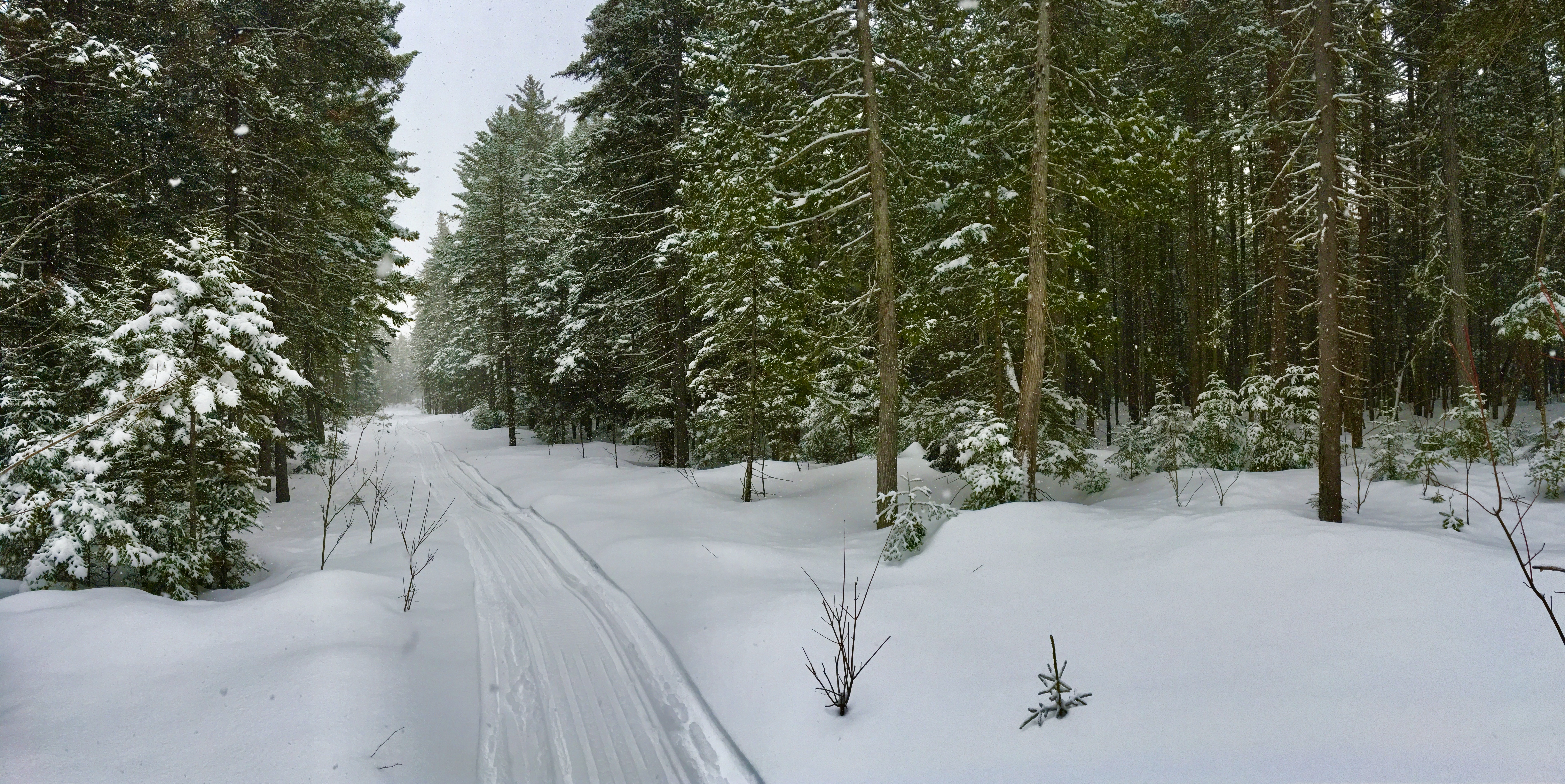
Along the plowed road made narrow by high snowbanks, my mind toggled between being aware of logging trucks and feeling elated about my first wildlife job in a region defined by tall spruce forests, and the fabled Allagash and St. John rivers.
A month earlier, I had finished third in the wildlife technician selection process. Miraculously, Stevens had called me back into the conference room of the state fish and wildlife headquarters in Augusta. “The job is yours if you want it,” he said. “Our top two candidates declined. Both refused to work in remote Ashland.”
Halfway to Clayton Lake, my heart rate skyrocketed when I saw a fast-approaching, overloaded 18-wheel logging truck. Stopping the swaying 100,000-pound truck would require several hundred yards. I stepped on the accelerator and drove my pickup into a snowbank seconds before the logging truck roared past. With both doors blocked by snow, I crawled out the driver’s side window and was greeted by a short, stocky Quebecois truck driver. He said, “I back up and get you out, oui?” When I replied, “merci beaucoup,” he laughed, adding, “Next time, you unstuck me, oui?”
Resuming my drive to Clayton Lake, I thought of Stevens’ other words of advice. “Dinner is served at 5 p.m. Don’t be late. And don’t forget logging camp rule No. 1: Never anger the cook.”
Arriving at 4:30 p.m., I was warmly welcomed by Bill Sylvester, superintendent of Clayton Lake’s International Paper Company’s logging camp. He escorted me upstairs in the boarding house, pointed to my bunk, quickly introduced me to the loggers and said, “You might want to wash up for supper before unloading your gear. I’ll see you downstairs.”
In 1978, Clayton Lake was a charming, remote International Paper logging village in northwest Aroostook County. Its tiny post office was the only one in the country where mail was handled in two states and Canada before delivery. That winter, my wife’s Valentine’s Day card mailed from Portland traveled to Boston, by plane to Montreal, by train to Lac-Frontière, and then Clayton Lake before being delivered by Margo Holden of the Clayton Lake post office.
Each logging camp dinner resembled a Thanksgiving feast. One dining-room picnic table was covered with fresh pastries, leftover breakfast donuts, fruit pies and my favorite, a Tarte au sirop d’érable (Quebec maple syrup sugar pie). Except for a logger asking me in broken English, “You get good meal, oui?” no one spoke.
Cooks — called cookees in logging camps — discouraged dinner talk. With their days starting at 4 a.m., they were eager to clean the kitchen and retire to bed. Of all the logging camps I visited — Telos, Comstock, Maibec’s, Pelletier’s — Clayton Lake’s was my favorite. One night, seated at the bunkroom card table, a veteran logger told me, “Le best cookees attract le best workers.”
In the remote, physically demanding world of Maine’s logging camps, good cookees were among the most irreplaceable employees. Loggers weighed the cookee’s reputation as heavily as wages when choosing where to work. Poor ones were fired and new ones quickly hired to quell unrest.
Several mornings after my arrival, with my truck loaded with a Ski-Doo Tundra, I followed International Paper Company forester Peter Farnsworth’s pickup’s tail lights in a plume of snow. Thirty minutes later we arrived at the Big Black River, one of the coldest locations in Maine. (On Jan. 16, 2009, a national weather service station recorded minus-50 degrees.) Farnsworth and I stepped out of our trucks, unloaded our snowmobiles in minus-20 degrees and rode our machines through several hundred acres of a deer wintering area spanning both sides of the frozen river.
Three events that day remain crystal clear: Farnsworth starting a bonfire to make three-boil black tea to enjoy with our lunches; sitting on snowshoes near the fire, leaning against a dead tree, and watching a family of northern flying squirrels peak out from a cavity a few feet above me; and watching a calf moose follow in its mother’s snow tracks, passing so close I could hear their soft guttural conversation.
At 4:15 p.m., while reveling in a hot shower back at the boarding house, I inadvertently broke logging camp rule No. 1. Shower water had leaked through the kitchen ceiling and onto the floor. Yvan Matheux, the cookee, raced upstairs and barked at me in French while waving a spatula. When he returned to the kitchen, a Quebecois logger chuckled, pointed his corn cob pipe at me and joked, “Le cookee, he say, ‘no meal for you.’”
A few days later, legendary Maine Game Warden pilot Jack McPhee landed his Piper Super Cub on Clayton Lake and within minutes took off with me seated next to him. Our mission was to delineate in pencil on my topographical map the approximate boundaries of the Big Black River’s expansive deer yard.
“Look at that handsome bull moose!” McPhee shouted on the intercom as we circled low over the animal. “He’s still carrying an antler that should have dropped two months ago.”
“My district is north of the (Canadian Pacific) railroad line,” he added. “It runs from Quebec across northern Maine to New Brunswick.” Stretched out in all directions were thousands of acres of mature spruce-fir forests. “Magnificent country,” McPhee said, “and you’re seeing an end of an era. With the pending spruce budworm epidemic, paper companies are rushing to harvest the trees before they’re killed by budworms. Come back in 10 years and it will look a lot different after the salvage cuts.”
With April’s arrival, the snows melted and my job in the woods ended. I hated to leave the special logging community of Clayton Lake. I’d grown close to the Quebecois loggers and the International Paper staff and their families. Saying goodbye and driving back to Ashland felt like leaving a loving home as a teenager. Today I look back on the winter of 1978 as the one of the happiest chapters of my life.
Ron Joseph of Sidney is author of Bald Eagles, Bear Cubs, and Hermit Bill: Memories of a Maine Wildlife Biologist, published by Islandport Press
We invite you to add your comments. We encourage a thoughtful exchange of ideas and information on this website. By joining the conversation, you are agreeing to our commenting policy and terms of use. More information is found on our FAQs. You can update your screen name on the member's center.
Comments are managed by our staff during regular business hours Monday through Friday as well as limited hours on Saturday and Sunday. Comments held for moderation outside of those hours may take longer to approve.
Join the Conversation
Please sign into your CentralMaine.com account to participate in conversations below. If you do not have an account, you can subscribe here. Questions? Please see our FAQs.