


U.S. Sen. Susan Collins announced Thursday that U.S. Immigration and Customs Enforcement has ended its immigration crackdown in Maine, but in communities that have been gripped by fear and uncertainty for more than a week, the news was met with caution and skepticism, not celebration.
City officials and immigrant advocates said even if the surge is over, there’s still a long road ahead: Dozens of community members are still detained (most out of state) and in need of legal help, hundreds of families could face eviction, and ICE agents remain in Maine, even if in lesser numbers.
Federal officials on Thursday also would not confirm whether the operation, dubbed “Catch of the Day,” has ceased.
Maine leaders, meanwhile, urged residents to remain vigilant.
“Even if it is true that ICE will no longer be conducting a major operation here, it does not make up for the damage already done — the constitutional rights that were violated, the families torn apart, and the many questions that remain unanswered,” said Portland Mayor Mark Dion. “This will continue to have lasting effects for many of our residents.”
Mufalo Chitam, executive director of the Maine Immigrants’ Rights Coalition, said she is worried that targeted operations will still continue in Maine because ICE agents initially came to the state with a list of 1,400 people to apprehend, and have arrested only about 200 individuals.
For now, she is cautioning the community to “stay put” while they confirm what the news means. Her organization, which manages a hotline for reported ICE sightings, said Thursday afternoon that although things have slowed in recent days, it still received 350 calls and texts in the past 24 hours.
Lewiston Mayor Carl Sheline said the advanced operation might be over, but residents should remember that immigration enforcement will continue.
“We need to remain vigilant, continue to check on our neighbors and take common sense steps to keep ourselves safe,” he said.
CITIES GRIPPED BY FEAR
ICE agents arrived in Maine on Jan. 20, armed with a list of targets federal officials claimed were the “worst of the worst.”
Over the following eight days, tension and anxiety ratcheted up in cities like Portland and Lewiston, where ICE concentrated its apprehension efforts.
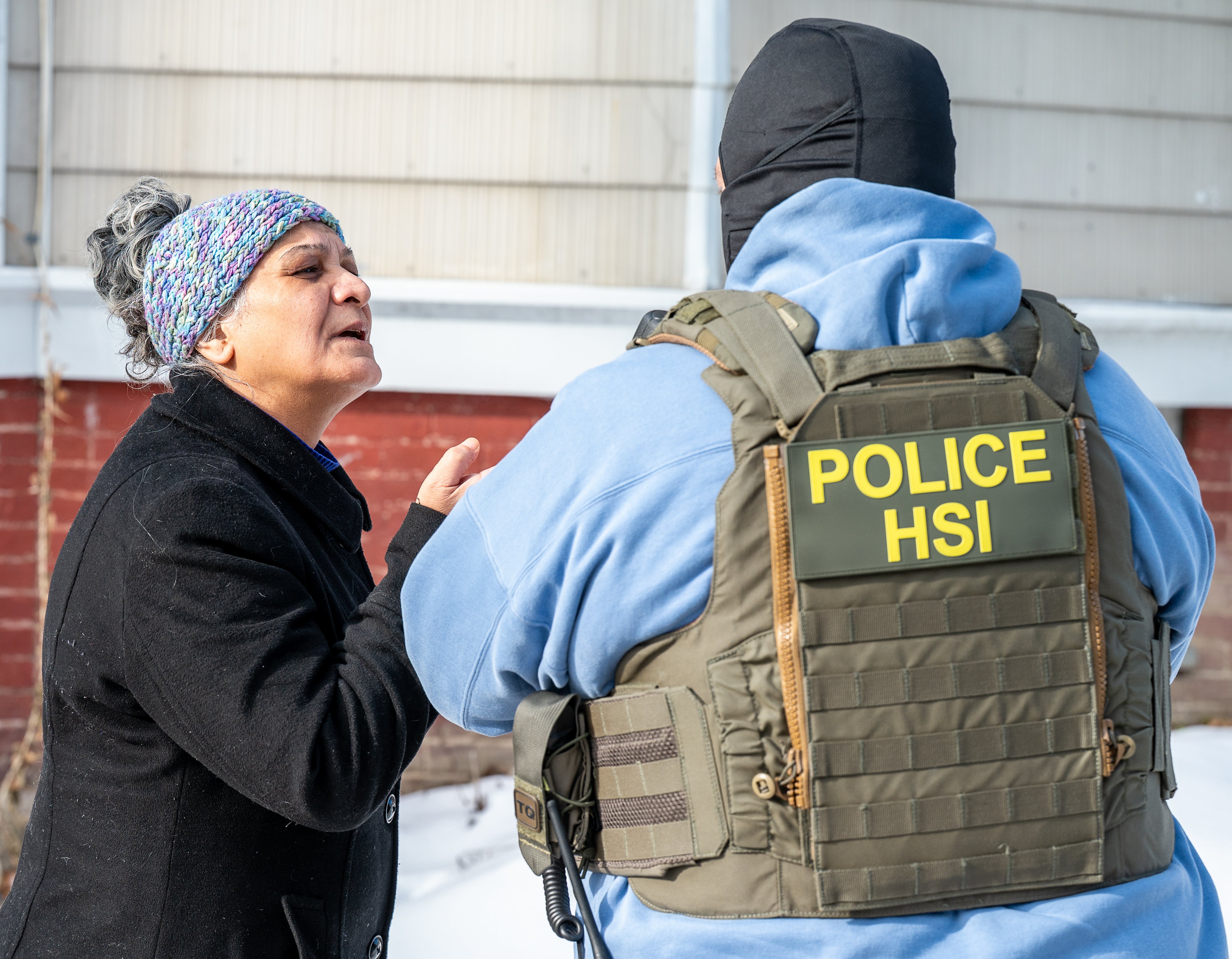
Immigrants were stopped by masked agents on the street, pulled out of cars, ambushed outside of their scheduled immigration check-ins. Some seemingly just vanished, leaving behind eerie scenes: an empty car idling in the street. The glass from a shattered window glittering on an infant’s car seat. A set of keys abandoned on the floor of a car.
Immigrant-owned and -frequented businesses closed their doors for fear of workers or customers being detained. Employees called out of work. Schools reported higher-than-usual absences. Even U.S. citizens began carrying their passports, saying they’re afraid of being racially profiled and detained.
In the first four days of the operation, ICE agents arrested 206 people, according to the Department of Homeland Security. The agency did not provide an updated number Thursday.
Among those DHS deemed the “worst of the worst” were also people in the country legally with no criminal records or only minor infractions: asylum seekers, a mother of four, an 18-year-old college student, a civil engineer, two corrections officers.
ICE has so far only highlighted 10 arrests by name of people accused of criminal activity, including aggravated assault and operating under the influence. The agency has not responded to repeated requests for a full list of arrests.

ACTIVISM ONGOING
ICE Deputy Assistant Director Patricia Hyde called the more than 200 apprehensions an “early success” but also blamed residents for interrupting agents’ work during the first week of the operation.
“On a few occasions, ICE officers were forced to pull away from criminal alien targets because of activists alerting the public to unmarked ICE vehicles. One such target was a known drug trafficker,” she said in a news release.
Indeed, Maine residents mobilized early in the surge to protect neighbors.
They built support systems for those affected, formed carpool groups for school and brought food to people’s homes. Activists led several protests, including late-night noisemaking rallies outside hotels believed to be hosting ICE agents. Meanwhile, many residents built a rapid response network to monitor enforcement activity, and some say they were threatened by ICE simply for observing.
And while ICE’s efforts may be winding down, the activism is not.
On Friday, dozens of Maine businesses plan to participate in a nationwide shutdown protesting ICE activity by closing their doors or donating sales to organizations that support the immigrant community.
Students at schools in districts across southern Maine are also planning to walk out or even skip school entirely.
‘THE NEXT PHASE’
Sue Roche, executive director of the Immigrant Legal Advocacy Project in Maine said that requests for help for people who have been arrested by ICE have slowed down, but the nonprofit has still received more than 60 submissions in its online form.
“The need for urgent legal and other assistance for impacted families and communities remains,” she said in a statement.
Just because the surge has ended, doesn’t mean the crisis has stopped, Project Home, formerly the Quality Housing Coalition, said in a social media post.
“It simply moved to the next phase.”
The agency, which has raised about $230,000 to help pay rent for 100 immigrant families risking eviction, said there are at least another 550 households at risk.
“Income stopped. Jobs were lost. Rent didn’t,” the nonprofit said. “Even if ICE left today, the damage is done.”
‘TIME WILL TELL’
Collins said Thursday that while “there are currently no ongoing or planned large-scale ICE operations” in Maine, ICE and Border Patrol will continue their normal operations in the state.
For many, that’s of little comfort.
Brendan McQuade, a University of Southern Maine associate professor and one of the founding members of the No ICE for ME campaign, said Collins’ statement “leaves the door open” for continued operations.
A spokesperson for the American Civil Liberties Union of Maine said the organization is glad to see that ICE activity may be winding down, but cautioned that the agency may “reescalate their presence” at any time, per federal law.
Since the Trump administration ramped up efforts to enforce immigration law nationwide, Maine’s U.S. Border Patrol saw a record high number of apprehensions in 2025.
Some of those began with traffic stops by local police, which experts say appears to have become a key tool for U.S. Customs and Border Protection agents.
According to data compiled by the Maine Immigrants’ Rights Coalition, ICE recorded 442 apprehensions in the state between Sept. 1, 2023 ,and Oct. 15, 2025.
Last year, federal officials also criticized local leaders and law enforcement agencies in Maine for failing to cooperate with federal agents.
Cumberland County Sheriff Kevin Joyce on Thursday held off on reacting to the news and said in a statement that “time will tell” if the enhanced operation will cease.
The sheriff has criticized the agency’s tactics, which he previously called “bush-league policing” after one of his corrections officers was detained by ICE in Portland.
“I heard ICE was going to target criminal aliens and secure the borders,” Joyce said in the emailed statement. “We have seen that clearly isn’t the case. So I will wait to see.”
Staff Writers Andrew Rice, Morgan Womack, Kelley Bouchard, Tim Cebula and Riley Board contributed to this story.
