
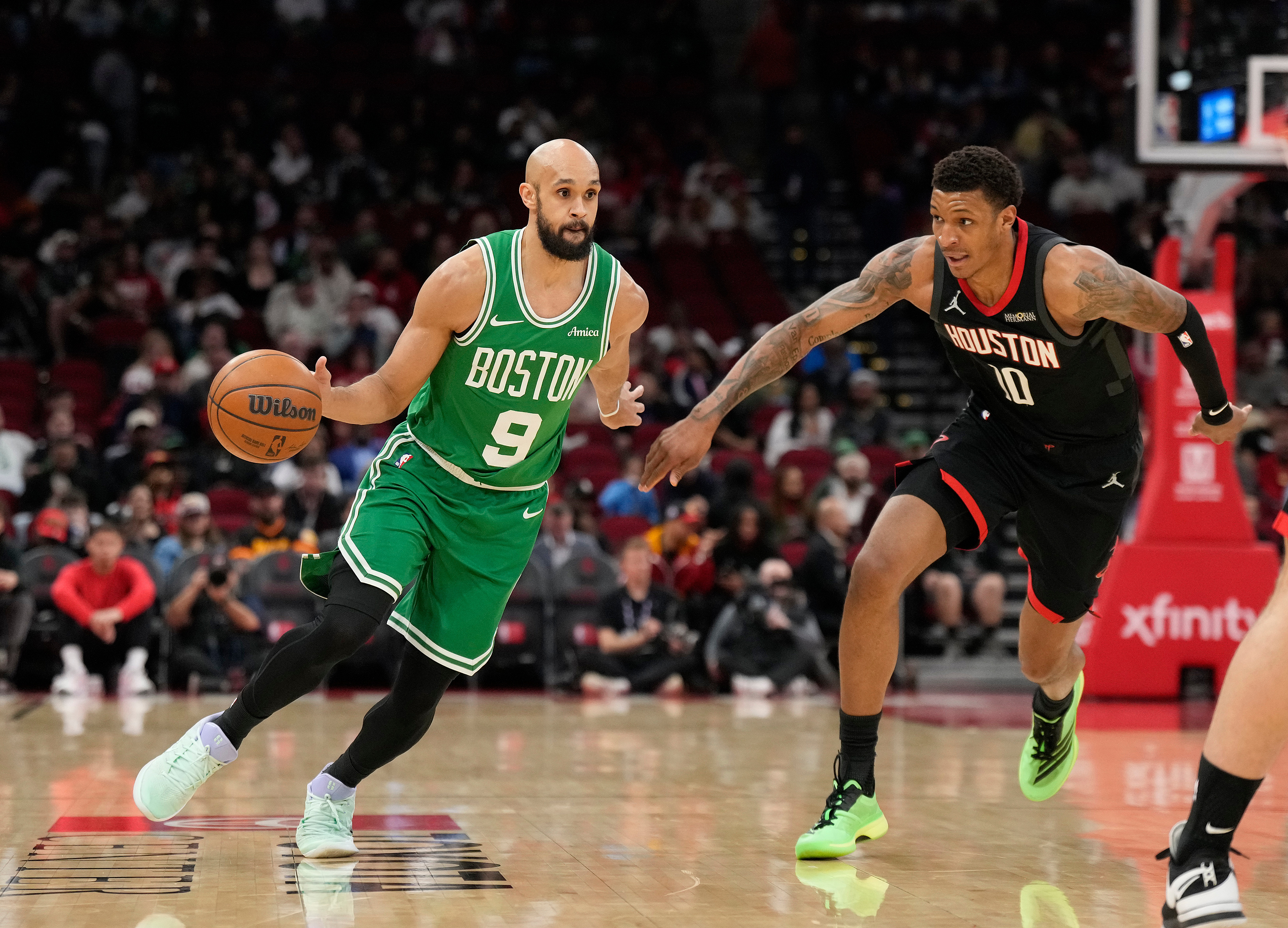
HOUSTON — Derrick White made six 3-pointers and scored 28 points, and the Boston Celtics used a big third quarter to build their lead and cruise to a 114-93 win over the Houston Rockets on Wednesday night.
White’s performance helped the Celtics win a fourth straight game despite missing star Jaylen Brown, who sat out because of left hamstring tightness in the second game of a back-to-back.
Houston coach Ime Udoka was ejected at the end of the third quarter after receiving a double technical for arguing with officials, and Alperen Sengun was tossed midway through the fourth after receiving two technical fouls for yelling at an official following a no-call.
The Rockets trailed by four after a 3-pointer by Amen Thompson early in the third before Boston went on an 18-3 run to make it 67-48 with about seven minutes left in the quarter. The Celtics hit five 3-pointers in that stretch, with two apiece from White and Baylor Scheierman.
Thompson made a basket for Houston before Boston used a 10-1 spurt to push the lead to 77-51 with four minutes remaining in the quarter. White led the way during that run, scoring the first eight points, with two 3-pointers.
Reed Sheppard received a loose ball foul near the end of the quarter and Udoka was ejected after arguing the call and getting two technical fouls. Boston converted four free throws to make it 87-63 entering the fourth.
Kevin Durant led the Rockets with 15 points in his return after sitting out Monday because of a sprained left ankle. Sengun, who had 39 points and 16 rebounds in Monday’s win over Indiana, was held to 13 points and nine rebounds.
Neemias Queta had 10 points, a career-high 19 rebounds and five blocked shots, and Luka Garza added 19 points to help the Celtics to the victory.
Up next
Celtics: Host Miami on Friday
Rockets: Host Charlotte on Thursday
Comments are not available on this story. Read more about why we allow commenting on some stories and not on others.
We believe it's important to offer commenting on certain stories as a benefit to our readers. At its best, our comments sections can be a productive platform for readers to engage with our journalism, offer thoughts on coverage and issues, and drive conversation in a respectful, solutions-based way. It's a form of open discourse that can be useful to our community, public officials, journalists and others.
We do not enable comments on everything — exceptions include most crime stories, and coverage involving personal tragedy or sensitive issues that invite personal attacks instead of thoughtful discussion.
You can read more here about our commenting policy and terms of use. More information is also found on our FAQs.
Show less