

“Polyphony” at Cove Street Arts (through April 11) and “Mawte: Bound Together” at Colby College (through April 13) have no real common thread except that you have less than a month to catch them. They both also represent new approaches to exhibitions for each venue, which is, I suppose, a kind of connective tissue.
A NEW ERA
“Polyphony” constitutes an announcement of a new vision for Cove Street Arts. Kelley Lehr and John Danos bought Greenhut Galleries in 2016 and opened Cove Street Arts in East Bayside in 2019. Greenhut already had a prestigious roster of artists, but Cove was a place to curate and exhibit Maine artists without asking any to commit solely to Cove. The gallery also hosts an ambitious programming schedule: concerts, artist talks, dance performances and more.
The times they are a-changin’, as the old Dylan song goes. After nearly 50 years, in July Greenhut will move from the Old Port into one of the galleries in the 8,000-square-foot Cove Street Arts, retaining its stable of artists and brand identity within the larger gallery’s walls. As for Cove Street Arts itself, it will now exclusively represent its own, separate roster of emerging and midcareer artists. Bruce Brown, the venerable and ubiquitous figure on the Maine art scene for decades who also curated photography shows at Cove, has retired. Instead of a dedicated space for photography, the genre will be shown throughout the galleries, sometimes on its own and sometimes mixed with other media.
“Polyphony” is a preview of what’s to come and features about 20 of its roster artists. What is immediately evident is the diversity of perspectives, voices and media. “Polyphony” is an opportunity to tease apart the specific curatorial proclivities of Lehr and Danos, and to see how those themes and sensibilities form the equivalent of a mycorrhizal network underneath the more apparent surface reality of any upcoming individual exhibitions.
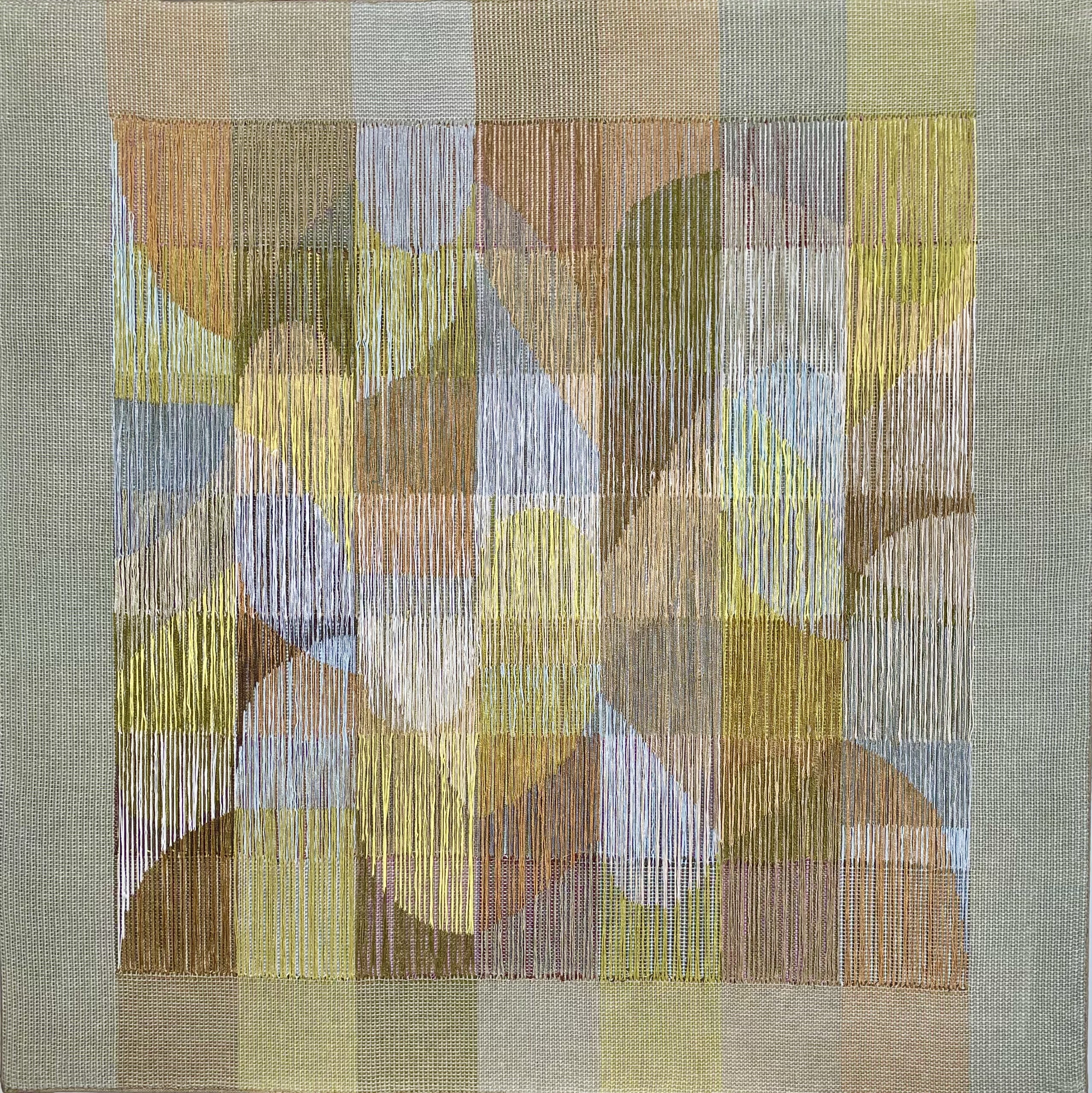
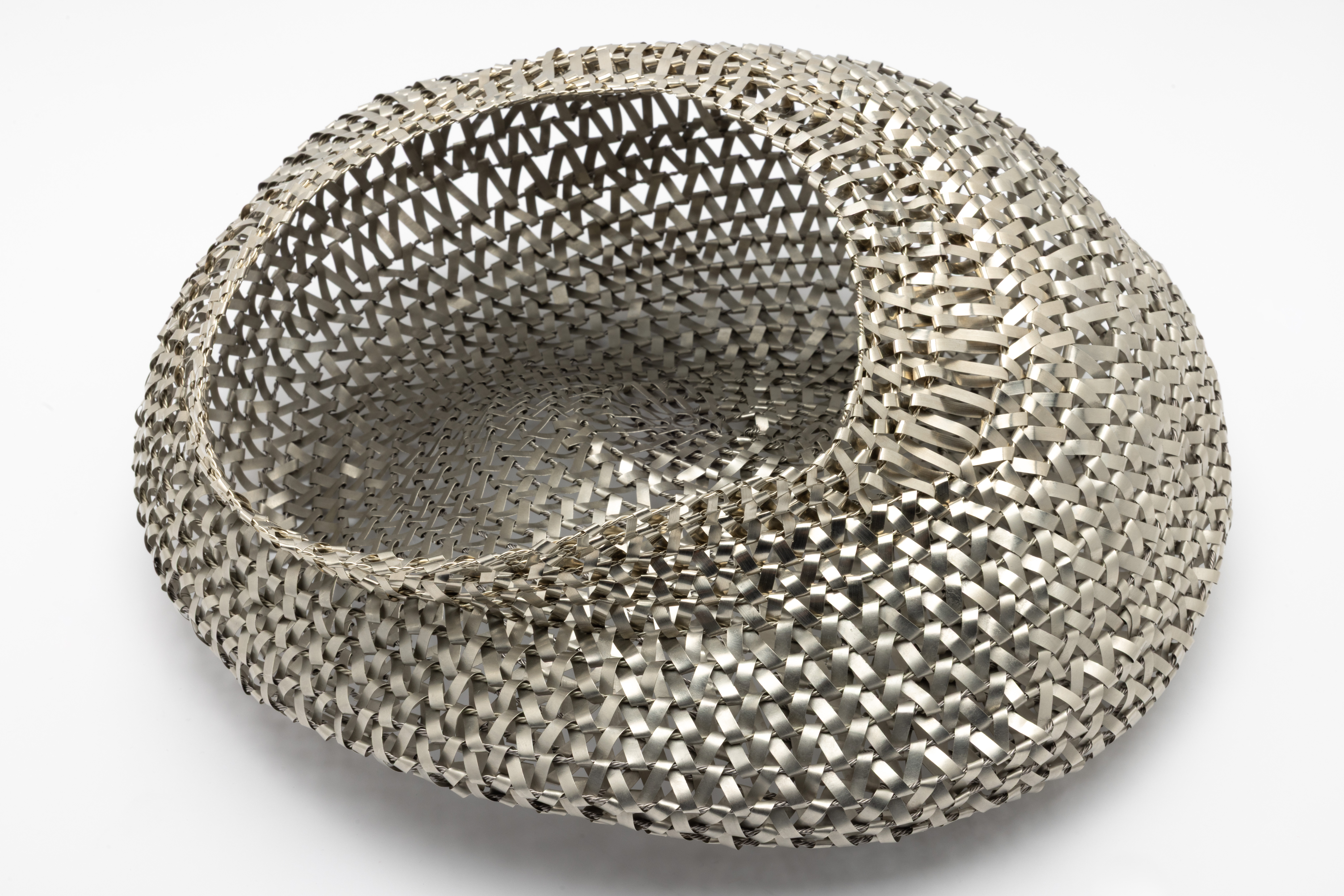
One discernible throughline is materials-based work. Plainly, Cove Street values materiality and tactility. We see this in the soulful silent presence of Steve Bartlett’s wood sculptures (you’ll want to stroke them), the exquisitely subtle wall weavings of Sondra Bogdonoff, the woven metal vessels of Aminata Conteh, the incised and patterned ceramics of Paul Heroux, the organic hybrid of natural materials employed by Lissa Hunter (clay, fiber basketweaving, shells, stones and more), the playful optical wood sculptures of Jamie Johnston, and Ashley Page’s pod-like natural fiber forms.
We can also perceive a sense of pervasive holding that at times might intimate something spiritual. Page’s pod forms, for example, or Conteh’s baskets, feel like porous vessels that hold not objects, but abstract ideas of history, memory, experience, community. The porosity serves to acknowledge how all these things are constantly in flux, influenced by newly acquired information, understanding, maturation and discernment. Alison Hildreth’s cosmic cartographies can imply a larger universal holding, a sense that our human bodies are connected to infinite, more mysterious phenomena that, while not completely graspable by our brains, nevertheless supports and witnesses our lives.
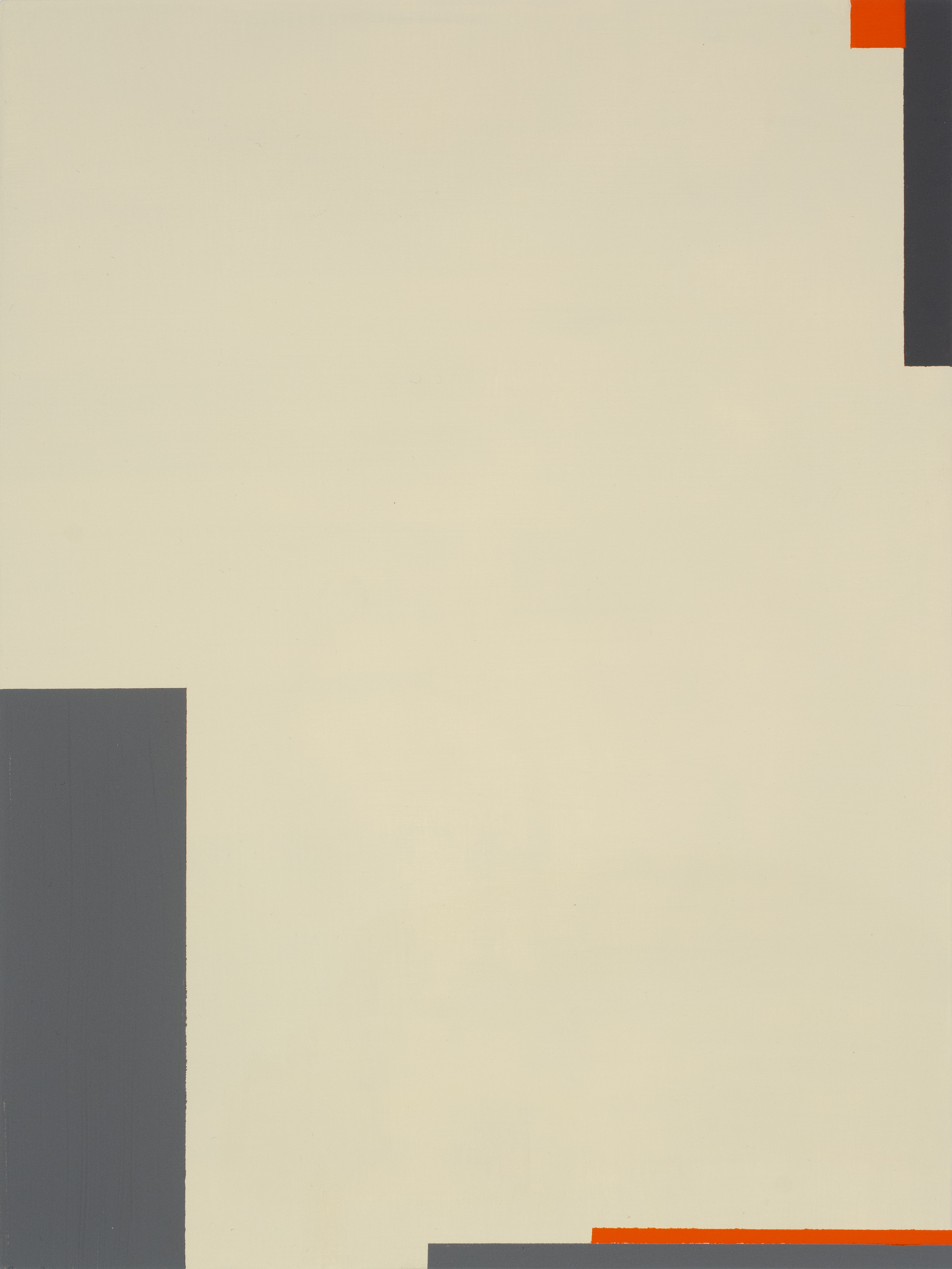
Even the minimalist, impossibly elegant compositions of Munira Naqui can suggest this paradoxical sense of co-emergent holding and porosity. Her arrangements of neat, colored rectangles and squares at the edges of open, empty fields of color carry a sense of peaceful stillness contained at the center. But the containment is partial; it allows things to enter and exit that stillness. Anyone who has meditated, even occasionally, can understand this phenomenon.
The work of other artists, particularly Grace DeGennaro, whose paintings are about sacred geometry, are more overtly spiritual, though they could also be defined — like Naqui’s works — as simply minimalist. That makes them approachable to a larger audience unconcerned with these deeper meanings and more occupied with concepts of geometry, formal composition and color.
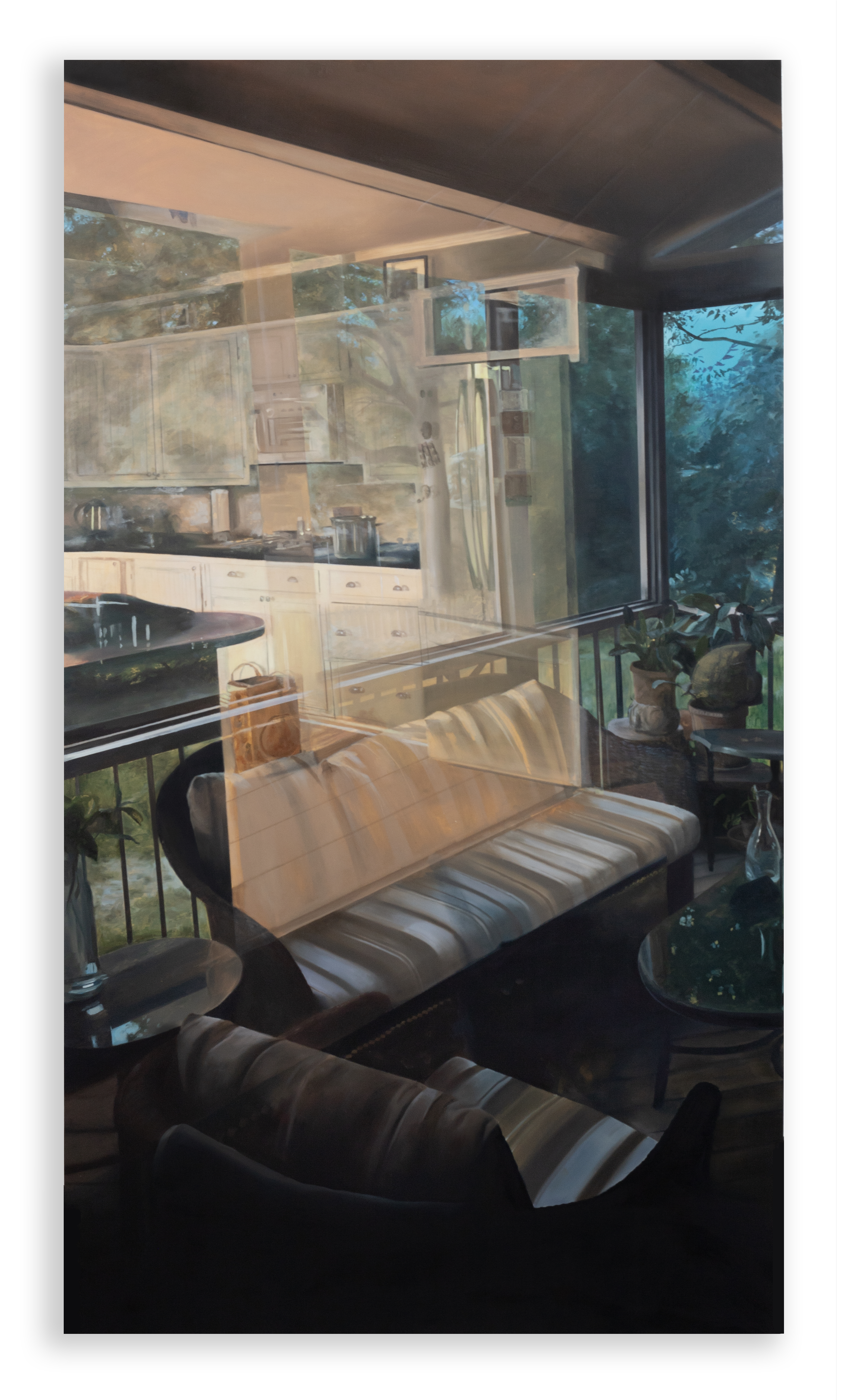
There are two photographers on the roster: Séan Alonso Harris and Hector Nevares Magaña. Both transcend purely documentary concerns. Harris locates something profoundly human in his subjects. Formally gorgeous, his portraits and street scenes capture his subjects’ emotional states, an inner energy that is simultaneously palpable and ineffable. They are steeped in the poetry of human existence. Magaña’s scenes, often devoid of humans, seem to touch on the mysterious essence of place, the supernatural forces and spirit of an environment. His bio cites his Mexican Catholic upbringing as a major influence, and this is evident. Magaña’s landscapes seem redolent with cycles of life and death, or spiritual belief and awe.
There is more, of course: Daniel Minter’s multimedia explorations of Black identity and community; Tom Hall’s sumptuous dreamlike landscapes; the whimsical, topsy-turvy folk art-like paintings of Alexander Nolan; eccentric childlike imaginings of Jennifer Goldfinger; David Row’s always-fascinating experiments with line, color and shifting planes; and the mind-warping perspectival shifts of Maine newcomer Ellen Weitkamp. Lastly, Cove Street Arts represents estates of deceased artists Driskell, Harold Garde and Miklos Pogany.
IN THEIR OWN VOICE
Colby Museum has been a leader in presenting the art of Indigenous peoples in ways that transcend the usual ethnographic focus common in museums. But “Mawte: Bound Together” takes this a step further. It formulates concepts, presents work, and creates displays directly and wholly from Indigenous perspectives, with a non-Indigenous staff curator serving only as a fulcrum for achieving the exhibition’s objectives within the Colby system.
The show gathers a dozen artists invited by Penobscot basketmaker Sarah Sockbeson to co-create every aspect of the show, which is housed at the Joan Dignam Schmaltz Gallery of Art in downtown Waterville. That encompasses everything, including what we first encounter, which is the typeface and motifs that adorn the entry to the exhibition and, inside, walls and wall texts. Designed by Brian Johnson (Monacan), it draws inspiration from Sockbeson’s traditional Wabanaki basket-weaving patterns.
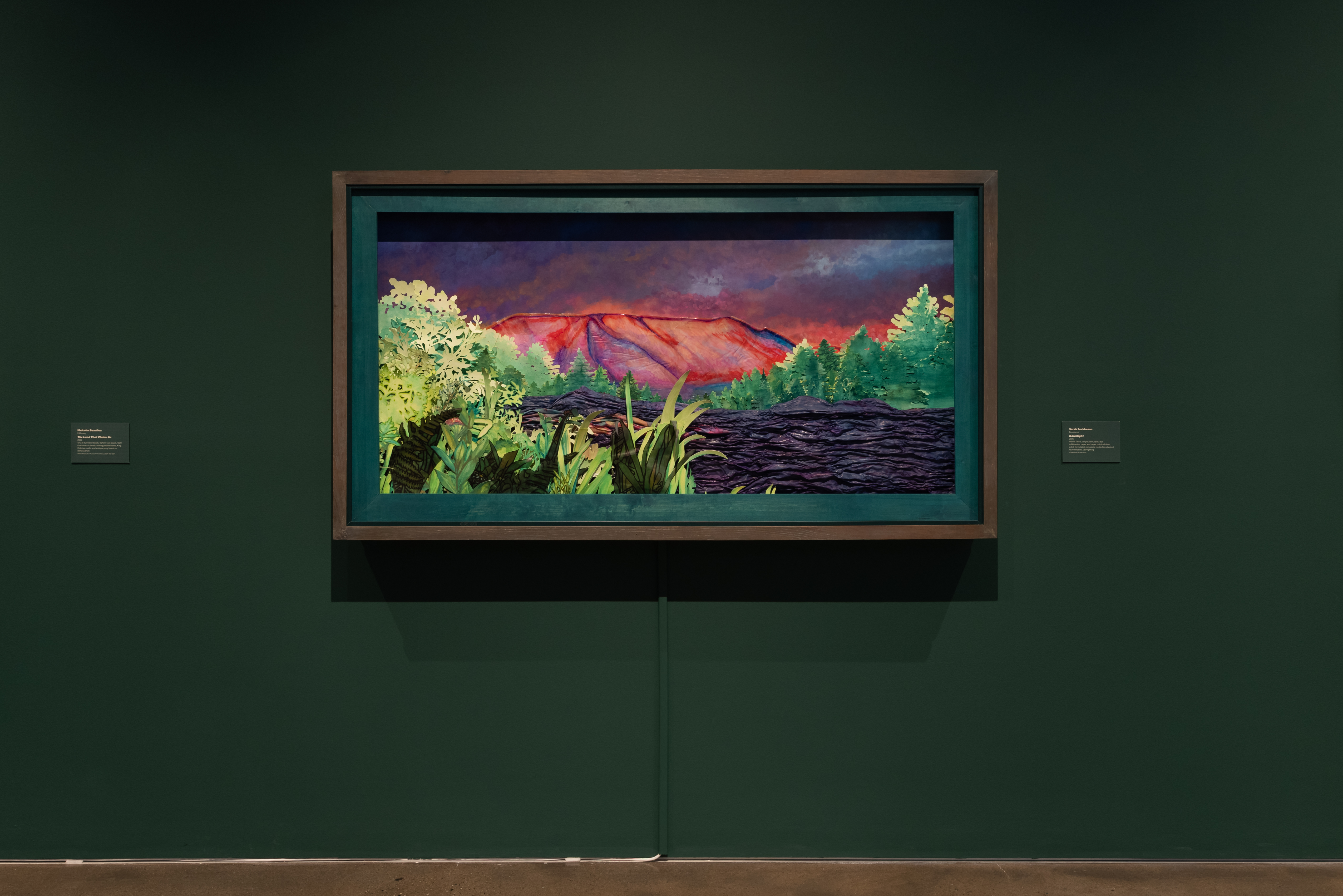
The exhibition is remarkable for many reasons, but one that immediately stands out is the way it shatters our assumptions of what contemporary Wabanaki art is and can be. Many artists are working outside their usual mediums and experimenting with different ways of presenting their work. Sockbeson is one obvious example. She does not contribute one of her ash and sweetgrass baskets. Instead, Sockbeson constructs a landscape called “Dawnlight,” which, the wall label informs us, is made from wood, fabric, acrylic paint, dyes, dye sublimation, paper and paper pup/cellulose, artist-formulated media (bio plastics), found objects and LED lighting.
“Dawnlight,” she writes, “reflects my commitment to artistic freedom and material innovation, especially in response to environmental threats…” This and other works serve to illustrate how Indigenous cultures keep moving forward and evolving, in the process annihilating ideas not just about the work Native peoples produce, but the romantic (and erroneous) depictions of these cultures as dying or extinct (as 19th-century Anglo-European artists insisted).
The land and rivers, of course, have been central to Indigenous culture and identity for “at least 13,000 years,” states the catalog. But access to both have been denied and/or restricted through treaties and laws such as 1980 Settlement Acts, which forced Wabanaki Nations to relinquish claims on 2.5 million acres of land. Sierra Autumn Henries (Chaubunagungamaug Nipmuck) tackles this issue of access in “Full Circle.”
As we approach it, we see a metal sign reading “Private Property. No trespassing.” Coming closer, however, we notice a knob at the top that opens the box behind the sign. Inside is an intricate circular pyrography design (made by burning it into birch bark). We are invited to decide whether to leave the box open or closed as we move to the next work.
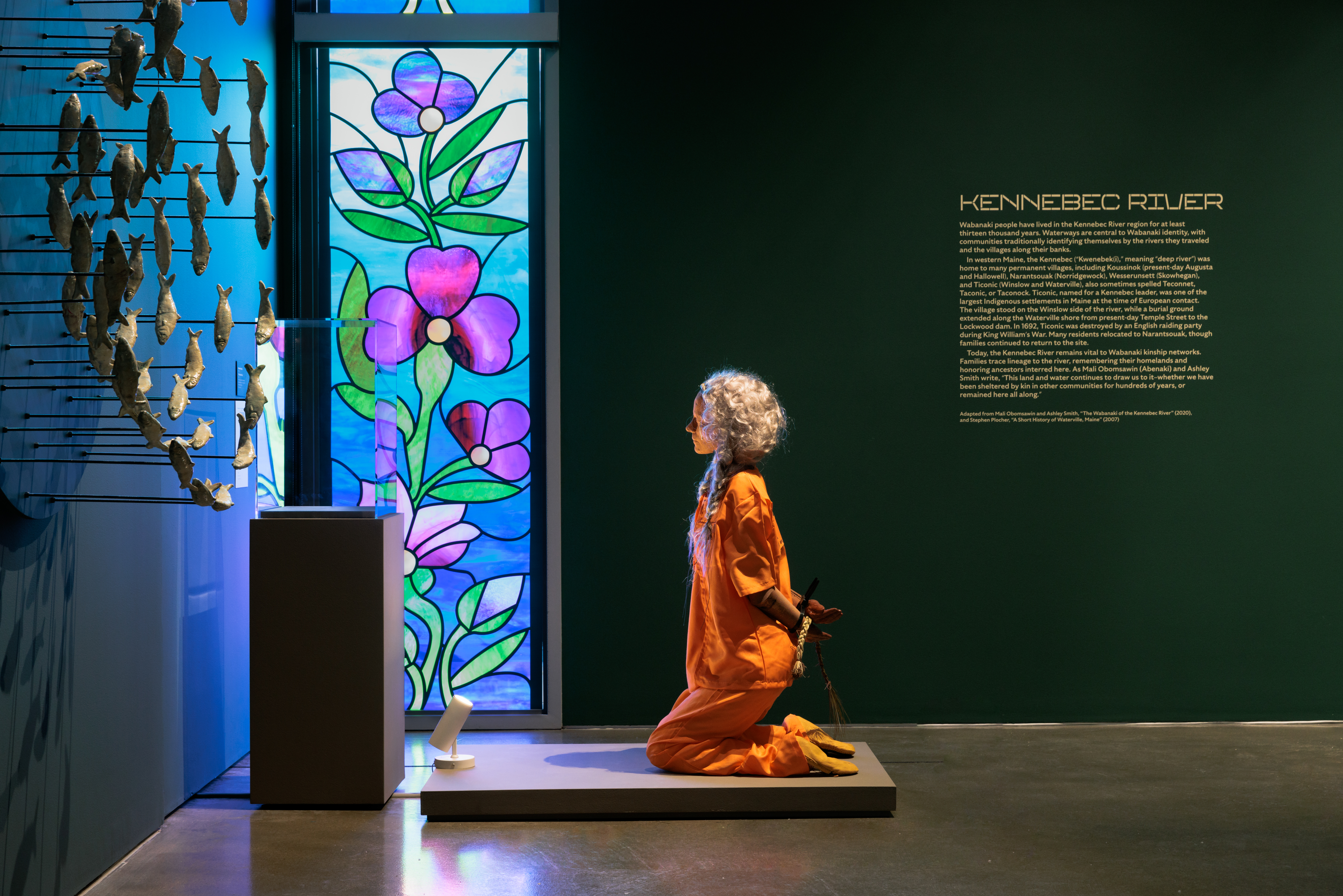
Suzanne Greenlaw (Maliseet) critiques another kind of restricted access: to cultural knowledge and artifacts that rightfully belong to sovereign Indigenous Nations. “The Ceramic Period” presents a female figure in an orange prison jumpsuit kneeling before an empty museum case on a pedestal.
What is missing from the case is a rare form of Wabanaki pottery held by a museum that offers the Wabanaki no access to it, which would help these tribes understand more about who they were. The jumpsuit obviously symbolizes activism penalized by prison. The clay female figure itself, Greenlaw states, “is symbolic of our clay teachings — a living entity — who is waiting for the return of her children.” Her hands, one of which clasps a length of braided seagrass, are bound behind her, pointing to yet another law that restricted Wabanaki tribe access to the sweetgrass they use in traditional basketry.
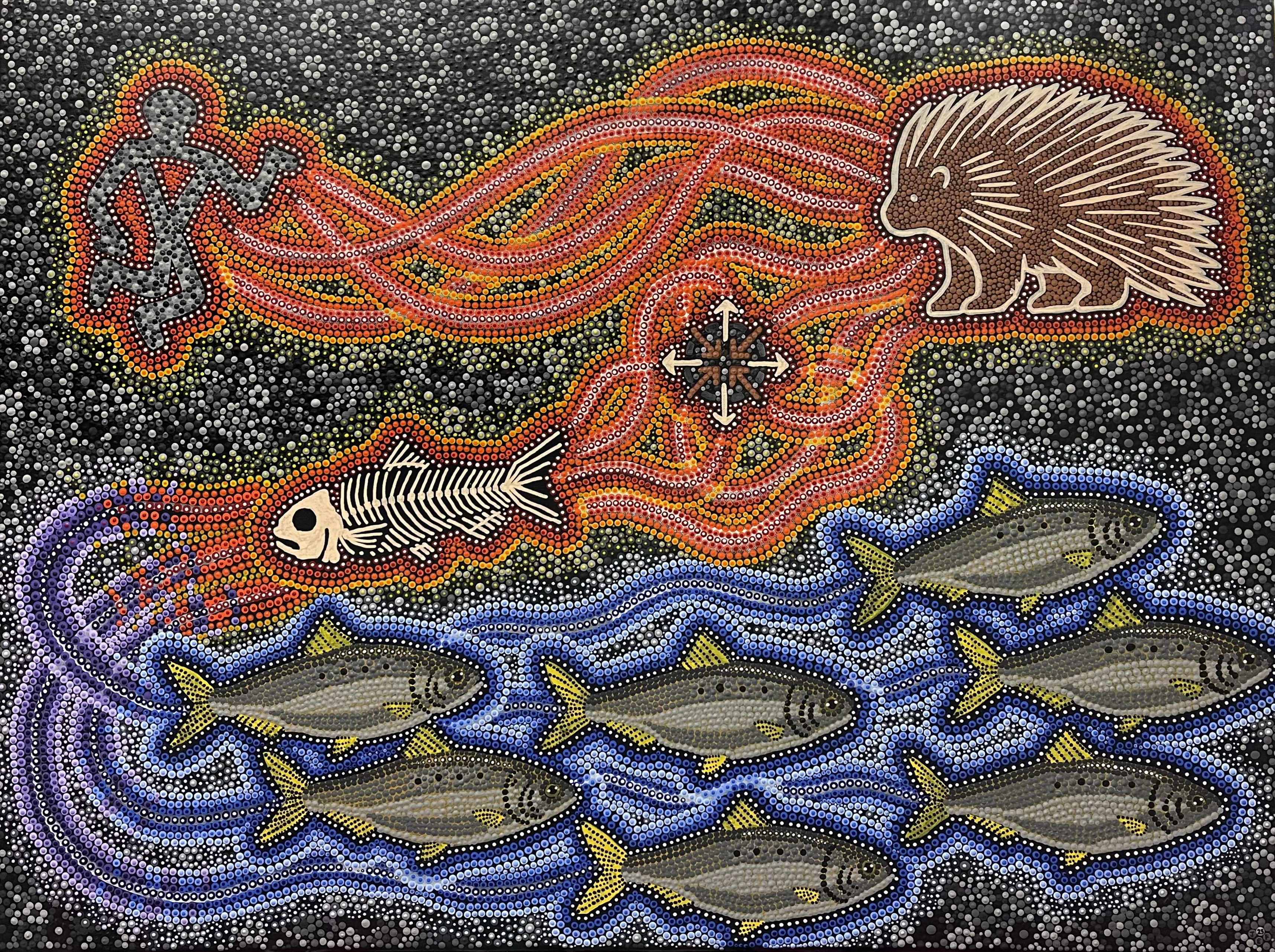
Not all exhibits highlight the clash of cultures between Indigenous people and white society and/or its systems. James Eric Francis Sr. (Penobscot) contributes a dot painting inspired by oral traditions of Klooscap, an ancient Wabanaki hero who shot an arrow into a tree and, in so doing, created all the animals. Klooscap transformed a disgruntled porcupine who longed to be a creature of the water instead of the land into a shad, a primary sustenance food of the Wabanaki that reappears at winter’s end. It is a complex, densely packed composition that is beautiful, but also astonishingly labor intensive.
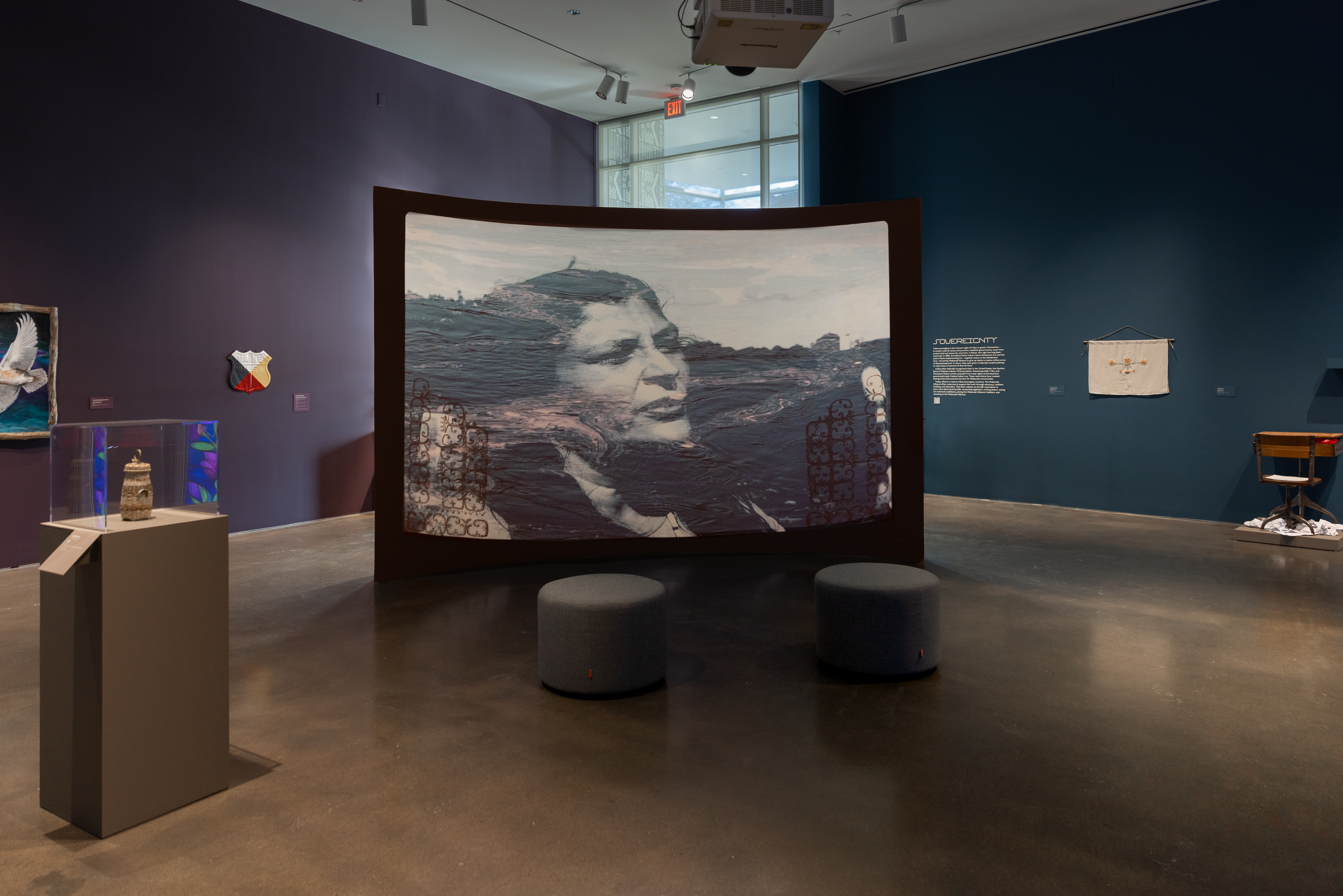
Melcolm Beaulieu (Mi’kmaq) displays an intricately beaded bog landscape. Tania Morey (Mi’kmaq/Maliseet) offers “Sipu,” a traditional brown ash, sweetgrass and birch bark basket. And there are works that feel triumphant too, such as Nolan Altvater’s (Passamaquoddy) video, “Naliktehmon,” chronicling the decommissioning of the Milltown Dam, which had reduced another subsistence food of Native people, alewives, to 900 in 2002… from 80 million.
Jorge S. Arango has written about art, design and architecture for over 35 years. He lives in Portland and can be reached at [email protected]. This column is supported by The Dorothea and Leo Rabkin Foundation.
IF YOU GO
‘Polyphony‘
Cove Street Arts, 71 Cove St., Portland. Through April 11. 10 a.m.-5:30 p.m. Tuesday-Friday, 10 a.m.-5 p.m. Saturday. Free. 207-808-8911, covestreetarts.com
‘Mawte: Bound Together‘
Colby Museum’s Joan Dignam Schmaltz Gallery of Art at the Paul J. Schupf Art Center, 93 Main St., Waterville. Through April 13. 11 a.m. to 7 p.m. (Thursdays until 9 p.m.) Wednesday-Monday, closed Tuesday. Free. 207-859-5600, colby.edu/museum
We invite you to add your comments. We encourage a thoughtful exchange of ideas and information on this website. By joining the conversation, you are agreeing to our commenting policy and terms of use. More information is found on our FAQs. You can update your screen name on the member's center.
Comments are managed by our staff during regular business hours Monday through Friday as well as limited hours on Saturday and Sunday. Comments held for moderation outside of those hours may take longer to approve.
Join the Conversation
Please sign into your CentralMaine.com account to participate in conversations below. If you do not have an account, you can register or subscribe. Questions? Please see our FAQs.