


BANGOR — It’s up to a federal judge to decide whether the Augusta Board of Education violated an outspoken activist’s First Amendment rights by silencing him for allegedly violating the board’s public comment policy by criticizing board members and administrators.
Nicholas Blanchard, who is also known as Corn Pop, filed a lawsuit in federal court earlier this year claiming the school board and its chairperson, Martha “Muffy” Witham, cut him off and ordered him to stop speaking whenever he has tried to speak out during public comment periods over the last year. Blanchard frequently, and sometimes disruptively, speaks up at school board meetings in Augusta and elsewhere in Maine.
Blanchard and his lawyers, including Nathan Ristuccia, from the national Institute for Free Speech, claim his speech is being limited based on content. They seek to have the board’s public comment policy be deemed unconstitutional, and that he be allowed to comment at board meetings without being censored.
“We’re asking for a return to the status quo, which was not having this policy enforced against my client,” Ristuccia said. “My client, unquestionably suffered irreparable damage. There is no public interest in maintaining a policy that’s unconstitutional.”
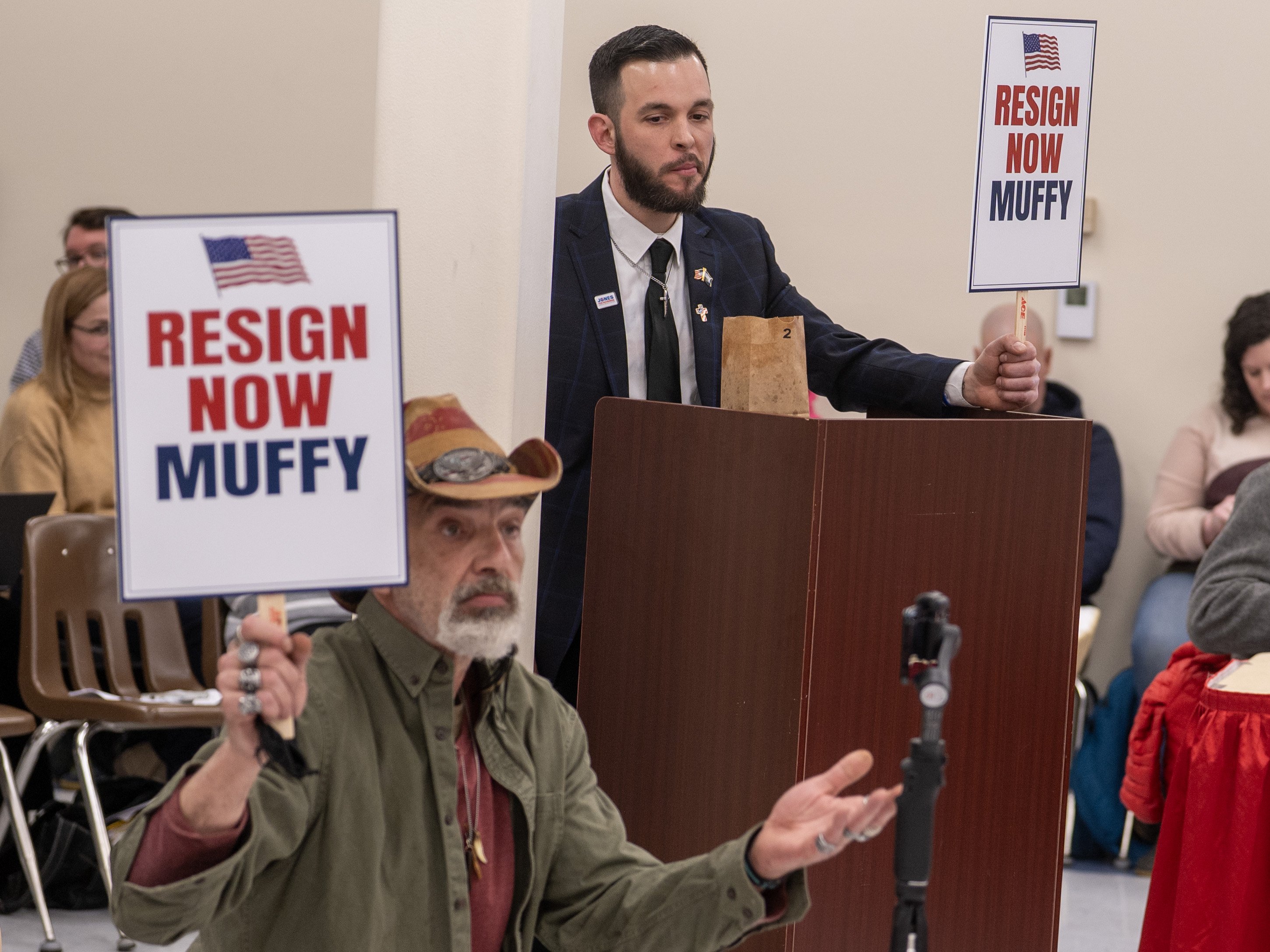
Blanchard is seeking a temporary injunction to force the board to allow him to speak at meetings without his comments being limited based upon their content, while the lawsuit proceeds.
U.S. District Judge Stacey Neumann heard arguments Friday in U.S. District Court in Bangor but did not issue her decision, which she said she hoped to issue soon.
An attorney representing the Augusta Board of Education and Witham argued the board is allowed to restrict speech on reasonable grounds at meetings because they are a limited public forum, based on time, manner and place considerations.
Attorney Susan Weidner said the board is allowed and even compelled by state law to restrict certain kinds of speech at meetings, including criticism of school employees. The board’s policy doesn’t allow the public to comment either negatively or positively about employees. It also does not allow gossip, defamatory comments, or abusive or vulgar language, and it gives the board chairperson the role of determining whether speakers violate the policy’s rules. The policy is read at the start of each board meeting.
Weidner said Blanchard has been allowed to speak on numerous occasions without being interrupted, and he has also resumed speaking after being warned he was breaking the rules.
She said he was not censored for the content of his speech, but he was limited because he violated the policy by criticizing staff members and personally attacking board members.
“The record shows (Blanchard) has spoken on many occasions,” Weidner said. “Many speakers have expressed the same viewpoints as the plaintiff, and not been interrupted.”

Blanchard’s lawsuit cites one incident when he accused a board member of being a communist. Ristuccia said often someone’s method of making a point, such as calling someone a communist, is inseparable from the words the person is sayin, and both aspects of that are protected speech.
Ristuccia said boards are allowed to restrict speech in some ways, such as banning shouting, requiring topics being discussed to be related to school business and banning speaking about students. And, he said, boards are allowed to set time limits.
Blanchard’s confrontations with school officials include an October 2025 Augusta Board of Education meeting at which three people partially undressed while Blanchard, who remained fully clothed, spoke out against transgender students being allowed to use locker rooms of their choosing.
The case could be significant given the trend of members of the public confronting local school boards across Maine on issues they feel strongly about, including transgender student policies.
Blanchard’s lawsuit against the school board and Witham, filed by Augusta-based Steve Smith Trial Lawyers and the Institute for Free Speech, is his second lawsuit pending against Augusta officials claiming unconstitutional violations of his rights.

In March, Blanchard also sued the Augusta Police Department and one of its sergeants, Desmond Nutter, in federal court claiming he was illegally detained by police at the October No Kings rally on Memorial Bridge in Augusta.
That case is still pending.

We invite you to add your comments. We encourage a thoughtful exchange of ideas and information on this website. By joining the conversation, you are agreeing to our commenting policy and terms of use. More information is found on our FAQs. You can update your screen name on the member's center.
Comments are managed by our staff during regular business hours Monday through Friday as well as limited hours on Saturday and Sunday. Comments held for moderation outside of those hours may take longer to approve.
Join the Conversation
Please sign into your CentralMaine.com account to participate in conversations below. If you do not have an account, you can subscribe here. Questions? Please see our FAQs.