


High school sports coverage is proudly supported by Maine State Credit Union.

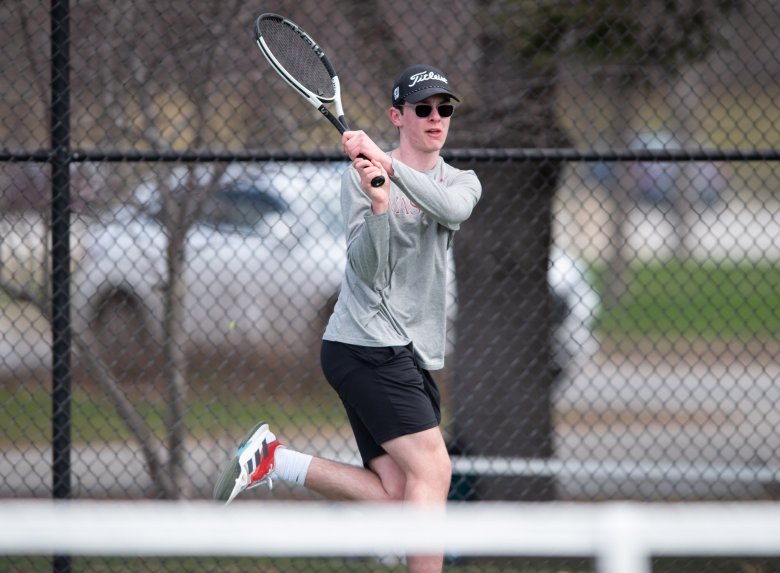
It’s the middle of April vacation, and Brendan Shaw and Evan Williams are on the Brunswick High School court at 9:30 a.m., hitting ball after ball in preparation for the boys tennis season.
The duo is in its first season as Brunswick’s No. 1 doubles team. Shaw, a senior, is in his first season with the Dragons and previously had little familiarity with Williams. In an effort to be successful quickly, they are addressing the biggest need as a team.
“The most obvious (key) is communication,” said Williams, a junior. “Deeper than that, it’s knowing your partner’s strengths and weaknesses. That’s all really important stuff.”
Doubles tennis is unique. For one, it involves a wider court (36 feet as opposed to 27 for singles), with one player positioned near the net while the other serves near the back of the court. What happens in the middle of the action involves each partner knowing where the other is going to be at all times, and what they can do.
“You have to be able to communicate and you have to have respect for one another, know each other’s games, know when their partner needs help, and they talk about it,” said Brunswick boys tennis coach Chris Leighton. “They never get down on their partner, it’s all positive vibes.”
“The other (key) is court movement,” Leighton continued, “because you’re supposed to move as a team. If the ball goes way to the left, the two (players) should also go to the left as well to cover the court, so you lessen the opening (for opponents) created when the ball goes wide.”
As he has been developing a relationship with Williams, Shaw is noticing instances when the pair is able to communicate, and others when they have to make a quick decision while reading one another.
“Sometimes, we have to switch if the ball is in a difficult spot,” Shaw said. “There has to be a chemistry without talking sometimes.”
Chris Kohl is an assistant coach with the Thornton Academy boys tennis team. Specifically, he’s tasked with working with the doubles teams. The Golden Trojans have had multiple successful pairs over the years, including the duo of Chan Park and Yuta Sato, who reached the semifinal round of the state doubles tournament last spring.
On top of constant communication, Kohl said the chemistry on and off the court is just as important when putting a doubles team together.
“They have to get along. That’s the part,” Kohl said. “… But they really need to complement each other. Sometimes, you’re looking at the strengths and weaknesses of players. You look at the strength of singles players and look at who might help each other. But are the personalities going to fit? Sometimes, (teams don’t work) because it’s a personality conflict. One might be too much of a ‘rah, rah’ guy. Just weird sort of things that you (take into account).”
Kohl said there are so many factors to consider that putting together a doubles team is “kind of like an art.”
“The really cool thing about doubles is, our job is to kind of instruct them during practice and then we get a little bit of time during or before a match,” Kohl said. “But they’re the ones who are trying to figure out the other team’s strengths and weaknesses, too. How can they work together to figure out what’s going to be successful is a really key component.”
Michael Paules and Isaac Gilman are also in their first season as a doubles team for Waterville. Gilman is recovering from a foot injury, so they have had to get creative during the preseason to develop chemistry, but they’ve found ways to work together on the court.
“We’ve been talking through lob (shots), just where we’re supposed to be (on the court),” said Gilman, a sophomore.
“We’re just staying transparent on the court,” added Paules, a junior. “You can’t just shut your teammate out, you really want to play with them. You really have to open up. One of the things about opening up is staying positive, regardless if you’re losing by six games or whatnot. Having fun is another (key), it helps make a bond, I find.”
“Isaac is the more aggressive player on the court, I’m a bit more passive,” Paules continued. “If I can look in Isaac’s eyes, maybe I can find where he’s about to make an aggressive play and I can adjust myself to prepare (for it). I can read what type of play he’s making.”
That bond has worked off the court with the pair as well, even talking strategy in the hallways at school.
“We’ve definitely mentioned strategy (off the court), especially with serving,” Paules said. “Especially fakes and shifting.”



We invite you to add your comments. We encourage a thoughtful exchange of ideas and information on this website. By joining the conversation, you are agreeing to our commenting policy and terms of use. More information is found on our FAQs. You can update your screen name on the member's center.
Comments are managed by our staff during regular business hours Monday through Friday as well as limited hours on Saturday and Sunday. Comments held for moderation outside of those hours may take longer to approve.
Join the Conversation
Please sign into your CentralMaine.com account to participate in conversations below. If you do not have an account, you can subscribe here. Questions? Please see our FAQs.