

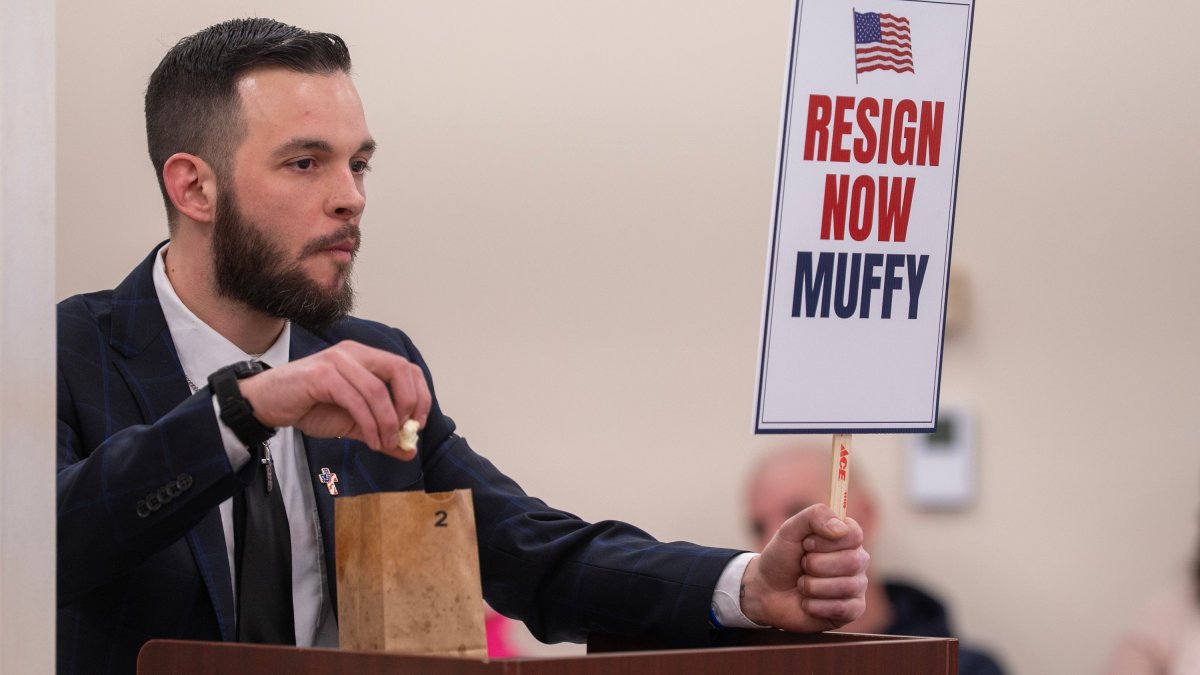
A federal judge has ordered the Augusta school board to stop enforcing some of its restrictions on public comment during its meetings, after an outspoken activist sued over claims the board’s policy violates the First Amendment.
U.S. District Judge Stacey D. Neumann, in an 34-page order issued Monday, ruled the city public school department, its Board of Education and board Chair Martha Witham cannot enforce aspects of the board’s public comment policy aimed at limiting gossip, abusive language and vulgar language.
Neumann also ordered the board to stop enforcing a section of the board’s policy prohibiting complaints, allegations and “personal matters” involving school employees and students.
She wrote that section of the policy was too vague — noting the similarly spelled terms “personnel matters” and “personal matters” are two different things, and the board has provided various explanations of the rule — although she noted a clearer policy may be enforceable.
Neumann’s order, meanwhile, allows the board to continue enforcing its ban on “defamatory comments.”
“The Court remains hopeful,” Neumann wrote, “that, going forward, public school board meetings can be conducted in a manner that both honors the guarantees of the First Amendment and preserves the civility essential to democratic governance, and that demonstrates that respectful and constructive discourse remains possible for all.”
Nathan Ristuccia, one of the lawyers for Nicholas Blanchard, the free-speech activist from Augusta who goes by the nickname “Corn Pop” and speaks frequently at school board meetings in Maine’s capital and elsewhere, praised Neumann’s decision.
“We’re thrilled,” Ristuccia, whose office is in Washington D.C., said in a phone call Tuesday morning. “The one thing that didn’t work out for us — we are not intending on appealing that or anything. We’re very happy with the decision and look forward to continuing the case.”
Melissa Hewey, one of two lawyers of the Portland law firm Drummond Woodsum who represent the school district, the school board and Witham, said via email Tuesday that she was evaluating whether there are grounds to appeal the ruling.
“The Augusta School Department’s public participation policy is similar to the policies of many of the school districts in Maine,” Hewey wrote, “and the Court’s decision prohibiting the School Department from enforcing the so-called personal provision could have significant negative implications for schools around the state as they struggle to balance the rights of their employees to confidentiality with the First Amendment rights of the public.”

Blanchard’s lawyers, from the national First Amendment advocacy group the Institute for Free Speech and Steve Smith Trial Lawyers in Augusta, filed the lawsuit in late January. Neumann heard oral arguments on his lawyers’ request for the preliminary injunction April 17 at U.S. District Court in Bangor.
The case will continue to be litigated; the preliminary injunction is an initial measure that indicates a judge thinks Blanchard is likely to succeed on specific aspects of his case. No future deadlines or hearings in the case were set as of Tuesday morning.
If the school department, board and Witham do not appeal Neumann’s ruling, the case will proceed next to discovery, Ristuccia said.
He said that even if the board changes its policy to conform with Neumann’s ruling, that would not end the lawsuit.
“They’re also being sued for their past actions, and of course, that doesn’t change their past actions,” Ristuccia said.
Ristuccia said that nationwide he is seeing a growing trend of school boards changing their restrictive public comment policies in response to lawsuits striking some of them down.
“I hope that other school boards in Maine will see this case and do the right thing on their own without needing to be sued by anyone,” the attorney said.
Blanchard’s lawsuit focused on school board meetings from January to November 2025, during which Blanchard made, or attempted to make, comments that were critical of board members or school staff before Witham cut him off.
The case came amid an ongoing trend in members of the public confronting local school boards across Maine on issues they feel strongly about, including transgender student policies, which have pitted state education officials against the administration of President Donald Trump.
Policies concerning transgender students in the Augusta schools have been among Blanchard’s complaints to the board. In October 2025, three people partially undressed while Blanchard, who remained fully clothed, spoke out against transgender students being allowed to use locker rooms of their choosing.
He has used other apparently unconventional or attention-grabbing methods of making public comments, including taping his mouth over to say “I can’t speak” and playing a recording about the First Amendment delivered in a voice that resembled Trump’s. When Witham tried to stop him, he placed a flag of the People’s Republic of China on her desk, and the board voted to call a recess.
Blanchard, meanwhile, also sued the Augusta Police Department and one of its sergeants over his arrest during a “No Kings” rally he was opposing. That case remained pending as of Tuesday, according to federal court records.
Blanchard is also running in June for a seat on the Augusta Board of Education.

We invite you to add your comments. We encourage a thoughtful exchange of ideas and information on this website. By joining the conversation, you are agreeing to our commenting policy and terms of use. More information is found on our FAQs. You can update your screen name on the member's center.
Comments are managed by our staff during regular business hours Monday through Friday as well as limited hours on Saturday and Sunday. Comments held for moderation outside of those hours may take longer to approve.
Join the Conversation
Please sign into your CentralMaine.com account to participate in conversations below. If you do not have an account, you can subscribe here. Questions? Please see our FAQs.