

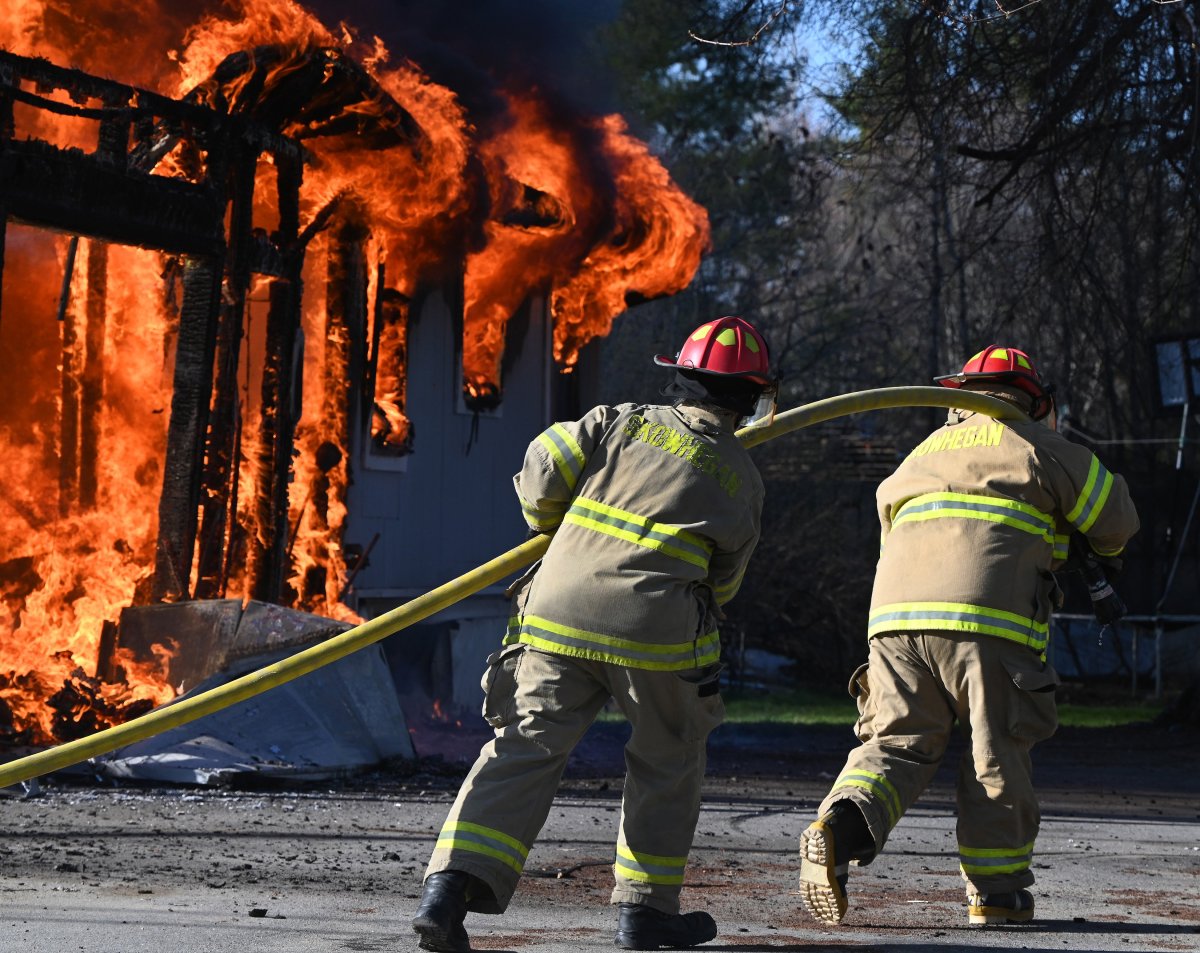
SKOWHEGAN — One person died in a fire that destroyed a home Tuesday night.
Investigative efforts were just beginning, State Fire Marshal Shawn Esler said at the scene around 7 p.m., about two hours after the fire broke out. Officials were not prepared to release information about the person who died.
Family members of those who lived at the home at 31 Waye St., some of whom also live in the neighborhood, said a woman and her daughter live there.
Crews responded around 5 p.m. to the blaze, Skowhegan fire Chief Ryan Johnston said. Police officers had arrived on scene initially, Skowhegan police Chief David Bucknam said.
“The captain, as he pulled out of the station, saw a large amount of black smoke,” Johnston said in an interview on scene as crews began to leave the scene while others worked to put out remaining hot spots in the charred remains of the single-story home. “He immediately struck a second alarm as they were on the way here.”
Firefighters found the front of the house fully engulfed in flames, Johnston said.
They made a “valiant effort” to try to locate a person inside, who was later found dead, the chief said.
He was unsure if there were any other injuries reported. Some people nearby were trying to assist extinguishing the fire when crews arrived, Johnston said.
The home was completely destroyed.
The Office of State Fire Marshal was investigating the cause, Johnston said. Several fire investigators arrived on scene shortly after 6 p.m.
Esler expected his office would be able to share more information late Tuesday night or early Wednesday morning. He offered his condolences to the family of the person who died.
Mutual aid came from the Athens, Canaan, Clinton, Cornville, Fairfield-Benton, Madison and Waterville fire departments, according to Johnston. Several Skowhegan police officers and detectives were on scene, too, along with Redington-Fairview General Hospital ambulances.
Waye Street is on Skowhegan’s north side, off North Avenue, also known as Route 150.

Comments are not available on this story. Read more about why we allow commenting on some stories and not on others.
We believe it's important to offer commenting on certain stories as a benefit to our readers. At its best, our comments sections can be a productive platform for readers to engage with our journalism, offer thoughts on coverage and issues, and drive conversation in a respectful, solutions-based way. It's a form of open discourse that can be useful to our community, public officials, journalists and others.
We do not enable comments on everything — exceptions include most crime stories, and coverage involving personal tragedy or sensitive issues that invite personal attacks instead of thoughtful discussion.
You can read more here about our commenting policy and terms of use. More information is also found on our FAQs.
Show less