

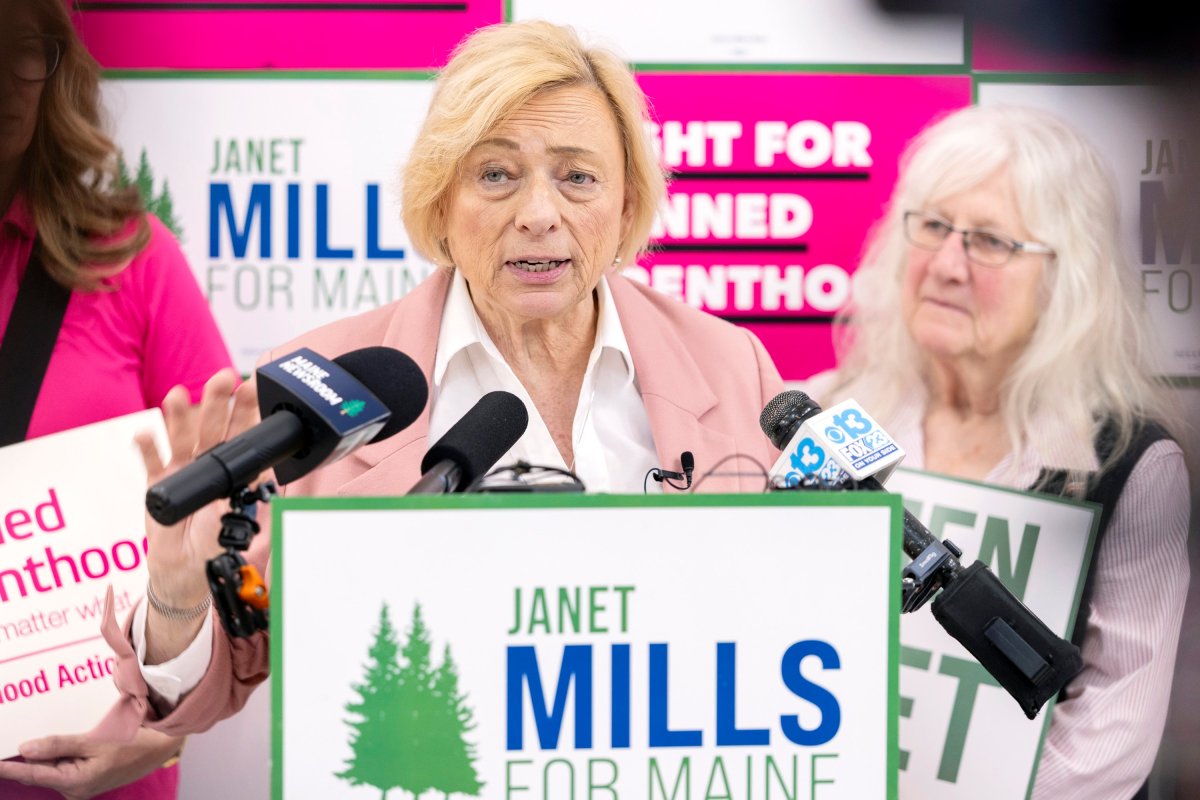
Gov. Janet Mills announced Thursday that she’s ending her campaign for U.S. Senate.
The stunning turn of events likely marks an inglorious end to the precedent-setting political career of the 78-year-old Mills, who was the state’s first female district attorney, attorney general and governor.
“While I have the drive and passion, commitment and experience, and above all else — the fight — to continue on, I very simply do not have the one thing that political campaigns unfortunately require today: the financial resources,” Mills said in an emailed statement.” That is why today I have made the incredibly difficult decision to suspend my campaign for the United States Senate.”
Mills’ foray into national politics was troubled from the start. She waited months to get into the race, giving her most formidable Democratic opponent, Graham Platner, time to gather momentum. Running as a septuagenarian in a campaign cycle when many Democratic voters are looking for generational change, she pledged early on that she would serve just a single Senate term if elected.
Her campaign events lacked the energy and enthusiasm of Platner’s, and she held them sparingly while attending to her duties as the state’s top official. And her ties to national Democratic leaders like Senate Minority Leader Chuck Schumer of New York proved to be more of a hindrance than a strength.
The governor’s exit sets up a head-to-head matchup between Platner, a political newcomer, and Republican Sen. Susan Collins on Nov. 3.
Platner thanked Mills for her service at a news conference Thursday in Augusta.
“We both got into this race because we knew how critical it is to defeat Susan Collins,” Platner said. “And her decision today reflects that commitment. I look forward to working with her between now and November to do just that.”
Collins also weighed in on Mills’ withdrawal, saying in a written statement, “I’m sure this was a difficult decision for Governor Mills, and I thank her for her decades of service to the people of Maine.”
Although a Mills spokesperson said the governor wouldn’t vote Republican in November, Mills stopped short of endorsing Platner, who is running a forceful anti-establishment, populist campaign.
Nicholas Jacobs, a political science professor at Colby College, was surprised that Mills suspended her campaign before participating in any televised debates against an untested, political newcomer.
Jacobs was equally surprised that Democrats did not rally around Mills, who has a history of winning statewide races and standing up to President Donald Trump. She also sports a centrist policy record, which often plays well in general elections here.
“I’m sure that’s surprising her as much as her announcement is surprising all of us,” Jacobs said.
Her announcement comes only days before the Democratic state convention and one week before she was scheduled to appear in the race’s first televised debate.
It also comes the day after the legislative session ended — the same day nearly two dozen state lawmakers were planning to endorse Platner.
Citing independent polls, his campaign had planned a media call for Thursday declaring the primary effectively over.
A DELAYED ENTRY
Mills gained national attention in February 2025 after Trump called her out in front of the nation’s governors at a White House event.
Trump threatened to withhold federal funding if Maine did not follow an executive order banning transgender athletes in women’s sports. Mills told him she was following state and local laws, and that she would see him in court.
Mills was held as an example of Democratic resistance. Local residents made T-shirts and other products celebrating her spontaneous “see you in court” retort.
Not long after, Schumer encouraged her to run. But Mills demurred for months at challenging Collins, creating a vacuum in the primary and an atmosphere of uncertainty for Democrats.
Platner filled that vacuum when he burst onto the scene in August. His campaign was launched with the help of the out-of-state political operatives behind Zohran Mamdani’s insurgent campaign for New York City mayor.
Mark Brewer, chair of political science at the University of Maine in Orono, said Mills was the victim of timing and of the anti-establishment sentiment of her party. Had she entered the race after her altercation with Trump, she may have cleared the field, he said.
Waiting eight months to announce gave Platner’s campaign time to take hold among a party desperate for something new, he said.
“(Mills) is combative, she’s feisty. She stood up to Trump. She’s a fighter, she’s all of those things,” Brewer said. “But she’s also viewed as part of the establishment. Right now, that’s not a place you want to be, especially within the Democratic Party.”
Platner’s advocacy for bold progressive policies like Medicare for All and his working-class bona fides as an oyster farmer and combat veteran earned him an early endorsement from Vermont Sen. Bernie Sanders. It also got him widespread media coverage.
Platner has said that Sanders’ endorsement allowed him to tap a national network of small-dollar donors.
“If we hadn’t been able to do that, this doesn’t happen,” Platner said at a town hall event in Windham in early April.
Mills didn’t enter the race until October.
MILLS GOES NEGATIVE
Soon after Mills got into the race, opposition research into Platner’s old misogynistic, racist and homophobic online statements dominated headlines, causing an exodus of his staff and raising questions about his electability. Then, Platner announced on a podcast that he had a tattoo that, unbeknownst to him, resembled a Nazi symbol. He has since had the tattoo covered.
But Platner continued to barnstorm the state, holding dozens of town halls that drew overflow audiences in communities both large and small. He addressed questions about his controversial comments, telling voters they were made during a dark period of his life and no longer represent his views. His narrative of personal evolution seemed to further endear him to his supporters.
He also built an army of thousands of volunteers, which he dispatched to organize against a state referendum to enact a Voter ID law and scale back absentee voting.
All the while, there were signs that Mills’ campaign was struggling to connect with her party’s base. She trailed Platner in most metrics — fundraising, independent polling, crowd sizes at rallies and, eventually, in ad spending on television and on social media.
Mills notched many wins for Democrats as governor, expanding Medicaid, fully funding public education, expanding and protecting abortion rights, and making community college free — among other progressive victories.
But she frustrated other progressive efforts, including increasing income taxes on the wealthy and enacting criminal justice reform. She blocked union-backed bills and took an incremental approach to tribal sovereignty.
Mills made a slight leftward pivot this year, allowing a bill to limit local and state cooperation with federal immigration officers to become law and supporting a millionaire’s tax that she had previously opposed.
But throughout the winter, Platner not only maintained his polling advantage over Mills, he performed better in hypothetical head-to-head matchups with Collins. That undermined Mills’ central campaign argument — that she was the best candidate to take on the five-term incumbent.
In March, seeking to shake up the dynamics of the race, Mills launched two attack ads against Platner, highlighting his Reddit comments and his infamous tattoo. But those attacks failed to move the needle in subsequent independent polls, and if anything, provoked anger in the party’s base.
After a few weeks of running the ads, Mills went dark on the airwaves, igniting speculation that she would end her campaign.
Mills had the backing of Democratic leadership in Washington, D.C. — leadership that has been the subject of relentless criticism from Platner, who is drawing support from progressive stalwarts like Sanders and Massachusetts Sen. Elizabeth Warren.
Mills’ supposed allies did not come to her aid in the messaging battle against Platner.
In a written statement, Schumer and Sen. Kirsten Gillibrand, both of New York, commended Mills for “breaking barriers” through her career and running “a hard-fought and principled campaign.”
Schumer and Gillibrand said they will work with Platner on unseating Collins.

We invite you to add your comments. We encourage a thoughtful exchange of ideas and information on this website. By joining the conversation, you are agreeing to our commenting policy and terms of use. More information is found on our FAQs. You can update your screen name on the member's center.
Comments are managed by our staff during regular business hours Monday through Friday as well as limited hours on Saturday and Sunday. Comments held for moderation outside of those hours may take longer to approve.
Join the Conversation
Please sign into your CentralMaine.com account to participate in conversations below. If you do not have an account, you can subscribe here. Questions? Please see our FAQs.