

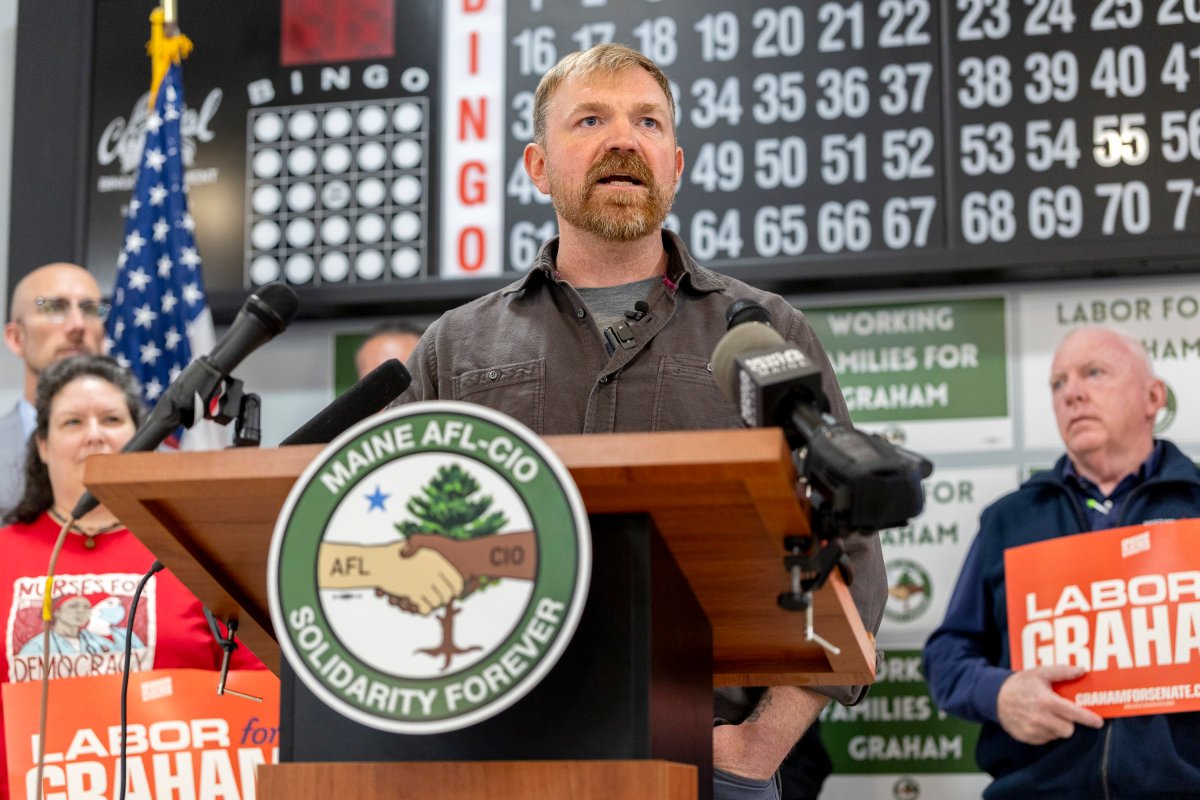
When Gov. Janet Mills suspended her U.S. Senate campaign last week, making political newcomer Graham Platner the presumptive Democratic nominee, campaign donors responded enthusiastically.
Since Mills announced her decision last Thursday, Platner has raised about $1.5 million, his strongest fundraising week to date, his campaign exclusively told the Press Herald on Tuesday.
That’s half of the $3 million his opponent, U.S. Sen. Susan Collins, raised in the first three months of the year in a must-win race for both parties.
Platner Campaign Manager Ben Chin said in a written statement they would continue to seek small-dollar donations and rely on a grassroots movement against the 73-year-old Collins and Republican-aligned groups.
“From the start of this campaign, Graham has taken on the establishment and proven that working people can compete with powerful interests,” Chin said. “As the general begins, we’re going to continue to do just that, and we’re raising the resources necessary to defeat Susan Collins.”
The surge of financial support comes at a crucial time for the 41-year-old oyster farmer and combat veteran from Sullivan who was virtually unknown when he burst onto the scene last summer.
In the first three months of the year, Platner’s campaign spent more than it took in for the first time since he entered the race last August, campaign finance records show. His campaign spent more than $5 million while raising just north of $4 million, from Jan. 1 through March 31.
Despite being in the red for the quarter, he ended the period with $2 million in cash as he pivots toward the general election against Collins, a resilient five-term incumbent whose reelection is vital for Republican hopes of maintaining control of the U.S. Senate.
Platner, who has raised $12 million, has surpassed both Mills and Collins in each reporting period since entering the race.
Collins raised $3 million in the first quarter of the year, while Mills raised nearly $2.7 million.
But Collins has $10 million in cash on hand, which is twice as much as she had at this point during her improbable 2020 reelection.
“The Collins for Senator campaign is in a powerful position as we head toward the general election,” Amy Abbot, Collins’ campaign finance director, said in a written statement.
“Support from Republicans, Democrats, and Independents in all 16 counties,” Abbott continued, “reflects broad confidence in Senator Collins’ record of delivering results for Maine and a clear rejection of the false and negative attacks already being funded by out-of-state dark money groups.”
Collins’ campaign said contributions have been “strong and steady” and that the campaign has seen a surge in interest since Platner became the presumptive nominee. However, it did not provide specifics.
Platner’s aggressive spending shows how the campaign is still trying to introduce the political newcomer to voters through the state.
Although recent polling has shown him with a narrow lead over Collins, 20% of people surveyed in March by Emerson College said they don’t know enough about Platner to form an opinion of him.
Platner overcame a last-minute barrage of negative advertising by Mills focusing on his old Reddit posts and his since-covered tattoo of a Nazi image. He not only ran ads about his personal growth, but other positive ads about his biography and populist messaging.
Candidate spending will likely be eclipsed by outside groups, who are lining up for and against Collins, who chairs the powerful Senate Appropriations Committee.
Collins’s allies have picked up Mills’ attacks on Platner’s past and have far more money and time to prosecute their case against him. Republican-aligned groups have reserved about $64.2 million in TV, digital and radio ads — three times more than the Democrat-aligned groups, according to AdImpact.
Democrats are bullish about unseating Collins, but she has defied the odds before.
Not only did she win in 2020 after trailing in almost every poll, but she did so while being outspent by a more than 2-to-1 margin by her Democratic opponent, Sara Gideon.
Gideon, a former speaker of the state House of Representatives, spent $63 million in her unsuccessful bid to unseat Collins. The Republican incumbent spent $28.4 million enroute to winning by 9 points and outperforming President Donald Trump by 18 points.
A lack of financial resources was not an issue with Gideon. She ended the cycle with about $11.6 million in cash.
Collins, meanwhile, spent $1.3 million more than she raised in the 2020 cycle, though she also ended the campaign with more than $1 million in cash.

We invite you to add your comments. We encourage a thoughtful exchange of ideas and information on this website. By joining the conversation, you are agreeing to our commenting policy and terms of use. More information is found on our FAQs. You can update your screen name on the member's center.
Comments are managed by our staff during regular business hours Monday through Friday as well as limited hours on Saturday and Sunday. Comments held for moderation outside of those hours may take longer to approve.
Join the Conversation
Please sign into your CentralMaine.com account to participate in conversations below. If you do not have an account, you can subscribe here. Questions? Please see our FAQs.