

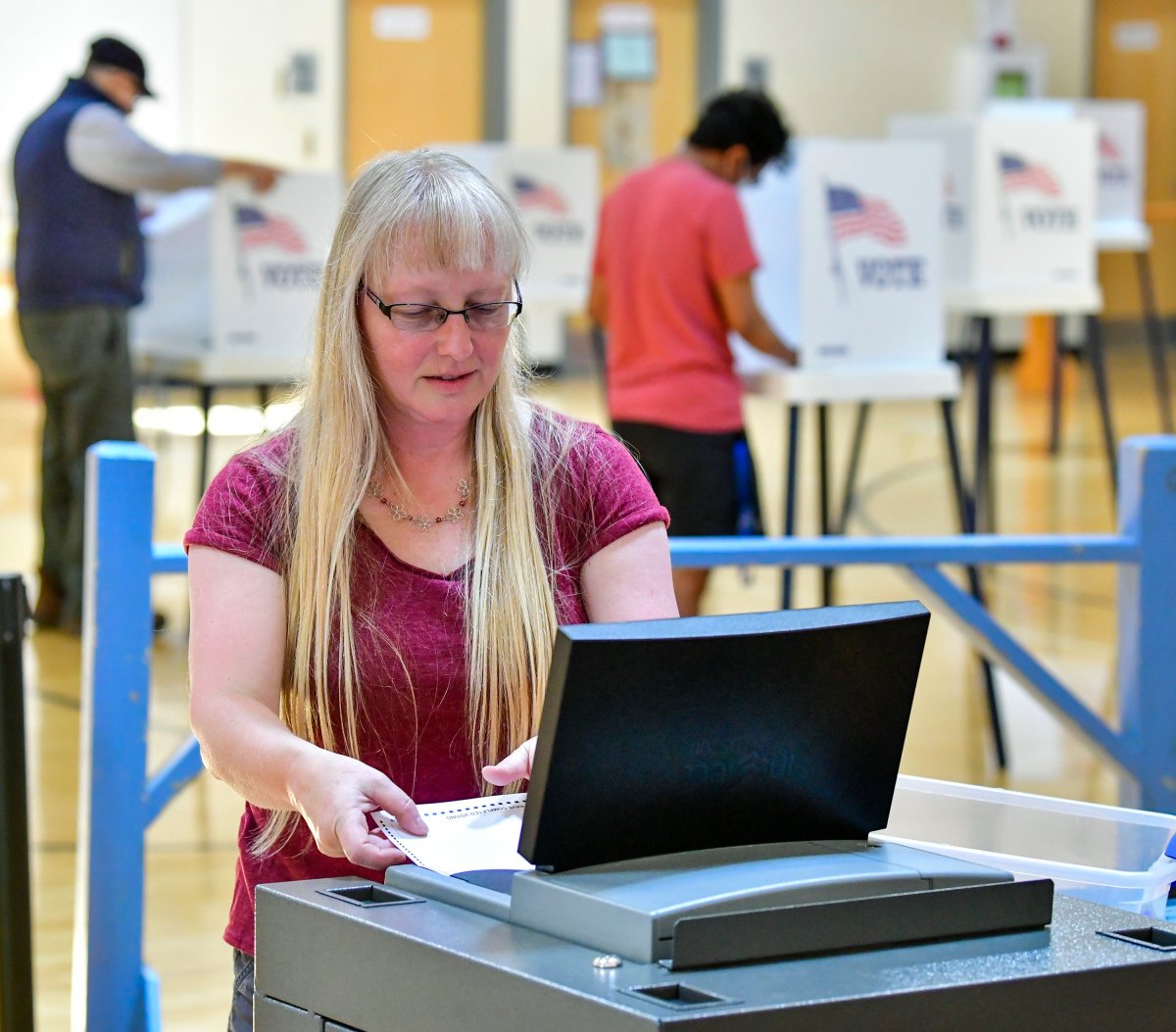
Absentee voting is underway ahead of Maine’s June 9 primaries. That means voters can start casting ballots in the races for U.S. Senate, U.S. House and governor, along with local races.
The Democratic primary for Senate has generated lots of interest both in Maine and nationally. The winner will take on U.S. Sen. Susan Collins in a November match-up that could determine which party controls the upper chamber in Washington, D.C.
But most of the heat was taken out of the race last month when Gov. Janet Mills suspended her campaign, all but ceding victory to political newcomer Graham Platner.
Meanwhile, the governor’s race is wide open and features a crowded field of five Democrats and seven Republicans. With no clear front-runners, it’s almost certain that ranked-choice voting will determine the winners.
Here are a few things to know about who’s on the ballot and how to absentee vote.
WHO’S ON THE BALLOT?
The Democratic primary for U.S. Senate will feature Platner, a veteran and oyster farmer from Sullivan, and David Costello, a former state and federal government worker from Brunswick.
Mills’ name also will appear on the Democratic primary ballot since her decision to drop out of the race came after the March 31 deadline for candidates to have their names removed. Mills has yet to formally notify the secretary of state’s office that she is withdrawing from the race, which means that, as of Friday, any votes cast for her will still be counted.
A candidate must formally withdraw for the secretary of state to prepare notices to be posted at polling places and distributed with absentee ballots to let people know a vote for that candidate won’t be counted.
In the Republican Senate primary, Collins is the only candidate on the ballot.
The governor’s race features 12 candidates. Those in the Democratic primary are: Shenna Bellows, Maine’s secretary of state; Troy Jackson, former Maine Senate president; Angus King III, a renewable energy entrepreneur and the son of U.S. Sen. Angus King; Hannah Pingree, former speaker of the Maine House and daughter of U.S. Rep. Chellie Pingree; and Nirav Shah, former director of the Maine Center for Disease Control and Prevention.
Candidates in the Republican primary are: Jonathan Bush, a businessman and cousin of former President George W. Bush; Bobby Charles, a former U.S. assistant secretary of state; David Jones, a real estate broker; Garrett Mason, former Maine Senate majority leader; Owen McCarthy, a medical technology entrepreneur; Ben Midgley, a former fitness franchise executive; and Robert Wessels, a retail manager from the town of Paris.
State Sen. Jim Libby, R-Standish, ended his campaign after failing to qualify for clean elections funds. But like Mills, he has not formally withdrawn and will still be on the ballot.
In the 1st Congressional District, U.S. Rep. Chellie Pingree is running unopposed in the Democratic primary. Republicans Joshua Pietrowicz, a former Toyota sales and leasing consultant from New Gloucester, and Ron Russell, a retired U.S. Army veteran and consultant from Kennebunkport, are vying for their party’s nomination.
And in the 2nd District, Democrats Joe Baldacci, a state senator from Bangor; Matt Dunlap, the state auditor and former secretary of state; Jordan Wood, a former congressional staffer; and Paige Loud, a social worker and graduate student, will compete in the primary. Former Gov. Paul LePage is the only Republican on the ballot.
All 186 seats in the Maine Legislature are up for grabs this year, though most primaries are uncontested. Voters will also decide school budgets and other local issues and races in June.
WHO CAN VOTE IN THE PRIMARIES?
Maine has had semi-open primaries since 2024, meaning that unenrolled voters can participate in the party primary of their choice. Voters who are enrolled in a party may only vote in that party’s primaries.
Enrolled voters who want to unenroll or switch parties must do so by May 26 (15 days prior to the election) in order to cast a ballot under their new affiliation in this year’s primaries. When a voter enrolls in a new party, they may not change their enrollment again for three months unless they move to a new municipality and establish a new voting residence there.
About one-third of Maine’s 1 million registered voters are unenrolled, so they could have a big impact on the outcome in the primaries.
HOW DO I REQUEST AN ABSENTEE BALLOT?
Maine has same-day voter registration at the polls, but voters looking to register online or by mail must do so by May 19 in order to participate in the June primary. For those registering by mail, your town or city clerk’s office should receive your registration by the close of business on the 19th. Online registrations should be completed before 5 p.m. that day.
Absentee ballots can be requested online through the Maine secretary of state’s office or by submitting a paper application or making a telephone request with your municipal clerk.
Municipalities are also required to offer in-person absentee voting starting 30 days before an election, but days and times vary by community. Voters can pick up, complete and return their ballot all at once. You can find out more about the days and times your municipality offers in-person absentee voting by contacting your town office or city clerk’s office.
The deadline to request an absentee ballot or vote in-person absentee is June 4.
HOW DO I RETURN MY ABSENTEE BALLOT?
Ballots must be returned by 8 p.m. on Election Day. Ballots can be returned in-person, via drop box or by mail. The Maine secretary of state’s office has advised that voters returning their ballots by mail should put their ballots in the mail no later than seven days prior to the election.
HOW WILL RANKED-CHOICE VOTING FACTOR IN THIS ELECTION?
Ranked-choice voting, which was first used in statewide elections in Maine in 2018, allows voters to rank candidates in order of preference in races featuring three or more contenders.
If no candidate gets more than 50% support in the first round, then the last-place finisher is eliminated, the second-choice votes of that candidate’s supporters are reallocated to the remaining candidates and the results are retabulated. The process repeats until a winning candidate receives more than 50% support.
Both primaries in the governor’s race and the Democratic primary in the 2nd District are likely to be decided using multiple rounds of tabulation.
For voters who want to learn more about the process and strategy behind ranked-choice voting, there are two upcoming events that could be helpful.
On May 12, the conservative organization Lead Maine and the Maine Republican Party will lead a conversation on ranked-choice voting at 6:30 p.m. in Lewiston. (Location provided with RSVP online.)
The Portland Public Library and Maine secretary of state’s office will also hold a nonpartisan mock ranked-choice election and informational session at the library’s downtown branch, at 5 Monument Square, at 10:30 a.m. on Saturday, May 23.

We invite you to add your comments. We encourage a thoughtful exchange of ideas and information on this website. By joining the conversation, you are agreeing to our commenting policy and terms of use. More information is found on our FAQs. You can update your screen name on the member's center.
Comments are managed by our staff during regular business hours Monday through Friday as well as limited hours on Saturday and Sunday. Comments held for moderation outside of those hours may take longer to approve.
Join the Conversation
Please sign into your CentralMaine.com account to participate in conversations below. If you do not have an account, you can subscribe here. Questions? Please see our FAQs.