

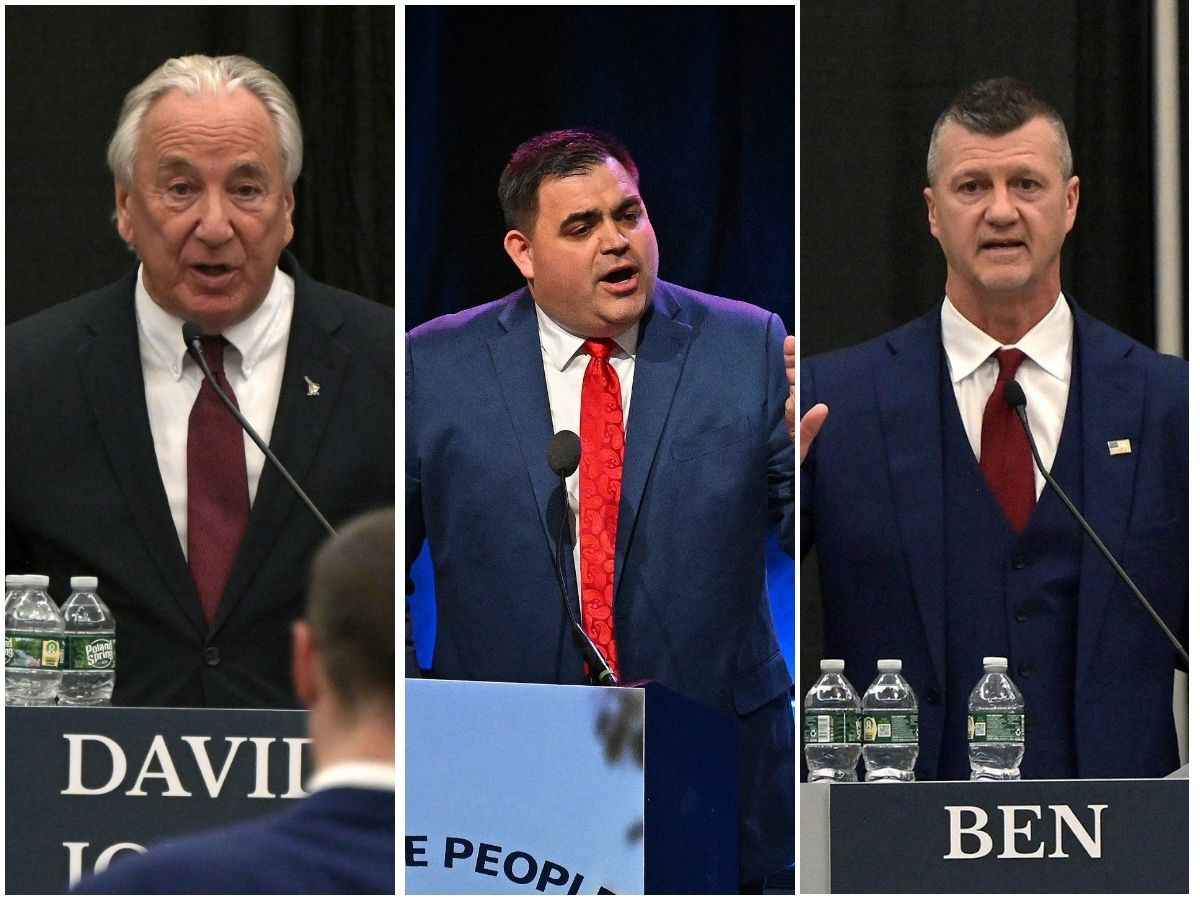
Before he was in politics, David Jones led a large real estate company. Owen McCarthy was the founder of a medical technology firm. And Ben Midgley was the head of two fitness franchise companies.
The trio, none of whom have ever held political office, each say Maine’s next governor should be a businessman, and are pitching themselves as outsiders whose experiences in the business world makes them the best pick to succeed Democratic Gov. Janet Mills.
In a crowded field with no clear front-runner, it remains to be seen how each will fare in the June 9 election, which will almost certainly be determined by multiple rounds of automatic runoffs in Maine’s ranked-choice voting system.
Jones and Midgley have also formed an alliance, announcing in a recent debate that each of their supporters should rank the other second on their ranked-choice ballots. (Robert Wessels, a former selectman in the town of Paris, has urged his supporters to back Jonathan Bush second.)
Bobby Charles, an attorney and former official in the federal government, has led early polling, while Bush, a cousin of former President George W. Bush, leads in fundraising. Bush is also leaning into his business record, but unlike the other three, is part of one of America’s most prominent political families, and has garnered national media attention for his run.
Garrett Mason, a former Maine Senate majority leader, is running on his experience as a lawmaker, and has benefited from millions of dollars in outside spending on his behalf.
The Republicans running on their business experience say they’ll bring new perspectives along with successful management and budgeting skills to the Blaine House.
“I want everyone to know how important it is we get a CEO who knows Maine, loves Maine and will make Maine great again,” Jones said at a recent debate.
DAVID JONES
Jones was watching a show with his grandchildren last May about the famous biblical tale of David, a young shepherd who bravely slays a giant, Goliath. His 5-year-old granddaughter turned to him and asked her grandfather if he also wanted to fight bad guys. If so, why?
“To make things better for me and all your other grandchildren?” the girl guessed.
The question solidified in Jones’ mind the answer to something he had been thinking about: a run for governor of Maine.
“I felt like, if I can make a difference, I should,” he said.
For Jones, a developer who owns F.O. Bailey, a real estate company, the desire to ensure opportunities for his children and grandchildren are a main reason he got in the race.
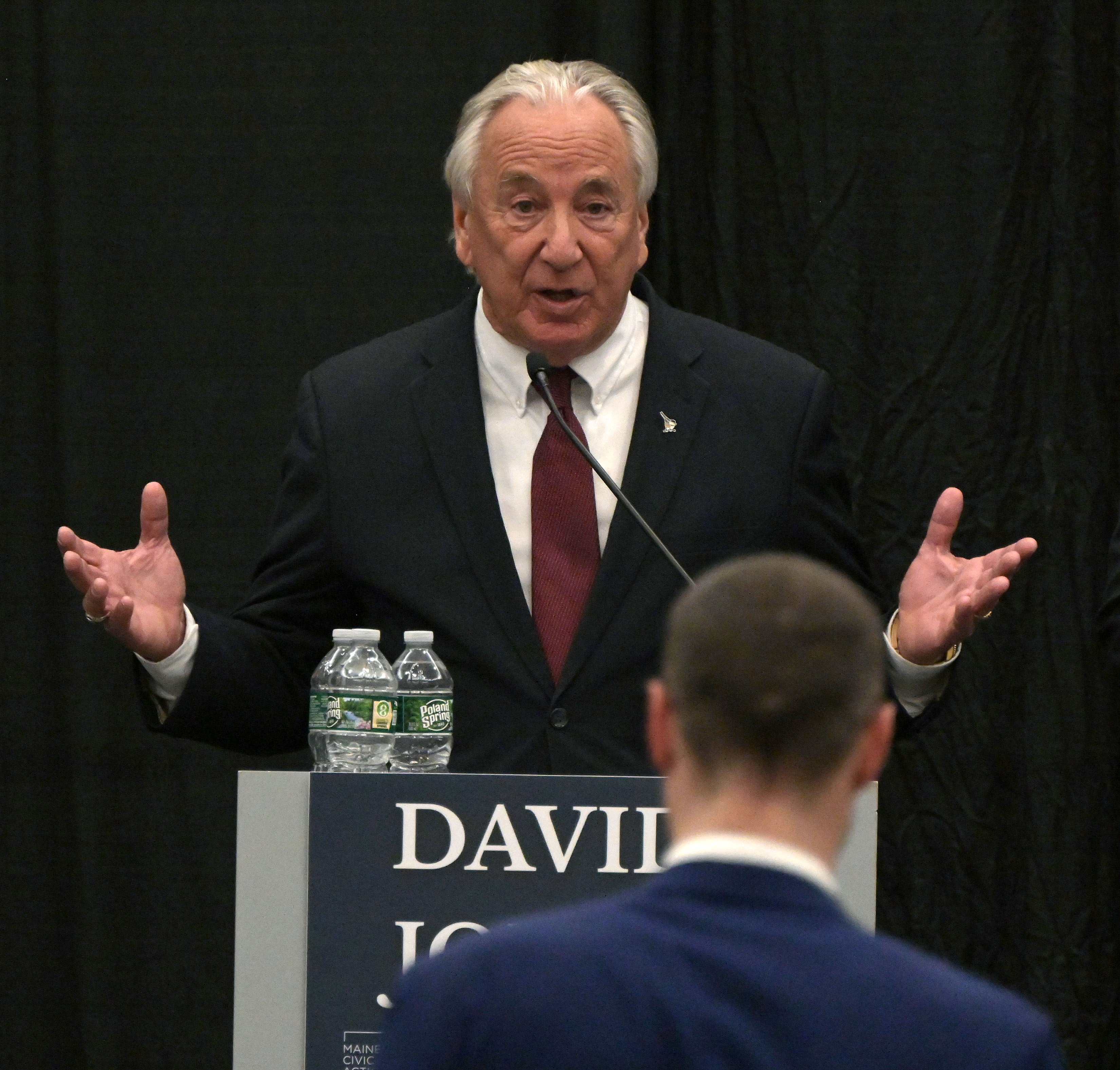
While he hasn’t held political office before, he’s had a front-row seat to Maine politics over the years. He raised money for President Donald Trump in 2016, served as a delegate to the Republican National Convention in 2024 and sued the state in separate lawsuits over COVID-19 lockdowns and ranked-choice voting in recent years.
“I’m the only candidate that has signed the front of the paycheck his entire life,” Jones said. “And then I’m the only guy that’s been involved in Maine politics in such a way that I understand everyone, whether it’s Democrats, Republicans or unenrolled.”
Jones, 70, grew up in New Jersey. After high school, he got in a car with a friend and moved to Florida, looking for a change. He got started in construction as a subcontractor, doing framing work on larger projects.
Soon, Jones said he was building houses and apartments, and he hired a couple people to help. Then it was bigger projects, like high-rises and shopping centers, and 1,100 employees.
He married his wife, Nancy, with whom he now has six children and eight grandchildren.
In the late 1990s, Jones relocated his family from Boca Raton to Embden, Maine. He wanted a change of pace again, and Maine seemed like a better place to raise a family than Florida.
In Maine, Jones continued work in construction and real estate, eventually moving to Falmouth and buying F.O. Bailey about 15 years ago.
Along the way, he dabbled in Maine politics, saying he was always interested in trying to get good people elected and finding ways to help Maine better itself. He ran for governor in 2006 as an independent, but withdrew before the election.
In 2015, Jones founded a political action committee, the Making Maine Great Again PAC, to raise money for Trump’s 2016 presidential campaign.
“He’s the original Trumpster in Maine,” said Ray Richardson, host of the conservative Ray Richardson Show on WLOB Radio. “He’s a Trump guy through and through.”
Jones has appeared as a regular guest on Richardson’s show for years. In 2020, he was among a handful of business owners to sue the state over COVID-19 restrictions that they said were hurting businesses.
The suit was unsuccessful. So was a challenge to the legality of ranked-choice voting around the same time.
But Jones said the efforts were worth it. “If you see something wrong, you have to try and stop it,” he said. (He said he still opposes ranked choice voting, but decided to encourage its use in this race by forming an alliance with Midgley because the system is in place, and will factor into the election.)
Rep. David Boyer, R-Poland, got to know Jones while working on Ron Paul’s presidential campaign in 2012 out of an office that was across the street from F.O. Bailey. Boyer, a supporter, said he likes that Jones has a “libertarian streak,” citing, for example, Jones’ early support of marijuana legalization efforts in Maine.
Jones brings the right mix of political outsider and knowledge of the state, he said.

“He’s an outsider but he didn’t parachute in here from D.C. or another state,” Boyer said. “He’s been here and he has a record of supporting conservative policies and positions.”
If elected, Jones said improving educational outcomes is a top priority, though he would end Maine’s free community college program, saying students should “have skin in the game” if they want to go to college. He also wants to improve the atmosphere for businesses, including by eliminating unnecessary regulations.
He has said he wants to eliminate property taxes by increasing the Maine homestead exemption on primary residences and by reining in state spending, with the savings redirected to covering property tax costs.
“Being governor is going to be a lot of hard work, and anyone who knows me knows I’m 24/7, 365,” Jones said. “I never stop. It’ll be the same way if I’m governor.”
OWEN MCCARTHY
A March debate among Republicans running for governor at the Cross Insurance Center in Bangor kicked off with a round of quick questions.
Candidates were asked about their fundraising strategies, political experience and careers. When he got to Owen McCarthy, moderator Steve Robinson started with a statement.
“Everyone I’ve talked to really likes you,” he said.
Then he got to the question.
“You’re too nice for the blood sport that is politics,” Robinson said. “Are you ready for prime time? Are you ready for a general election fight?”
McCarthy pushed back with a definitive yes. He rallied the crowd first, asking, “Who’s ready to win in 2026?” to a round of applause.
“I might seem nice, and I might seem kind,” he said. “But I’ve fought for everything I’ve ever gotten.”
McCarthy, 38, is the youngest candidate for governor from either party. The co-founder and former president of MedRhythms, a Portland-based medical technology company, he’s pitched himself as an entrepreneur and innovator with roots in rural Maine.
On the campaign trail, McCarthy talks about getting in the race to make a better future for Maine. His 72-page blueprint for policy plans, called Maine 2040, was developed with his 5 and 3-year-old sons in mind.

A native of Patten, a small town in Penobscot County, he was the first in his family to go to college, studying engineering at the University of Maine.
“I don’t think the next generation of Mainers has the same opportunity I had,” he said in a recent interview.
After college, McCarthy attended Harvard Business School. He co-founded MedRhythms with Brian Harris, a friend who also attended UMaine and moved to Boston. The company specializes in devices that use music to trigger a motor system response and treat conditions such as stroke and Parkinson’s disease. McCarthy and Harris relocated the business to Portland in 2016.
While he hasn’t held political office before, McCarthy served on the University of Maine System Board of Trustees from 2023 to 2025.
His plans include an immediate 10% income tax cut and complete phase-out within eight years, and he’s talked a lot about adding jobs and growing the economy — both in traditional Maine industries like maritime work and forest products, and in new sectors like remote jobs.
McCarthy said his administration would work with President Donald Trump, but he would also push back on any federal changes or cuts that hurt Maine.
“I’d do that with any president — whether it’s Trump or if, in two years, it’s a different president,” he said.
Harris said he wasn’t surprised to hear his friend was getting into politics. McCarthy has always been passionate about Maine, and is a hard worker, he said.
“Owen has always been somebody who is motivated and excited by challenges, and complex challenges,” Harris said. “I think (being governor) is a good fit for him in that way, because it’s Maine and complex challenges — that will be the world he lives in.”
BEN MIDGLEY
Midgley got his start in the fitness industry cleaning machines in exchange for a gym membership.
A college dropout, he worked his way up in the business, though it didn’t come without struggle. At one point, he was on unemployment and receiving food stamps.
Midgley said the hard times were also a motivator. Over the next 30 years, he became president of the Planet Fitness chain and co-founded Crunch Fitness, leading the company as it grew to 500 locations in 46 states and six countries.
After retiring in 2024, Midgley said he was looking for a way to give back to his home state. Last August, he launched a bid for governor.
“I think I have a different perspective on how to help people effectively,” he said.
In the crowded primary, Midgley has distinguished himself with the backing of some key political allies. Members of former Republican Gov. Paul LePage’s inner circle, including his daughter, Lauren LePage, and long time advisor, Brent Littlefield, are working for Midgley.
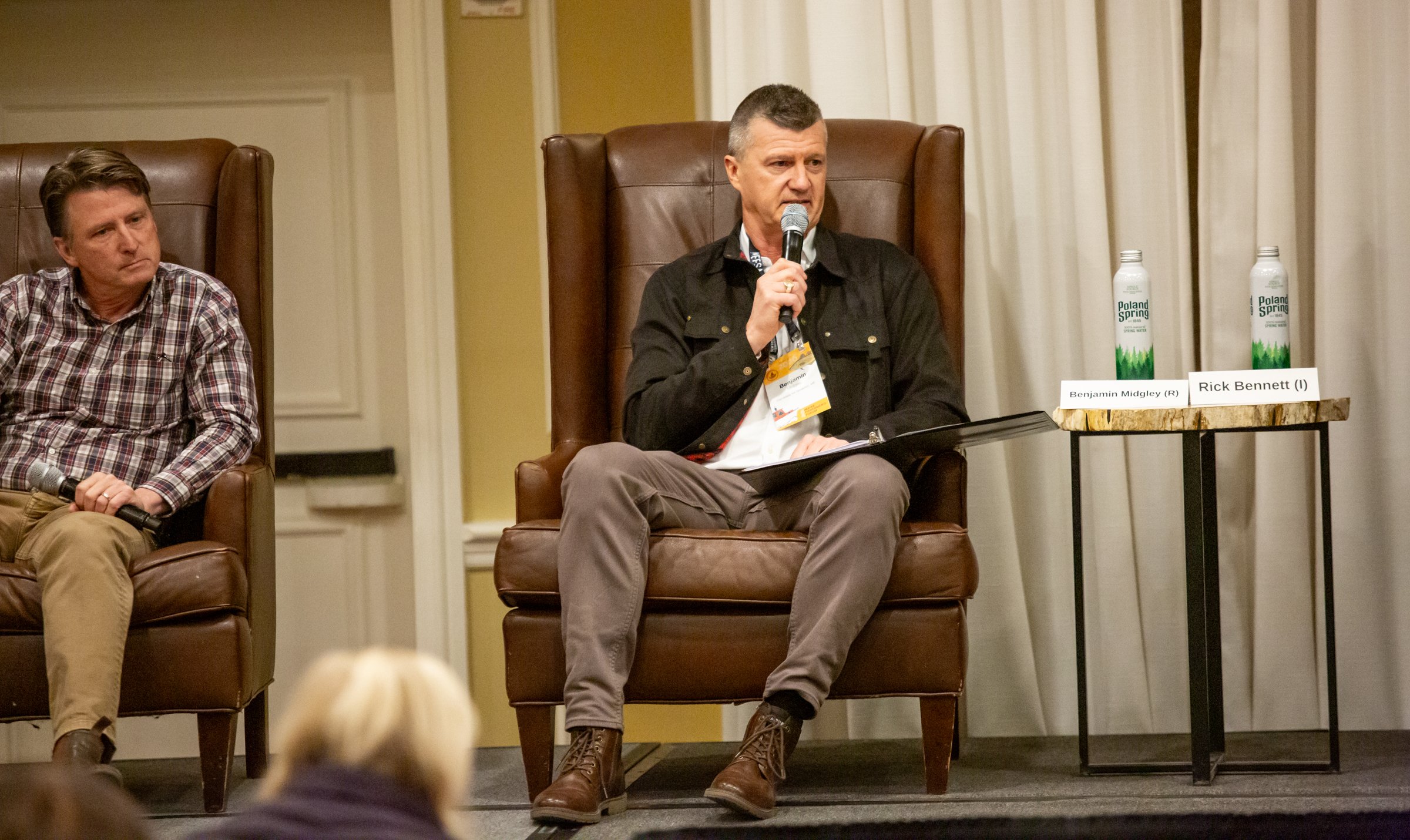
He also has the support of Maine House Minority Leader Billy Bob Faulkingham, R-Winter Harbor, and Assistant Senate Minority Leader Matthew Harrington, R-Sanford, Lauren LePage’s husband.
Midgley’s campaign could be gaining momentum at a critical time. He’s led or come in second in a handful of unofficial straw polls recently, and he had the most cash on hand at the close of the latest fundraising period, thanks in large part to a $500,000 loan to his own campaign.
And in another sign his campaign could be rising, an anonymously-sourced website, midgleyexposed.com, is attempting to discredit Midgley with conservatives by painting him as a “woke gym CEO” and former Democrat. Midgley’s campaign has filed a complaint with the state campaign finance watchdog, according to the Bangor Daily News, blaming Charles for the site.
Midgley hasn’t been shy about the fact that he’s a former Democrat. When he was 18, his mother took him to their town hall and told him to register that way, he said. He became a Republican a decade ago, saying he felt the party was more aligned with the things he valued like preserving American jobs, bringing costs down for people and keeping politics out of schools.
A native of Kennebunk, Midgley, 56, went to California for college but ended up returning to Maine and attending the University of Southern Maine. College was a struggle, and it was hard to afford, Midgley said, so he turned to forging his own career path. He never graduated.
Along the way he married his wife, Sonia, with whom he has three children, the youngest of whom is in high school.
His supporters point to his success in the fitness industry as a key reason they back him.
“In the beginning he needed a job,” Faulkingham said. “Now 15,000 people have jobs because of him. That’s the type of executive experience we need.”
Midgley said he agrees with many of former Gov. LePage’s policy positions, but that stylistically the two are very different. While LePage often made headlines for his brash comments, Midgley is more measured, drawing attention, for example, for his binder full of organized notes and pull-tabs on the debate stage.
On the campaign trail, Midgley has advocated for welfare reform but said he wants to do so in a way that helps recipients transition off of benefits in a sustainable way.
“The goal is not just to cut the spending, but to help people do better,” he said.
Other priorities include eliminating waste in the state budget and increasing oversight to stop fraud. On housing affordability, he wants to address cost-prohibitive regulations that are preventing more homes from being built and speed up the permitting process.
In a field where several candidates are pitching themselves as the outsider who can reform Augusta, Midgley said his personal experience and success as a job creator make him stand out. He also said he’s willing to work with everyone.
“It doesn’t matter who the smartest people are, whether they’re Democrats, Republicans or independents,” Midgley said. “You have to get the best ideas and get the policies in place that will do the most good for the most amount of people.”

We invite you to add your comments. We encourage a thoughtful exchange of ideas and information on this website. By joining the conversation, you are agreeing to our commenting policy and terms of use. More information is found on our FAQs. You can update your screen name on the member's center.
Comments are managed by our staff during regular business hours Monday through Friday as well as limited hours on Saturday and Sunday. Comments held for moderation outside of those hours may take longer to approve.
Join the Conversation
Please sign into your CentralMaine.com account to participate in conversations below. If you do not have an account, you can subscribe here. Questions? Please see our FAQs.