


They drove to the mill from all directions — firefighters rushing to help Searsmont fight a blaze at Robbins Lumber.
Neighboring departments are used to answering calls, and nearly all of the firefighters who arrived just after 10 a.m. were volunteers. Some showed up in their own vehicles, straight from their day jobs. Some put on the gear they keep with them. Others went to firehouses to get fire trucks and water tankers.
“There wasn’t any indication this was a hard call,” said Captain Kevin Callahan from nearby Appleton.
Then, a silo full of wood shavings blew up.
“There’s been a huge explosion! The silo just exploded! Multiple firefighters injured and burning,” a man said urgently on radio traffic.
The smoke got heavy and black.
Debris from the structure, the contents of the silo and the fire rained down on Montville firefighter Jacob Spaulding, according to a report provided by the town.
Searsmont fire Chief James Ames told the Midcoast Villager the blast “blew me 15 feet right through the air.” Belmont volunteer firefighter Katherine Paige was badly injured as she’d been waiting to go into the basement of the silo, her chief told Maine Public.
Almost immediately, at 11:04 a.m., LifeFlight was called in for urgent trauma care.
“I thought everybody had died,” Callahan said. “All I saw was the silo go up, the silo come down.”
Firefighters staggered out, he said, while others were dragged away from the flames by fellow first responders. Three fire trucks went up in flames.
“It was like the gates of hell opened up in Searsmont,” Callahan said.
ALL-CALL
The fire at Robbins Lumber on May 15 drew first responders from dozens of towns and is now under investigation by state and federal authorities. It has left a lasting impact across the Midcoast region and firefighting communities beyond Maine. One person died trying to put out the blaze; others are expected to be in the hospital for months.
This account of the day’s events draws from interviews, public statements, local records and on-the-ground reporting.
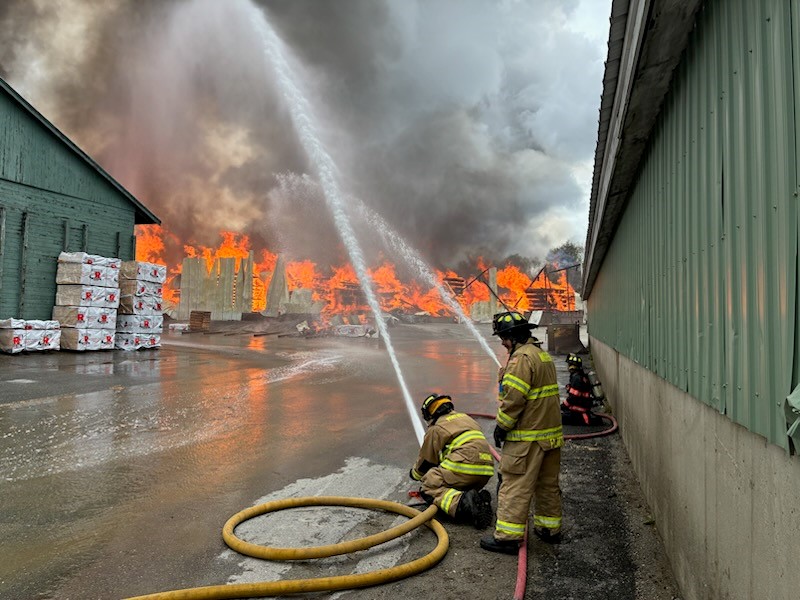
The burning silo landed on a warehouse that Bill Gillespie, the Liberty fire chief, was later told was holding more than 4 million board feet of pine, piled five or six stories high.
Robbins Lumber has been selling pine since 1881. On the day of the fire, it acted as fuel — pine burns hot and fast.
“We need more help here now, immediately,” a man, who Gillespie later identified as a Montville fire member, said on the radio.
“There were explosions popping off all over the place,” Gillespie said.
After the radio call for more help, a man’s voice responded saying they were on the way and he had an ambulance to offer.
“We need more than that,” the first voice said.
That day, 26 agencies responded. Union was part of the second wave. Fire Chief Jesse Thompson wrote to his town’s select board that his two rescue crews arrived to find what he called “an unbelievable site.”
Spaulding’s girlfriend, Natalie, was there when the explosion happened and saw him emerge from the fire. She got him into a car and started driving to a hospital, according to a fundraiser for his medical care. An ambulance intercepted them on the road and took him the rest of the way. At Maine Medical Center he was put on a ventilator, his family wrote on Facebook.
Meanwhile, there was concern the black smoke billowing out from the burning warehouse and filling the sky would block LifeFlight helicopters. A spokesperson said later that the smoke wasn’t an obstacle and the pilots landed safely. Two helicopters had left from their bases in Bangor and Lewiston and touched down within 100 feet of the fire to transport patients with severe burns.
Another worry — a potential secondary threat — appeared. Near the burning warehouse and silo were fuel tanks. Gillespie, who is also president of the Maine Fire Chiefs’ Association and had taken charge on the ground, thought the fuel tanks could explode, which made containment even more urgent.
A crowd of bystanders was building up and, for their own safety, fire crews started to move them back. On a ridge above town, dozens more people gathered to watch the smoke.
“This has been one of the hardest calls that I have had to deal with as a chief,” Thompson, from Union, told the select board.
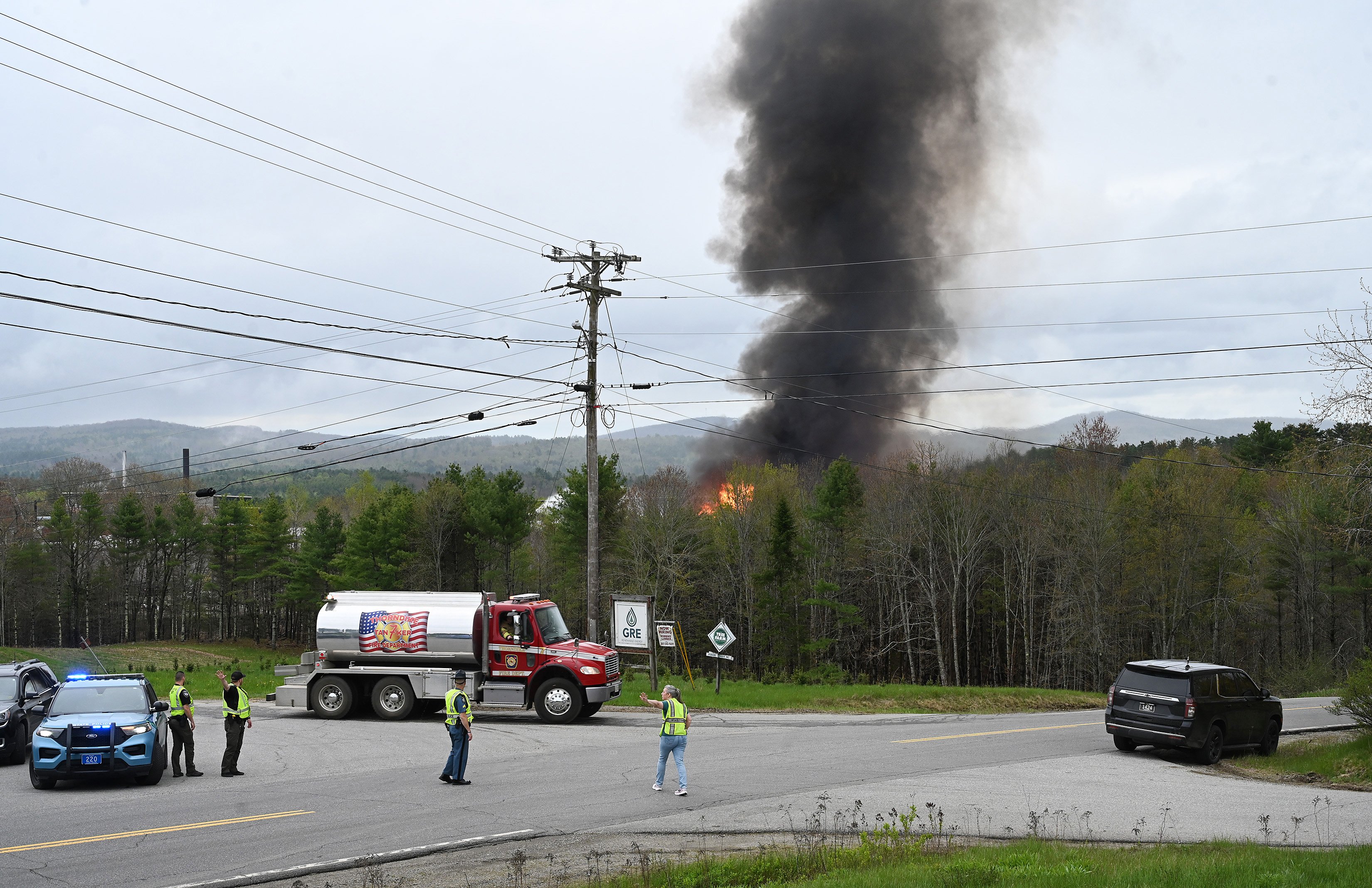
Water was another challenge. Robbins Lumber has a hydrant system, Gillespie said, but not every hydrant was working, and the ones that were couldn’t pump nearly enough water. They drafted from farm ponds and sent tankers to the river.
Firefighters were able to make curtains of water by spraying it across a roof, creating a barrier for the heat.
“There were probably six or seven buildings in the proximity that easily could have ignited had we not been able to get close enough,” Gillespie said.
Politicians started to publicly offer their thoughts and prayers. A statement from Gov. Janet Mills urged people to steer clear of the area and to make way for emergency responders.
She asked people in Maine to keep “all those affected in their thoughts.”
Around noon, a call came into the Red Cross office in Bangor. Caroline King, executive director for northern and eastern Maine, and her team quickly assembled water and snacks, and started calling volunteers. Within 10 minutes, they got in the car to meet up with volunteers in Rockland. Together, they caravanned to Searsmont with cots and blankets packed into a trailer.
As they mobilized, it started raining in Searsmont. It was coming down heavily, then slowed to a drizzle.
Robbins Lumber’s campus of more than 15 buildings is tucked between rolling, forested hills, inland from the Midcoast’s better known towns.The rain helped contain the risk of the fire spreading into the forests, said Jon Palmer, a National Weather Service meteorologist.
“The rain was definitely a good thing while it lasted,” Palmer said.
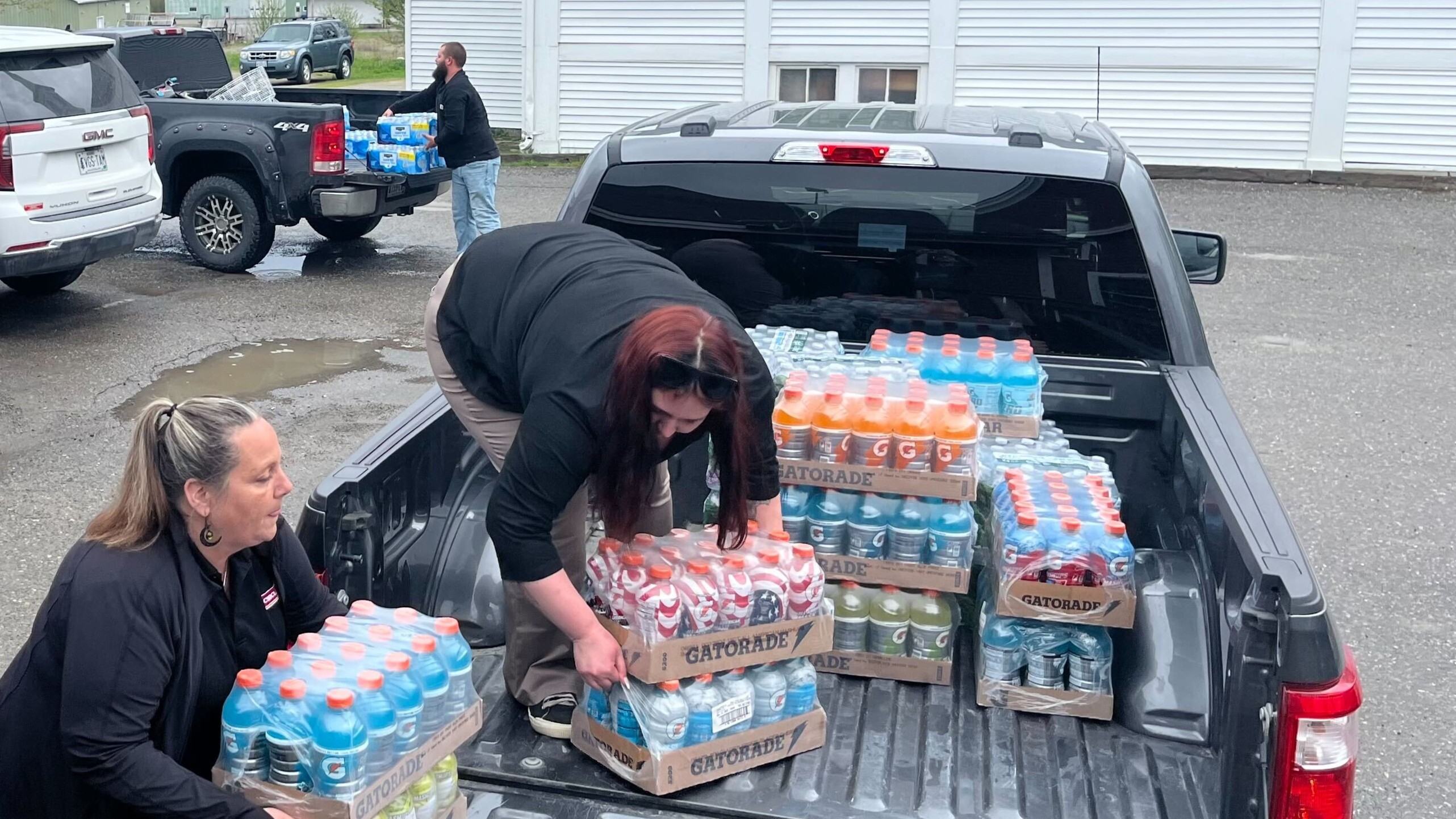
During the lunch rush at the Fraternity Village General Store in town, around the corner from the fire station, a customer asked if they would take donations to help the firefighters. People started to walk in, carrying water, Gatorade, snacks, and fruit. Some called from an hour away in Bangor to say they were bringing supplies.
As soon as the store could shuttle donations to Robbins Lumber, the back room would fill up again.
The longevity of the situation started to set in. At 12:48 p.m., the Camden Fire Department announced that it expected to be on site for several days.
LifeFlight was called in again, and sent four more crews to urgently transfer people to bigger hospitals with specialty burn units, a spokesperson said.
In the afternoon, the state fire marshal’s office focused on trying to account for all the firefighters who had shown up. Gillespie estimated it was more than 100, and the fire marshal wasn’t sure where they’d all ended up. They wanted to know if anybody was missing and what hospitals they had been taken to, deputy Joel Davis said.
Paige from the Belmont department had severe burns and was headed to Maine Medical Center in Portland, her husband Paul wrote on Facebook. Nine others had been sent to other hospitals, including Pen Bay and Waldo Hospital, then transferred to MaineMed.
But at least one person was still inside the debris.
THE ULTIMATE SACRIFICE
Two hours after the explosion, leaders on the ground figured out someone was missing. They started a search and within 20 minutes, Gillespie said, they found him.
The smoke had turned from black to gray and was blending into the clouds. A video posted on Facebook by Liberty Fire & Rescue shows dozens of firefighters and other crews stopped what they were doing, lined up in two rows, and saluted as six people wheeled a body draped in an American flag.
Andrew Cross was loaded into a vehicle. He was 27, and was a volunteer firefighter in Morrill, the same town he’d grown up in.
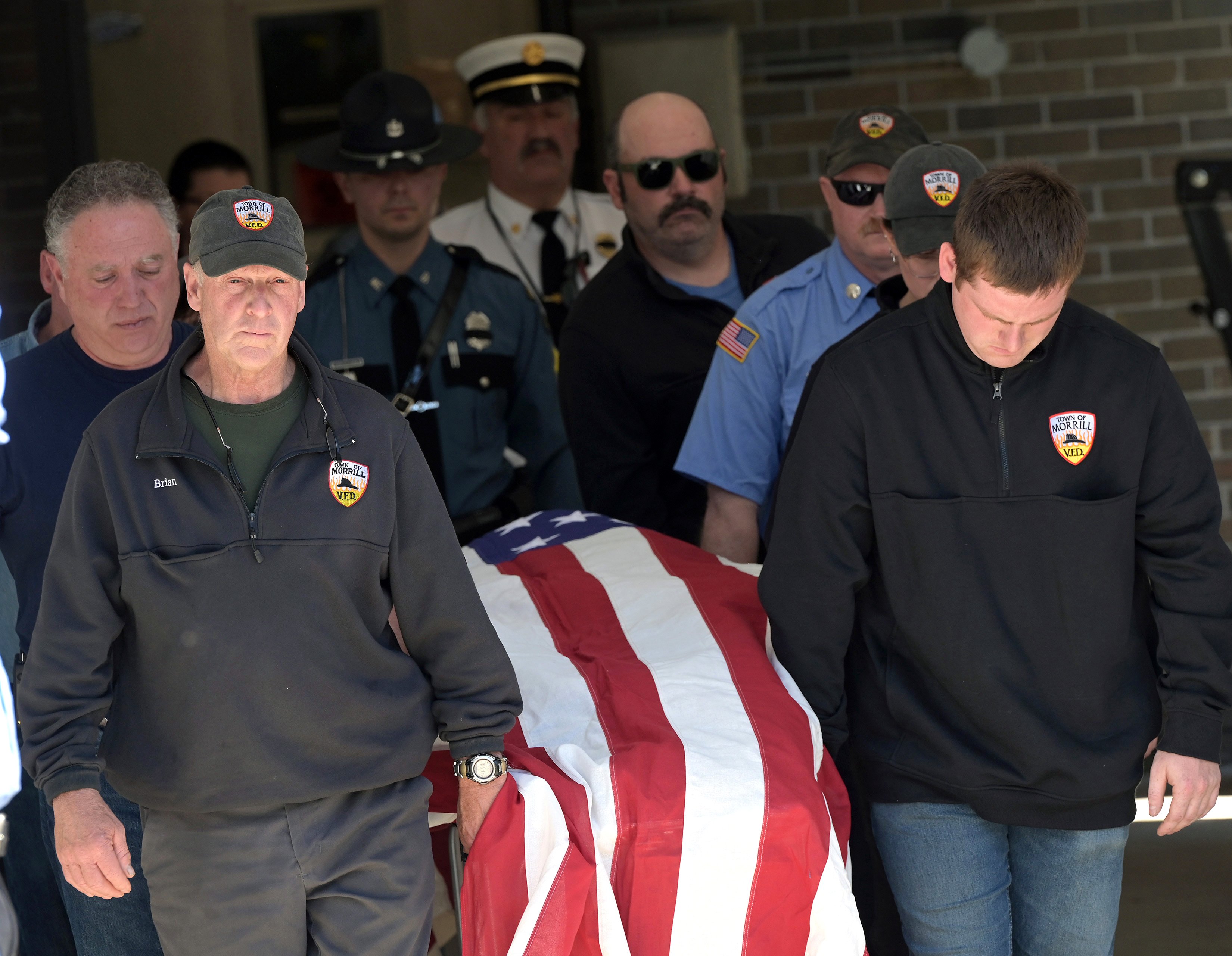
Callahan and other first responders helped take Cross’ body to the state medical examiner’s office. At about 7:45 p.m., as they pulled into Augusta, first responders and law enforcement officers lined the streets.
Callahan stood in his firefighting uniform, saluting, right next to the hearse.
The next day, Cross was returned to Waldo County, escorted by a procession of fire and emergency vehicles.
Cross worked as a machinist at Bath Iron Works, typically ending his shift at midnight. He “didn’t think twice” when the emergency call came in, Morrill’s fire chief said.
He was a “good, bright young man,” said Jethro Pease, who was Morrill’s fire chief when Cross joined. Cross was approaching his seventh anniversary at BIW. He loved having family and friends at his home for a big meal and to laugh and tell lots of stories, his obituary said.
He was always ready to help others, Pease added, so it made sense he did all he could to contain the fire.
RECOVERY BEGINS
On the day of the fire, firefighters stayed up all night. Red Cross volunteers did, too, serving food from a giant box truck with windows.
Just before 11 p.m., the state announced the fire was contained but said suppression efforts were still underway.
All day, a dalmatian named Halligan had rotated around the campus, getting hugged and petted, providing comfort. She’s not even 2 years old yet, said Timothy Nickels from Ember’s Paws of Hope, who brought her.
He and Halligan came back that weekend while first responders kept working on the fire and debriefed on what they’d seen. All weekend, Nickels said, Halligan wouldn’t take a break because she knew people needed support.
“All them up there have a very long road ahead of them,” said Nickels, a former firefighter and paramedic himself.

By that Sunday, Lincolnville Fire posted a “welcome home” message showing one of the injured volunteers, Aaron Heald, in front of a fire truck and a homemade banner. Below his boyish grin he held up both hands covered in bandages and splints.
The same day Katherine Paige’s husband, Paul, posted on Facebook that she was responding to his voice with nods and shrugs.
She’d need several surgeries and skin grafts, he wrote, and he was told she’d be in the burn unit for more than a month. By Tuesday, she was able to write “I love you” on a piece of paper, which he wrote moved him to tears.
The injured also include three members of the Robbins family, including co-owners Jim and Alden Robbins, as well as Alden’s daughter Lily, who is an EMS volunteer. They were taken to Massachusetts General Hospital, which confirmed Thursday it still had three patients in critical condition.
Doctors believe Sarah Tompkins, the EMS chief in Searsmont, will be in the hospital for months, said a fundraiser for her care. Her partner, Hubert McCabe, resigned as a Searsmont selectman to be with her. The wife of Thomas Wolf, a Searsmont firefighter and Robbins Lumber employee, will be away from work to support him through rehabilitation and recovery, said a fundraiser for him. His assistant fire chief, Wayne Woodbury, was also getting treated at Maine Medical Center as of the last official update.
The Maine fire marshal’s office and the federal Bureau of Alcohol, Tobacco, Firearms and Explosives are investigating the cause of the fire and explosion. Together they’ve done more than 150 interviews. They’ve used drones, cranes and other heavy equipment in what they called “an extremely labor-intensive operation” to get down to parts of the silo they can’t reach, and to map the scene.
Gillespie has barely let his mind release from operational mode. He said it was crucial to stay calm the day of the fire so he could help everyone else avoid panic. But he is not sure what all this will mean for the future of volunteer firefighting.
For more than a decade he’s been telling state legislators that Maine’s firefighting power is declining, and not enough people are stepping up to serve, leaving people across the state at risk.
“This event can either have a catastrophic effect on the fire service, where people are in fear based on the number of injuries,” he said, “or they’ll feel a civic responsibility to help.”
Later, reflecting on the day, Callahan said, “I’m one of the lucky ones. There are a lot of people who are not lucky and are hurting tremendously.”
For the first few days after the fire, Callahan said he broke down in tears every time he told the story of what happened. He said he wouldn’t describe what he feels as a broken heart — it’s beyond that.
“It’s a level of pain,” he said, “I’ve never experienced.”
Staff writers Dylan Tusinski, Sophie Burchell and Drew Johnson contributed to this report.


Comments are not available on this story. Read more about why we allow commenting on some stories and not on others.
We believe it's important to offer commenting on certain stories as a benefit to our readers. At its best, our comments sections can be a productive platform for readers to engage with our journalism, offer thoughts on coverage and issues, and drive conversation in a respectful, solutions-based way. It's a form of open discourse that can be useful to our community, public officials, journalists and others.
We do not enable comments on everything — exceptions include most crime stories, and coverage involving personal tragedy or sensitive issues that invite personal attacks instead of thoughtful discussion.
You can read more here about our commenting policy and terms of use. More information is also found on our FAQs.
Show less