

At debate after debate this year, Garrett Mason has made a pitch to voters that he’s different from the other Republicans running for governor.
He’s the only one to serve as a Maine lawmaker. The only one who has worked on a state budget and the only one to pass legislation on school choice and to lower income taxes.
“I am a proven conservative who has delivered results for you,” Mason said, addressing a TV audience at a recent forum hosted by WGME and the Bangor Daily News.
In the race for Maine governor, Mason, 40, is one of seven candidates vying for the Republican nomination and the chance to succeed Democratic Gov. Janet Mills, who is term-limited.
A former Maine Senate majority leader, he served eight years in the Legislature and runs two small businesses from his hometown of Lisbon. He has deep roots in the community, and national donors aligned with President Donald Trump have spent more than $4.2 million on his behalf.
All of that makes a compelling argument for Mason to be the Republican nominee, yet the race remains unsettled.
Attorney and former federal official Bobby Charles leads polling and has run an aggressive social media campaign, while Jonathan Bush, an entrepreneur and cousin of former President George W. Bush, has raised the most money and also polled ahead of Mason.
Other candidates — Ben Midgley, David Jones and Owen McCarthy — are the antithesis of Mason’s campaign. All businessmen with no elected experience, they say a political outsider with a background as a chief executive officer is needed to bring change to Augusta.
Mason, who also ran for governor in 2018, said he’s gained life experience since that first run at age 33. This time around, his relative youth is a benefit.
“I’m the only one on our side that has both the experience and, I feel, has the stake in the game to make the changes that will make young people stay,” he said.
FIGHTING FOR REPUBLICAN PRIORITIES
Mason studied business at Pensacola Christian College in Florida, and thought at the time he would go into sports management or advertising. When he returned to Maine in his early 20s, he interned for the Portland Sea Dogs then got a job in public relations with the former Lewiston MAINEiacs, a junior league hockey team.
While at that job in 2010, Mason learned about a new tax on entertainment tickets that lawmakers had passed. The team was worried it would be a hit to fans, so he got involved in a repeal effort.
The measure, which also contained other tax changes, was successfully repealed with 61% of the vote. It was while working on that issue that Mason decided he would also run for office.
“That was my moment where I was like, ‘I’m complaining about this. I should probably try and do something about it,'” he said. “So I did.”
At the age of 25, Mason defeated incumbent Sen. John Nutting, D-Leeds, amid a wave of midterm support for Republicans.
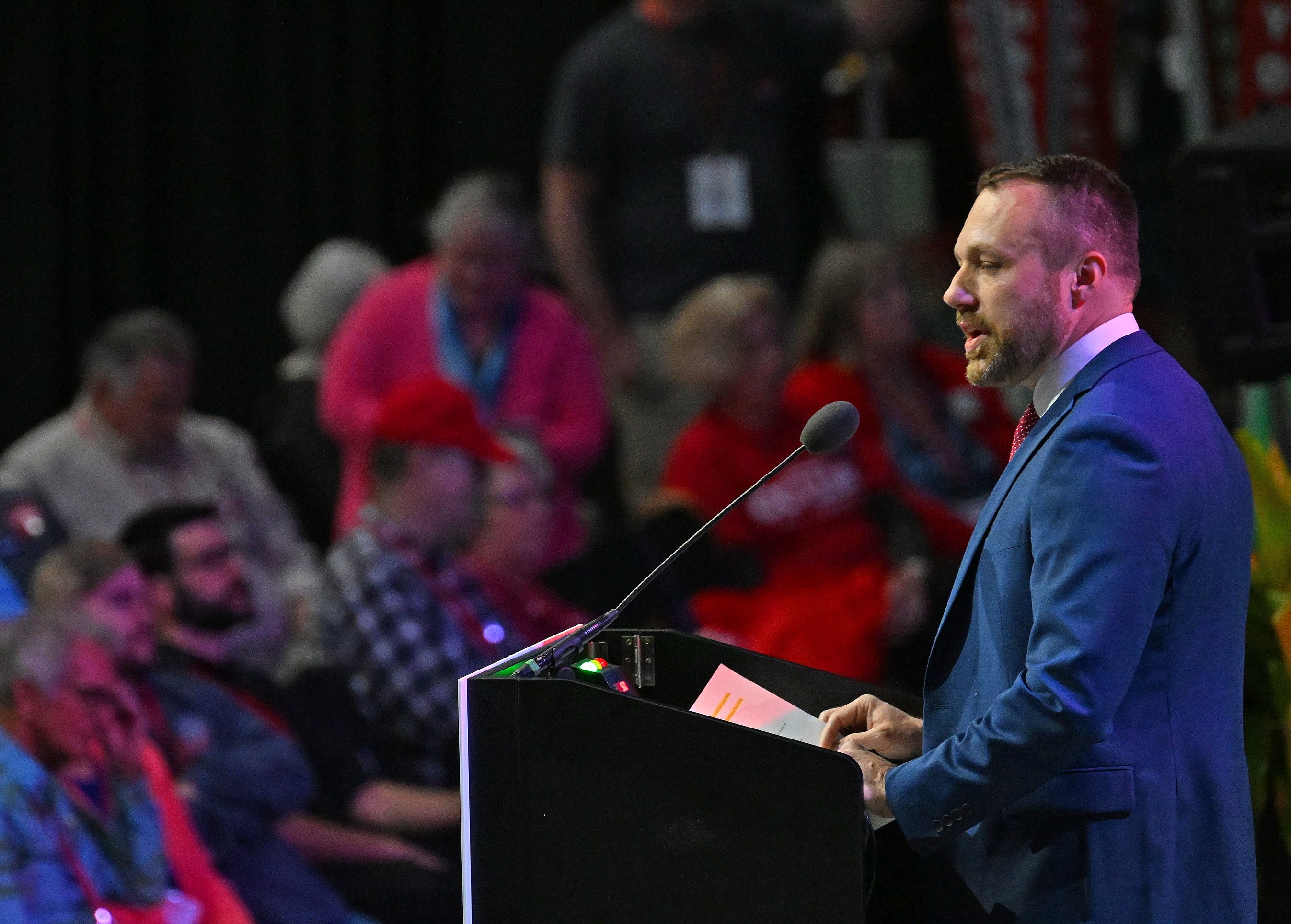
In 2011, he sponsored LD 1553, the bill that created Maine’s public charter school program. The proposal, which gained the support of a handful of Democrats, was signed by then-Gov. Paul LePage, also a Republican, who lauded the bill as a landmark for school choice in Maine.
Mason has also touted his backing of LePage’s income tax cuts that reduced Maine’s top income tax rate and eliminated the bottom bracket in a move the state said at the time took about 70,000 low-income Mainers off the tax rolls.
Former Republican Sen. Roger Katz, R-Augusta, served in the Senate the same eight years as Mason. Katz, a moderate, said Mason was “very much to the right,” and that the two almost never agreed on certain issues, including Medicaid expansion and reproductive rights.
Still, Katz said he respected Mason because he knew many of Mason’s positions were rooted in his Christian faith, and he was living his values. (Mason is an evangelical Christian, and has said his religion is central to who he is.)
“You can make a lot of calls and good luck finding someone who will say something negative about Garrett as a human being,” Katz said. “He got along with virtually all of his colleagues.”
Former House Majority Leader Jeff McCabe, D-Skowhegan, whose time in leadership overlapped with Mason’s for two years, agreed. While McCabe said he differed with Mason on policy issues, especially related to healthcare, they had a good working relationship.
“He’s very socially conservative and fiscally conservative,” McCabe said. “But he’s an extremely nice guy and was easy to get along with on the day-to-day operations of the Legislature. He’s very approachable.”
After being named majority leader in 2014, much of Mason’s work focused on the budget.
While several of his competitors have thrown out specific numbers they want to cut from the state budget, which has grown during Mills’ two terms from about $8 billion to more than $12 billion per two-year budget cycle, Mason wouldn’t commit to a specific number to cut.
Instead, he said he would repeal legislation that has passed and not been funded to date, and would also look to cut fraud, waste and abuse, especially in the Department of Health and Human Services. He pointed to a recent federal audit that found Maine made $46 million in improper payments for autism services in 2023.
“We know there are problems there, and problems in other places,” he said.
Mason has also said he would repeal Mills’ 2019 expansion of MaineCare, which qualified about 70,000 additional people for the program following voter approval.
About 400,000 people currently receive health insurance through MaineCare, the state’s version of Medicaid.
“Republicans believe that is excessive and it prohibits the free market from being able to provide services for those people,” Mason said. “There’s spending the Democrats have approved that just doesn’t meet muster with Republicans.”
FROM LISBON TO THE GOVERNOR’S RACE
Mason grew up in Lisbon, a former mill town of about 10,000 people, where his family history dates back more than 200 years. He lives today with his wife, Rebekah, and their 6-year-old daughter, Piper, in the house he grew up in.
“Everything I know and what I care about is here,” Mason said recently over coffee at Little River Coffee, a few blocks from the grassy banks of the Androscoggin River.
Growing up, Mason’s father, Rick Mason, owned an excavation company. His mother, Gina, served on the Town Council and was a dedicated volunteer at the town of Lisbon’s annual Moxie Festival celebrating the root beer-like soda. After Gina Mason died unexpectedly in 2017, the festival’s parade was renamed in her honor.
When Garrett Mason was first elected to the Legislature, his cousin, Dale Crafts, was representing the town in the House of Representatives. After he was termed out in 2016, Gina Mason ran for his seat and won, serving alongside her son during his final term in the Senate. (Crafts went on to challenge U.S. Rep. Jared Golden, D-2nd District, for his seat in 2020.)
After his mother’s death, Mason’s father ran for the state seat. Rick Mason is now in his fourth term and is running for his son’s old Senate seat.
“I always tell people they followed in my footsteps rather than me following in theirs,” Mason joked about his parents.
After terming out of the Senate, Mason started a public affairs and lobbying firm, Dirigo Public Affairs, in 2020. He and his wife also run the Maine Home Collective, which specializes in construction of accessory dwelling units and homes under 1,000 square feet.
Today he also serves as an Androscoggin County commissioner.
BIG DONORS PICK THEIR CANDIDATE
Some donors — and prominent ones at that — have found Mason’s candidacy appealing, though he has lagged behind other contenders in personal fundraising.
Restoration of America PAC Maine, which is funded by national Republican donors Richard Uihlein and Thomas Klingenstein, has spent more than $4.2 million in support of Mason, and has raised more than $5 million.
In ads, the group touts Mason as supporting law enforcement, cracking down on illegal immigration and standing with Trump’s efforts to stop transgender athletes from participating in girls’ sports. Another ad features current and former lawmakers talking about his experience in the Legislature, saying he’s the only candidate who “can deliver results.”
Officers for the PAC did not respond to a voicemail message or emails seeking information about why they support Mason over other Republican candidates.
For his own part, Mason has pitched himself as an experienced lawmaker who could jump into the state budget on day one. But is that an argument that resonates with voters in 2026, when conventional political experience isn’t always looked at favorably?
Being viewed as part of the establishment can be a problem for political candidates these days, said Mark Brewer, chair of the political science department at the University of Maine. But he said that’s true more so for Democrats than Republicans.
In the Republican party, as long as a candidate gets approval from Trump and his MAGA movement, or at least doesn’t run afoul of them, they should be “good to go,” Brewer said.
“You want to combine both of those things: I’m in the right part of the Republican party but I also know how to get things done,” he said. “That, I think, is potentially a winning message for Republican voters and Mason can make that pitch in a way none of the others can.”
When Mason ran for governor in 2018 as he was wrapping up his time in the Senate, he finished a distant second to Gorham businessman Shawn Moody in the primary.
Since then, Mason got married, had a daughter and started his businesses — all things he said make him more prepared to lead.

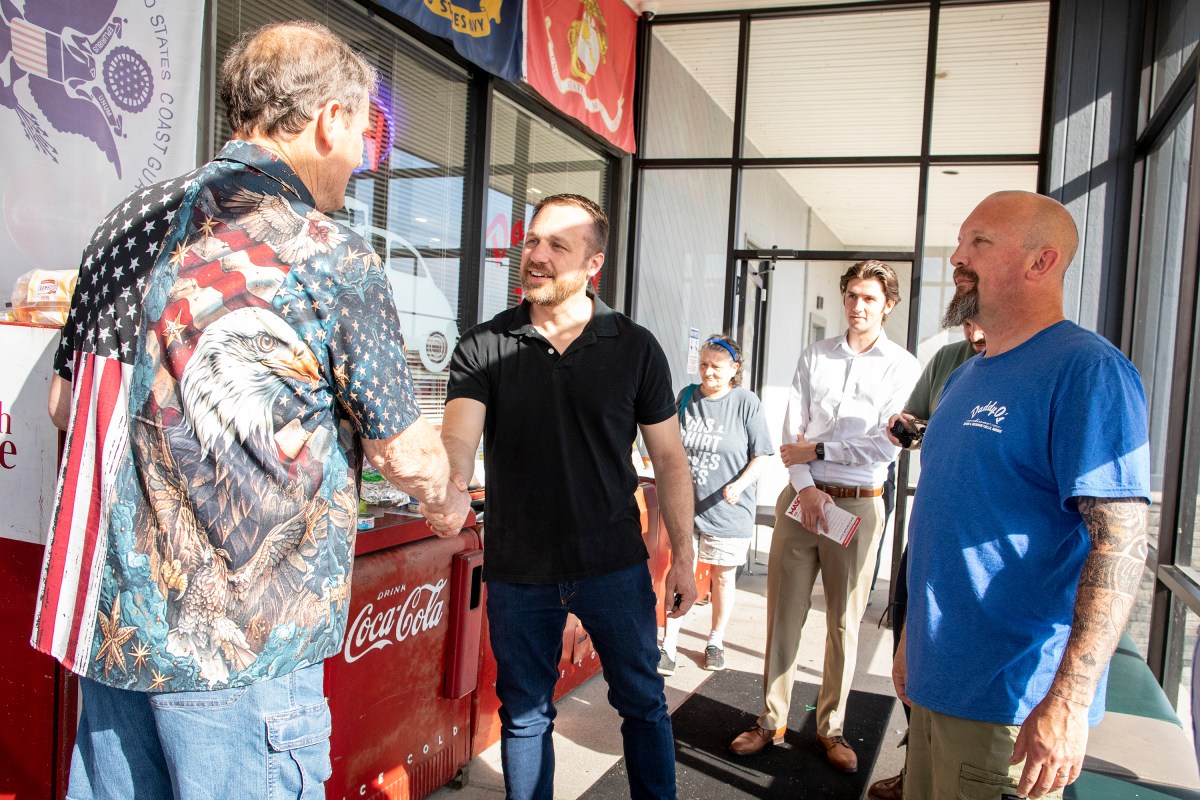
On a recent campaign stop in Oxford at Daddy O’s, a popular and colorful diner wallpapered with license plates, Mason chatted about his businesses with Steve and Donna Whitney, Republicans who said they were still making up their minds about whom to vote for.
They said they were looking for credibility, someone to tackle government fraud and a candidate “who thinks the way we do.”
“Not just on the fiscal issues, but the social issues,” Donna Whitney said. “The boys in girls sports, picking their own bathrooms, what you feel you are today.”
Mason also talked with Daddy O’s owner Aaron Ouellette about the cost of running the diner — the price of eggs and electricity and minimum wage for employees. Ouellette, a Republican who described himself as moderate, said that like the Whitneys, he is also undecided.
“I’m still looking, but I like the options out there,” he said.
Bethel Citizen Staff Writer Rose Lincoln contributed to this report.

We invite you to add your comments. We encourage a thoughtful exchange of ideas and information on this website. By joining the conversation, you are agreeing to our commenting policy and terms of use. More information is found on our FAQs. You can update your screen name on the member's center.
Comments are managed by our staff during regular business hours Monday through Friday as well as limited hours on Saturday and Sunday. Comments held for moderation outside of those hours may take longer to approve.
Join the Conversation
Please sign into your CentralMaine.com account to participate in conversations below. If you do not have an account, you can subscribe here. Questions? Please see our FAQs.