



High school sports coverage is proudly supported by Maine State Credit Union.
It’s a venue that provides some of the most ideal conditions for the longball. It’s no coincidence, then, that York High School’s baseball field is where Greely set its single-game home run record.
The ocean breeze that can be felt at the ballpark not even a half-mile from the Atlantic Ocean is hugely beneficial to batters. Add in a fence that’s only 315 feet at its deepest point, and the field — where Greely homered six times in a 2009 game — is a hitter’s dream.
“It’s a jetstream,” said Greely coach Derek Soule. “When we’re facing power hitters there, we play pretty close to the fence because we figure (a well-hit ball) is either going to be a single or a home run, and (our pitchers) are working exceptionally hard to keep the ball down in the zone. It changes the strategy considerably.”
York’s field is one of many to have that effect. Maine’s high school baseball venues take many different forms, and the ways players and coaches adapt to the shapes, sizes, surfaces and even geographical factors can mean the difference between victory and defeat.
After departing its Memorial Field complex in 2023, the Skowhegan baseball team moved into a new home this fall. Unlike Memorial Field, which played on the smaller side, the new field is deeper to the gaps, which has led River Hawks coach Peter Kirby to think differently when his team is up to bat.
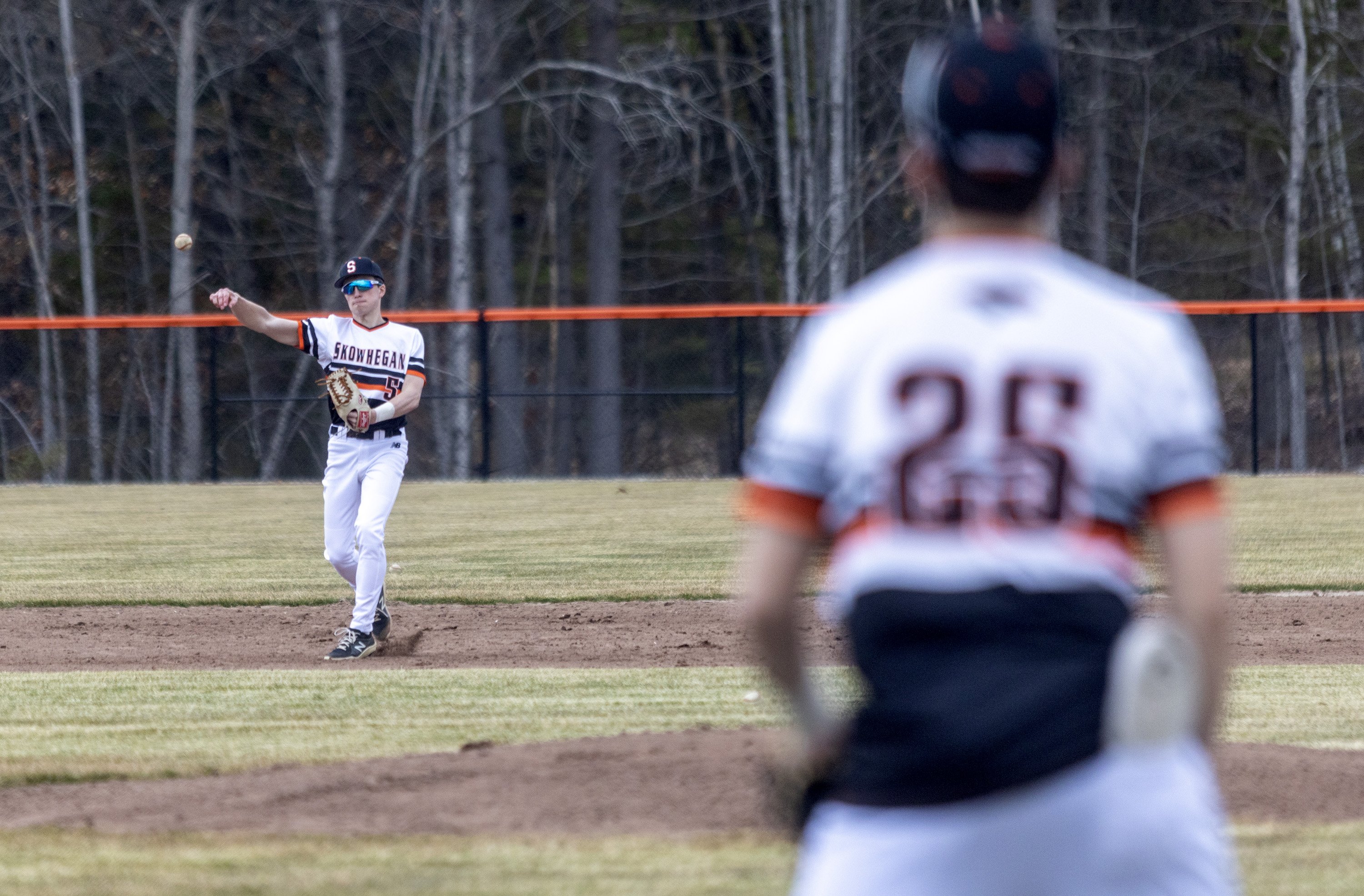
“If I have guys I know can drive the gap, I’m giving them the green light a lot more on 3-0 counts now because driving that gap is going to change the game more than on a smaller field,” said Kirby, whose team played home games at Madison High while its new field was under construction. “At Madison (last year), some of those balls off the fence were singles if the fielder played it right. Now, you’re running for a while.”
The Mountain Valley Conference has many distinct fields. Dirigo’s is 265 feet down the line to right but goes 445 to center and 340 down the line to left. Most of Boothbay’s right-field fence is 270 or shorter. Spruce Mountain’s fence is about 295 in left-center, stretches to 345 in right-center, and drops to roughly 240 in right. Mt. Abram’s field brings the mountain winds into play and also has massive space between home plate and the backstop.
The size (or surface) of a backstop can force fielders to play completely different from game-to-game. At Skowhegan’s new field, which also has a lot of room from home plate to the backstop, a passed ball often means two bases instead of one. At Dexter, where Bucksport coach Josh Jackson tells his team to watch out for a boarded surface, the ball can carom in different directions.
“With a bigger backstop, if you have runners on base, you’re definitely thinking about it — it is pressure,” said Mt. Blue catcher Ben Wrigley. “With a big backstop, you usually also have lots of foul territory, and that means you have a lot more room to go out and make a play (on a foul pop-up). You have to be a lot more (alert).”

As members of Livermore Falls’ 1999 Class C title-winning team, Spruce Mountain co-coaches Travis Dube and Adam Lake played on the Phoenix’s current field at the town’s Griffin Field complex. The park’s small dimensions played a factor in the ’99 Andies hitting 33 homers in 16 regular-season games, and although the adoption of BBCOR (a bat standard adopted in 2012 to make metal bats similar to wood in performance) changed things, Dube said the field’s eccentricities still play a role.
“As a pitching staff, it got drilled into us, ‘Ball is down in the zone,’ because anything that gets elevated at Livermore Falls is finding its way over a fence,” Dube said. “When BBCOR came in and nerfed the bats, that became less important, but it’s still a small field, and you can’t just hit it hard and expect to get two bags out of it; you’ve really got to hit it away from a fielder or get a misplay.”
MVC fields, Dube said, have some other quirks that force teams to adjust. Spruce’s field has a lip at third base that keeps players at the hot corner on their toes. Mountain Valley’s has a noticeably high mound, which gives ace pitchers an advantage hurling downhill, as well as a funky inward curve in the fence in left-center, resulting from its proximity to the Hosmer Field track. Dirigo has historically had fast grass and a stone mix in the infield.
Then, there are turf surfaces, where the ball really moves. Soule said the added speed of balls on turf was something his team had to account for at the University of Maine’s Mahaney Diamond in last year’s Class B championship game against Ellsworth, and Mt. Blue coach Steve Porter said turf changes how he manages his infield.
“When we (play on the turf fields at Lewiston and Brewer), it helps with the fielding because you get true hops and can get a read on it without getting a lot of quick bounces,” Porter said. “The ball is going a little quicker through the turf, which lets you play a little bit deeper because it gets to you faster.”

Adjusting to turf wasn’t the only thing Greely had to do at Mahaney Diamond last year. Soule also took note of the massive foul territory and made that an emphasis when preparing for the state final. He moved the bases at Greely’s home field in from the foul line to replicate what his team would see at UMaine — and with the Rangers leading Ellsworth 6-5 in the bottom of the seventh, that paid off.
“Their leadoff batter was a dangerous hitter who stole a lot of bases that we really wanted to keep off base with a one-run lead, and he hit a pop-up that our first baseman, Ben Kyles, ran down,” Soule said. “In most places, that’s out of play, but there, it’s an out. That’s something we strategized for, and if you get that guy on-base leading off the seventh, I don’t know if we win the state championship.”
Porter, Jackson and Mt. Abram outfielder Landon Marble said that going over the quirks and ground rules of the field they’re about to play on is something their teams do before each game. At some fields, Jackson noted, balls that bounce off the outside of a dugout are out of play, while they are live balls at others. When Bucksport went to Belfast in the preseason, Jackson also told his players to watch out for a hill in left field.
Knowing how the field plays is a major advantage for the home team. Mt. Blue outfielder Gary Harkins said that the Cougars have a major leg up at Hippach Field, where they know the infield bumps and outfield divots better than opposing teams. Mt. Abram players, Marble said, are savants of their large field’s mannerisms.
“It’s a home-field advantage,” Marble said. “We know how the ball is going to bounce in the outfield, and we know our hitters, how deep each guy can send it and what’s going to happen if they do. When other teams come here, they’ve got to pay attention and really know the depth, too.”


We invite you to add your comments. We encourage a thoughtful exchange of ideas and information on this website. By joining the conversation, you are agreeing to our commenting policy and terms of use. More information is found on our FAQs. You can update your screen name on the member's center.
Comments are managed by our staff during regular business hours Monday through Friday as well as limited hours on Saturday and Sunday. Comments held for moderation outside of those hours may take longer to approve.
Join the Conversation
Please sign into your CentralMaine.com account to participate in conversations below. If you do not have an account, you can subscribe here. Questions? Please see our FAQs.