


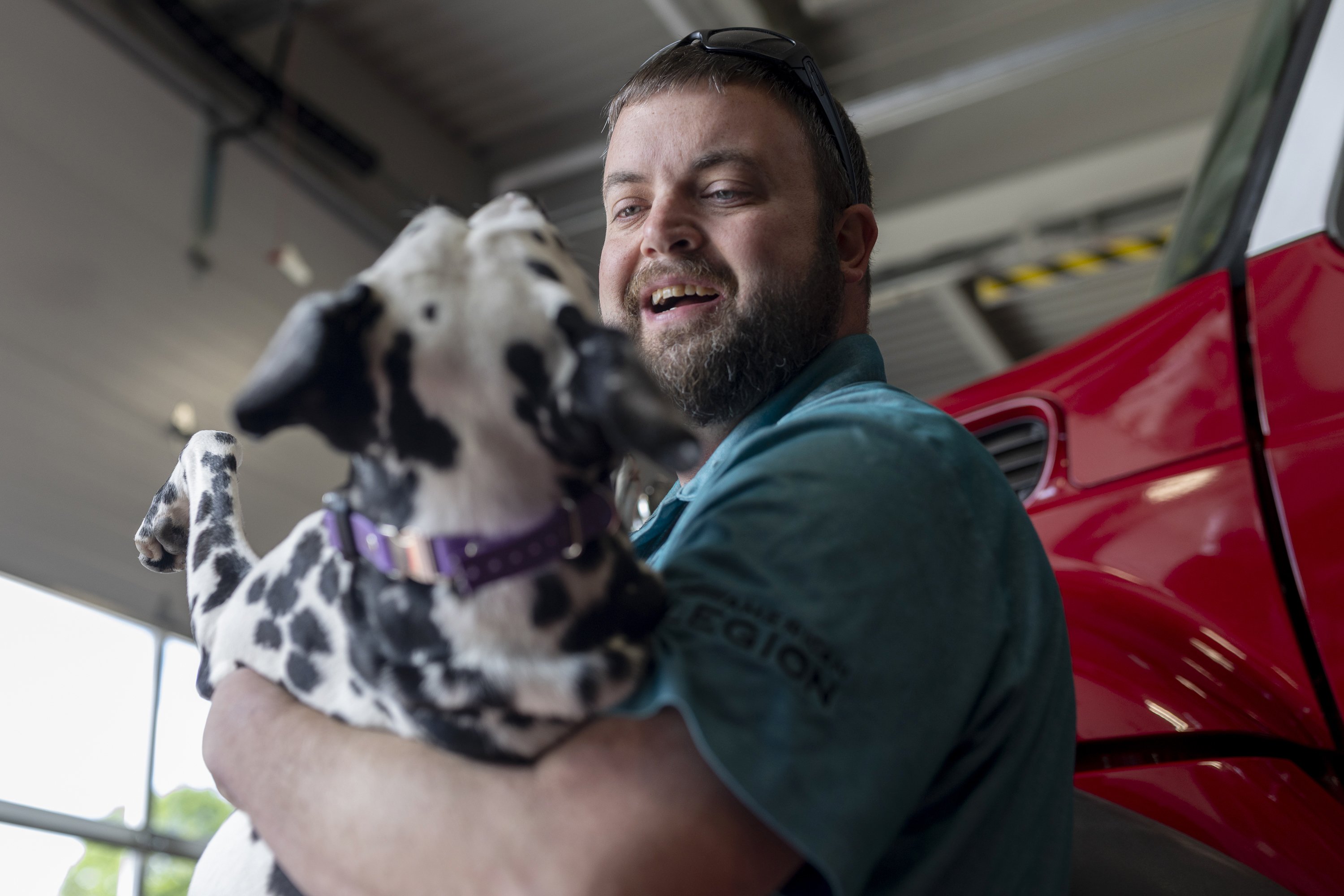
When Halligan lays at your feet, it’s a sign. Though she hasn’t completed her training to be a therapy dog yet, her handler, Timothy Nickels, believes she has a gift to be able to tell when someone’s having a hard time.
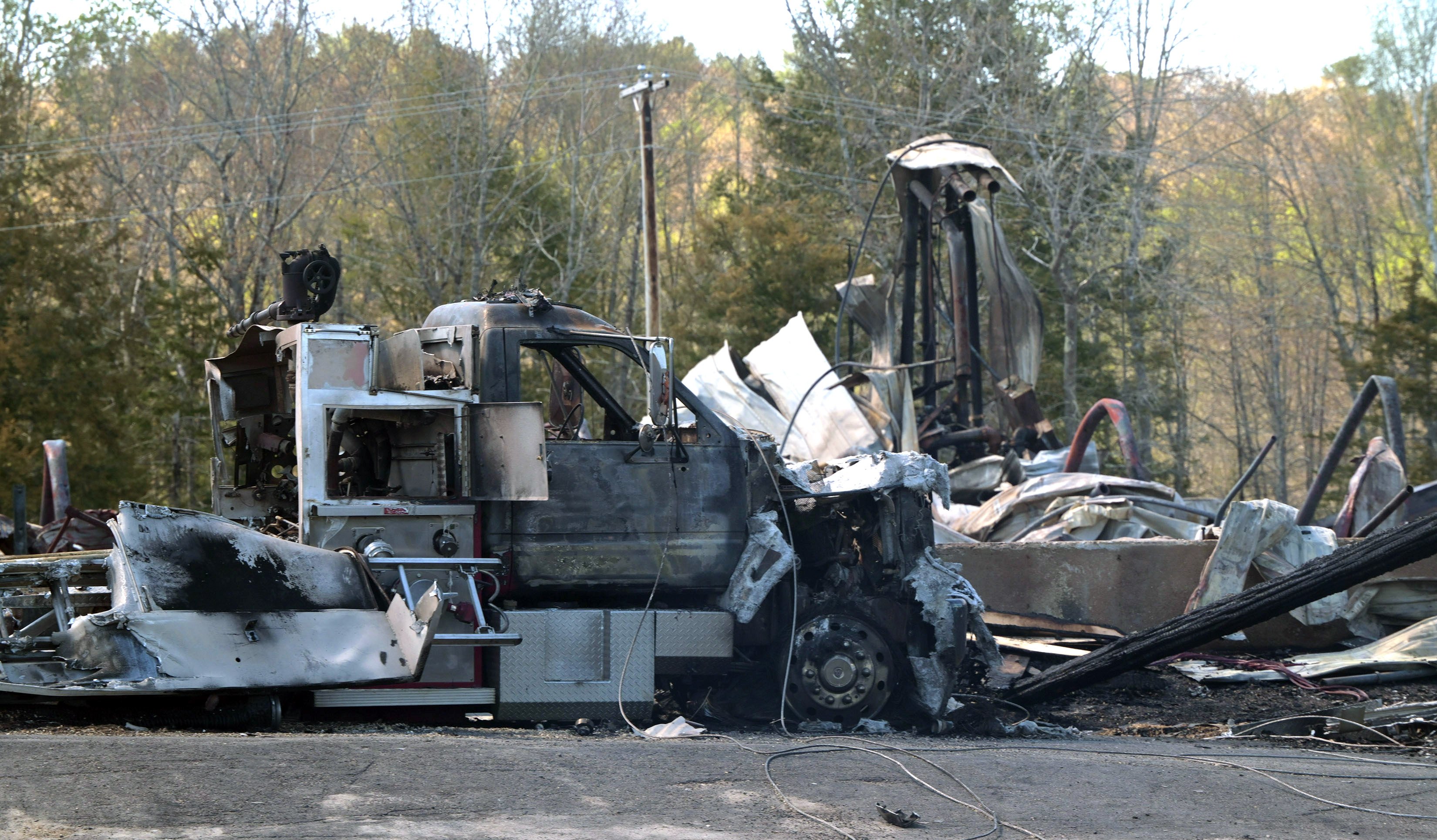
On May 15, Nickels and Halligan were at the Maine Veterans’ Home in Scarborough when they got a call asking them to go to Searsmont. They arrived at Robbins Lumber around 1:30 p.m. while firefighters were still putting out the blaze from a silo that had exploded onto a warehouse full of wood.
Halligan started checking in with some of the more than 100 people spread out over a large area, some of whom had just seen fellow first responders get severely injured. She opened herself up to belly rubs and invited people to pet her.
Nickels didn’t want Halligan to get too tired, but when he tried to give her breaks, “she sensed that people weren’t right and she cried and barked in the car and just wanted to stay with anyone there.”
Halligan and Nickels were among a cadre of emotional and mental health supports on site around the Robbins Lumber fire, available to first responders and their families, reflecting a sea change in acknowledging and treating the trauma that comes with their work.
Over the course of the weekend at least 30 people were there, said Emily Genevere, who was on site as a leader of a peer support team based in Penobscot County and organized on the ground in Searsmont as more helpers arrived.
Some came specifically because local departments who were still in the midst of trying to contain the immediate disaster took a moment to consider mental healthcare and contacted a retired firefighter, Jason Mills, who now runs a consulting company called The Resilient Responder.
That’s exactly the type of reaction Mills has worked to build with first responder agencies around the state. He was a firefighter for 25 years in Augusta and worked for LifeFlight, and he said when he first got into it, it was not culturally acceptable to say you needed support.
“They probably would’ve said you should leave the department, that this job wasn’t for you,” he said.
Mills retired from firefighting and went back to school to study clinical mental health and started The Resilient Responder to offer training, consulting and counseling.
His company is part of a movement that has emerged, said Mary Gagnon, senior director of prevention and workplace wellbeing at the Maine chapter of the National Alliance on Mental Illness.
“I think probably a lot of first responders were tired of seeing their colleagues suffer, honestly,” she said.
Mills tells first responders that their mental health is part of their operational readiness. Given the cultural norms of the past, it’s “mind-blowing” for him now to hear firefighters talk openly about who they’re seeing for counseling. “It’s not something we’re hiding anymore,” he said.
What he thought people in Searsmont needed in the moment, though, as the traumatic event was still unfolding, was Halligan.
“People feel safe with animals,” Mills said. “Dogs are emotionally disarming.”
CREATING A LIFELINE
Like Mills, Nickels is a retired first responder who wants to support his peers in ways that he had needed when he was active. He served with fire departments in Cumberland County for 22 years and medically retired because of post-traumatic stress disorder, he said.
Dogs helped him recover from his worst symptoms. At a time when he felt suicidal, his first dog, Ember, wouldn’t let him go anywhere alone. Nickels started an organization he named Ember’s Paws of Hope to help other first responders and veterans. It has three dogs and plans to add another in Aroostook County this summer. (Nickels is also running in a primary election in June for a seat in the state Legislature.)
The day of the fire at Robbins Lumber, Caroline King of the Red Cross saw people hug and pet Halligan late into the night. Halligan is a Dalmatian, a breed long associated with firefighters.
“She was a good girl that day,” King said.
Nickels and Halligan went back to Searsmont early Saturday morning, where about a dozen people started processing what they saw and experienced, and Halligan visited with them again.
At one point, Nickels said, a group of support members was guided through the Robbins Lumber site and a chief explained what had happened the day before. Morrill volunteer firefighter Andrew Cross had died in the explosion, and Nickels watched as Halligan laid down and focused on the spot where Cross was found.
“Animals are what we would want to try to be as friends or counselors — nonjudgemental, empathetic, present,” Mills said. “Those are the things that the dogs do without even trying.”
They can help people reengage with the world after a traumatic experience, said Gagnon.
Even before that experience, though, there’s work to be done. Mills’ company educates first responders about the science of stress and trauma, builds relationships, works with families, and provides clinical counseling, among other things.
He said he contracts with about a half dozen fire and police departments around the state, and works with about a dozen more.
“Our first responders are at a way higher risk of sustaining a career-ending psychological injury than they are a physical injury,” Mills said.
Nickels has started hosting a monthly dinner at Pat’s Pizza in Windham to be proactive and give people space to talk with others who understand their work.
He and Mills both have a hand in a new support group for people involved in the Searsmont fire, which will meet for at least four weeks, perhaps longer depending on need.
On Sunday, two days after the Robbins Lumber fire started, Mills was in a classroom in Bangor already starting to build awareness and relationships with the next generation. People just getting into the fire service were having their first day of training, and even before the incident in Searsmont, the organizer had asked Mills to present about mental health.
“First responders will work themselves to death taking care of everybody else,” he said, going out in the middle of the night, in the heat or the cold, or breaking up family barbecues to answer a call.
“We’re trying to help them get past the idea that taking care of themselves is selfish.”
Whenever they’re stressed, Mills encourages people to get adequate sleep, go for a walk, get outside, and socialize in supportive ways.
Intervening before, during and after an incident helps normalize the typical stress reactions, Gagnon said, and can lower the long-term mental and physical impacts of trauma.
The last time she and others could remember a mental and emotional health response as big as the one in Searsmont was the 2023 mass shooting in Lewiston.
TAKING HIS OWN LESSONS TO HEART
It took until Saturday night, the day after the fire, for the magnitude of what had happened at Robbins Lumber to hit Nickels. Someone sent him a TikTok with pictures and radio clippings, “and I took time to process everything,” he said.
“I can’t help people if I can’t help myself.”
He and Halligan went out in their driveway, and from their home in Steep Falls, they could see the stars. They listened to a bit of music.
“I disengaged my brain for a little bit and just relaxed,” Nickels said.
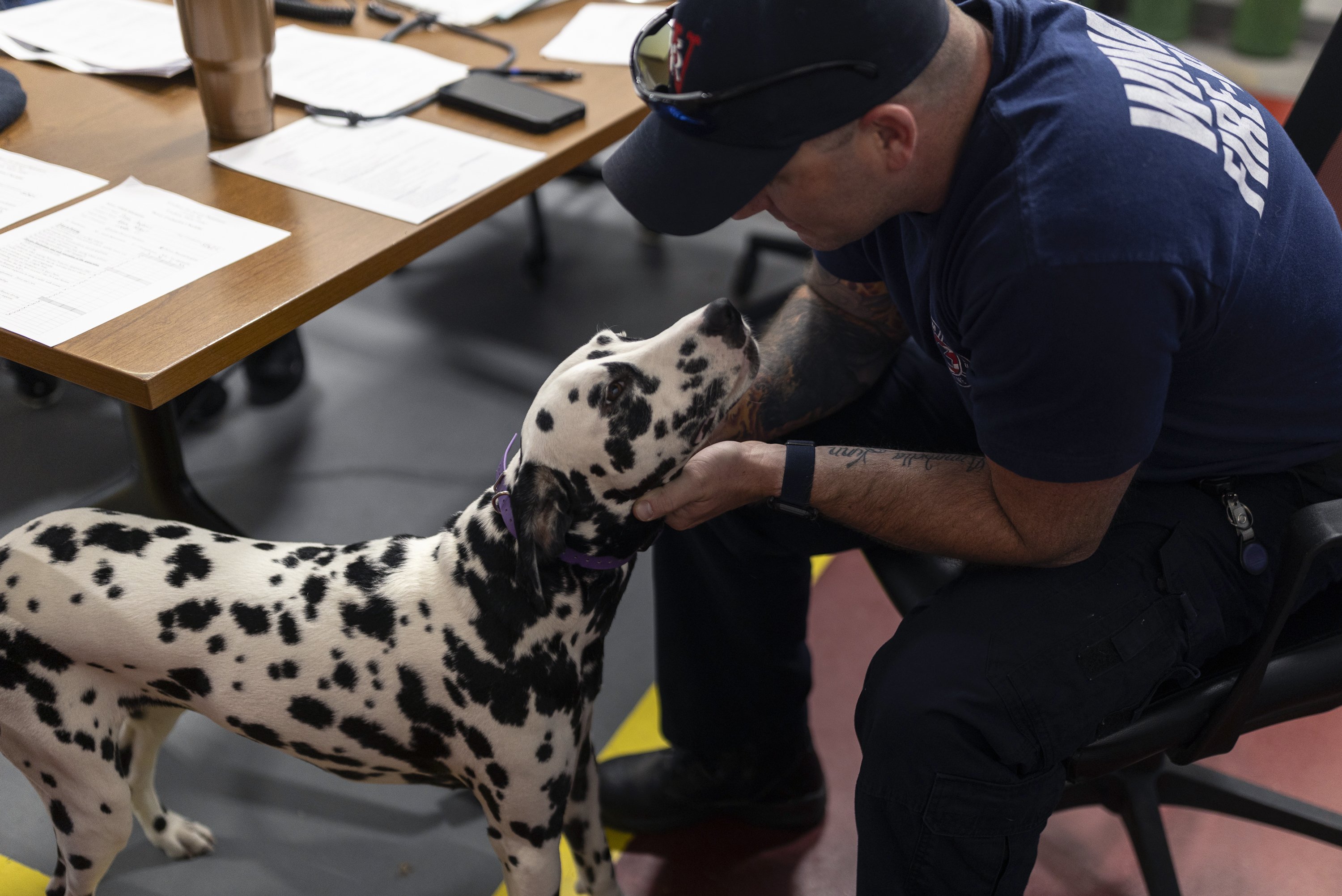
On Sunday he went back to Searsmont to help first responders through their debriefings.
“We were telling them to take care of themselves,” he said. “All them up there have a very long road ahead of them.”
His biggest piece of advice is to talk to someone — a therapist or other people who were involved.
“Don’t bury it,” he said.
“Even people who are just getting out of a firefighter training program, I tell them to get a therapist now, so if something like this happens, you already have that connection.”
A week after the fire, Nickels drove north again to be at Cross’ funeral in Morrill. Halligan could tell everyone was upset, he said. She recognized people she had met the week before. She leaned against them, or went up to them wagging her tail, offering pets and support.
IF YOU NEED HELP
IF YOU or someone you know is in immediate danger, dial 911.
FOR ASSISTANCE during a mental health crisis, call or text 888-568-1112. To call the Suicide and Crisis Lifeline, call 988 or chat online at 988lifeline.org.
FOR MORE SUPPORT, call the NAMI Maine Help Line at 800-464-5767 or email [email protected].
OTHER Maine resources for mental health, substance use disorder and other issues can be found by calling 211.

We invite you to add your comments. We encourage a thoughtful exchange of ideas and information on this website. By joining the conversation, you are agreeing to our commenting policy and terms of use. More information is found on our FAQs. You can update your screen name on the member's center.
Comments are managed by our staff during regular business hours Monday through Friday as well as limited hours on Saturday and Sunday. Comments held for moderation outside of those hours may take longer to approve.
Join the Conversation
Please sign into your CentralMaine.com account to participate in conversations below. If you do not have an account, you can subscribe here. Questions? Please see our FAQs.