

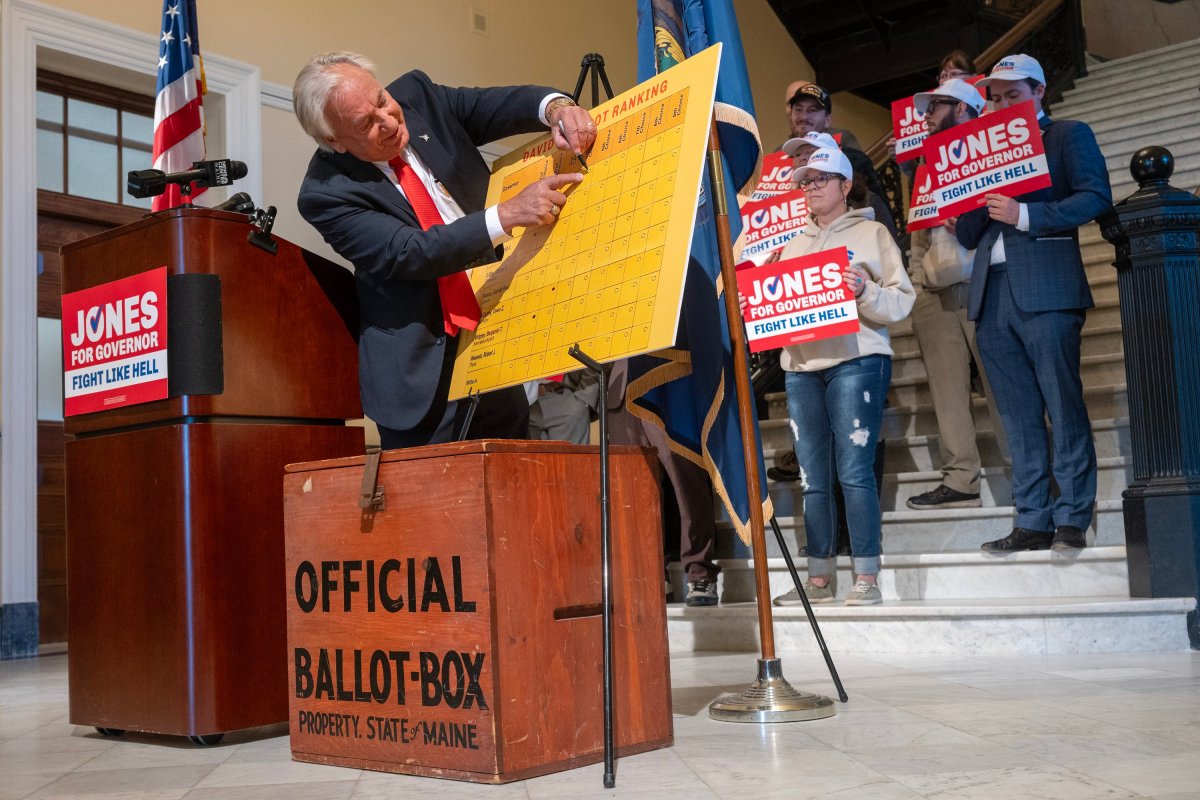
AUGUSTA — A Republican candidate for governor on Monday walked reporters through bubble-by-bubble on how he will vote June 9 on Maine’s ranked-choice ballot in the latest example of the state’s voting system factoring into its crowded primary elections.
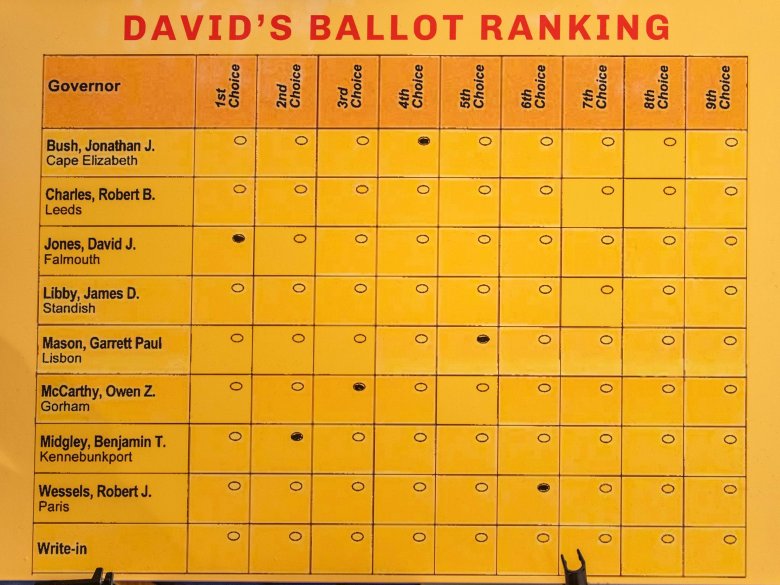
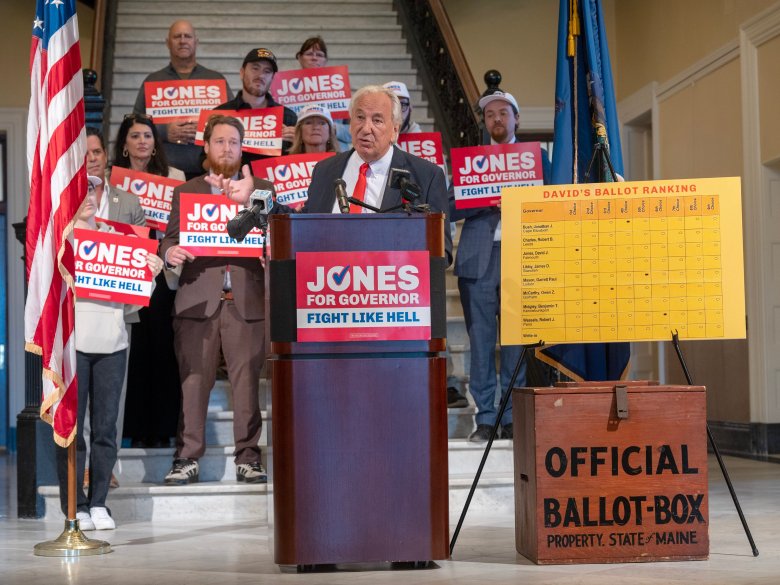
David Jones, who previously announced he would rank fellow businessman Ben Midgley second, encouraged voters to engage with Maine’s ranked-choice process while also revealing the rest of his rankings in the race.
Ranked-choice voting is used in all state-level primary elections, but only for federal elections in the general election.
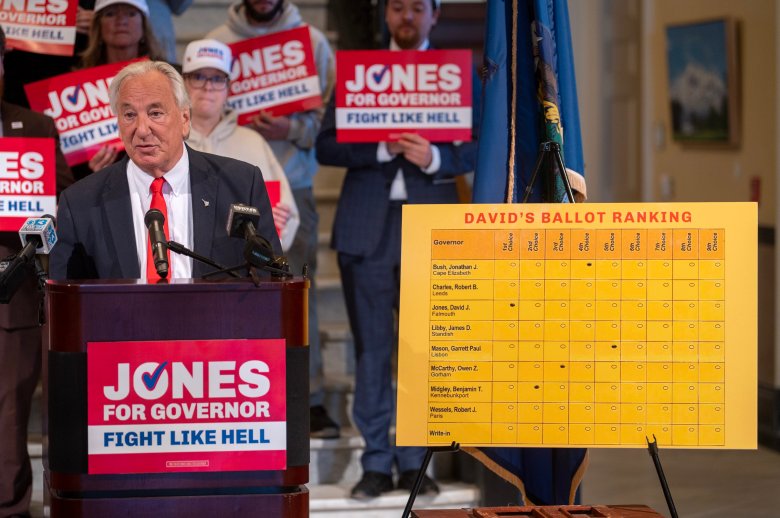
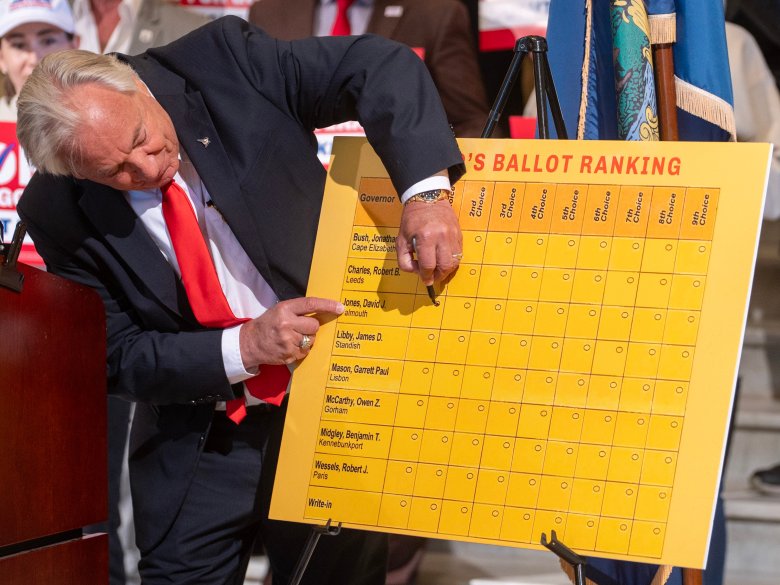
Jones filled out a poster-board sized sample ballot with a Sharpie during a State House news conference, sprinkling in instructions for voters and commentary on his fellow candidates.
The event came just eight days before the June 9 primaries and as it’s become increasingly apparent that ranked-choice voting will play a big role in determining the outcomes.
The embrace of ranked-choice voting from a Republican candidate is especially noteworthy given the party’s long-standing skepticism of the system, which has been used in Maine for nearly a decade. Jones himself previously sued the state over the legality of ranked-choice voting.
Jones, who has lagged other candidates in polling and fundraising, made it clear that he does not think Bobby Charles, who has led polling in the race, should be governor, and discouraged voters from ranking him. He said it’s critical for voters to use the ranked-choice process.
“I’ve explained to people that it’s really important we use the tools available,” he said. “You can’t build a house without a hammer or a saw. That tool is here. And if we don’t use it to our favor, someone we don’t want to be governor could be governor.”
While ranked-choice voting has previously been used to determine state primaries in Maine, it has played an especially prominent role in this year’s race for governor. Alaska is the only other state that uses ranked-choice voting in statewide elections.
Both the Republican and Democratic primaries in Maine are crowded races in which it’s unlikely any candidate will get more than 50% of the vote initially.
Ranked-choice voting can be used in races with three or more candidates. Instead of voting for only one candidate, voters have the option to give each candidate a ranking.
If no candidate gets more than 50% support in the first round, then the last-place finisher is eliminated, the second-choice votes of that candidate’s supporters are reallocated to the remaining candidates, and the results are retabulated. The process repeats until a candidate wins by receiving more than 50% support.
Proponents of ranked-choice voting say it leads to more civility, since candidates don’t want to alienate supporters of their opponents, and want to win over second-place votes.
In a large field, endorsing organizations and candidates will often single out their top two or three choices.
Democratic U.S. Senate candidate Graham Platner, for example, recently announced that he ranked Troy Jackson first in the Democratic primary for governor, followed by Shenna Bellows and Hannah Pingree. Platner has not said how he ranked the other two Democrats in the race, Nirav Shah and Angus King III.
Maine Republicans have historically been resistant to ranked-choice voting, though some of the candidates in this year’s race for governor have formed alliances with competitors. In addition to the alliance between Jones and Midgley, Robert Wessels, a former selectman in the town of Paris, has encouraged his supporters to rank healthcare executive Jonathan Bush second.
Jones said Monday that if elected he would work to repeal ranked-choice voting. Still, he did not shy away from providing a full-ballot rundown on how he will vote.
After ranking himself first and Midgley second, he is ranking medical technology entrepreneur Owen McCarthy third, followed by Bush, former Senate majority leader Garrett Mason and then Wessels.
Jones, who has repeatedly clashed with Charles, said “I just can’t bring myself” to vote for Charles, and said he would not rank him.
He cited Charles’ campaign promises, such as slashing the state budget by $4 billion, as well as his style, saying Charles has attacked the other candidates and not engaged with them, as the reasons he will not rank the candidate.



We invite you to add your comments. We encourage a thoughtful exchange of ideas and information on this website. By joining the conversation, you are agreeing to our commenting policy and terms of use. More information is found on our FAQs. You can update your screen name on the member's center.
Comments are managed by our staff during regular business hours Monday through Friday as well as limited hours on Saturday and Sunday. Comments held for moderation outside of those hours may take longer to approve.
Join the Conversation
Please sign into your CentralMaine.com account to participate in conversations below. If you do not have an account, you can subscribe here. Questions? Please see our FAQs.