
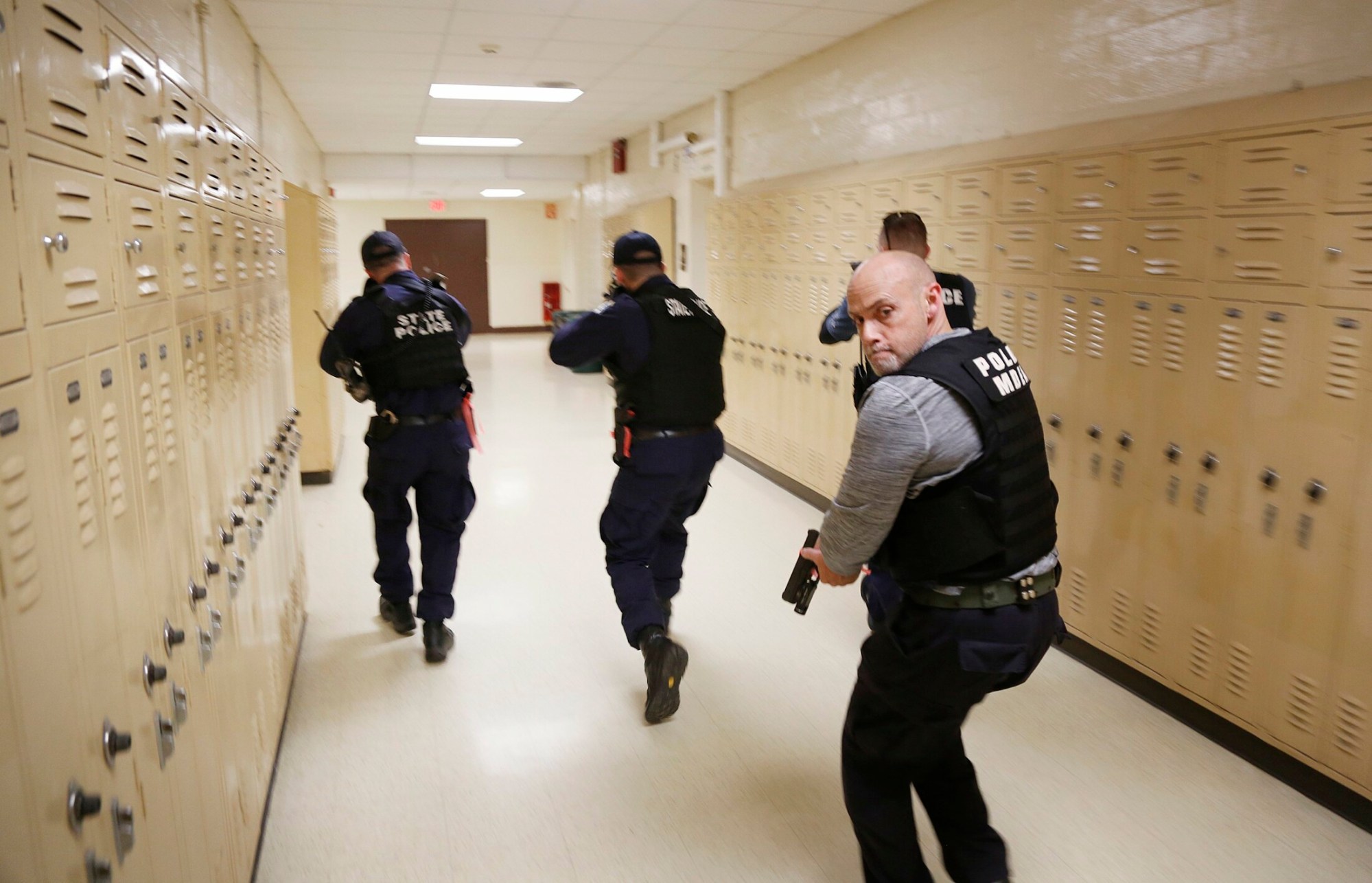

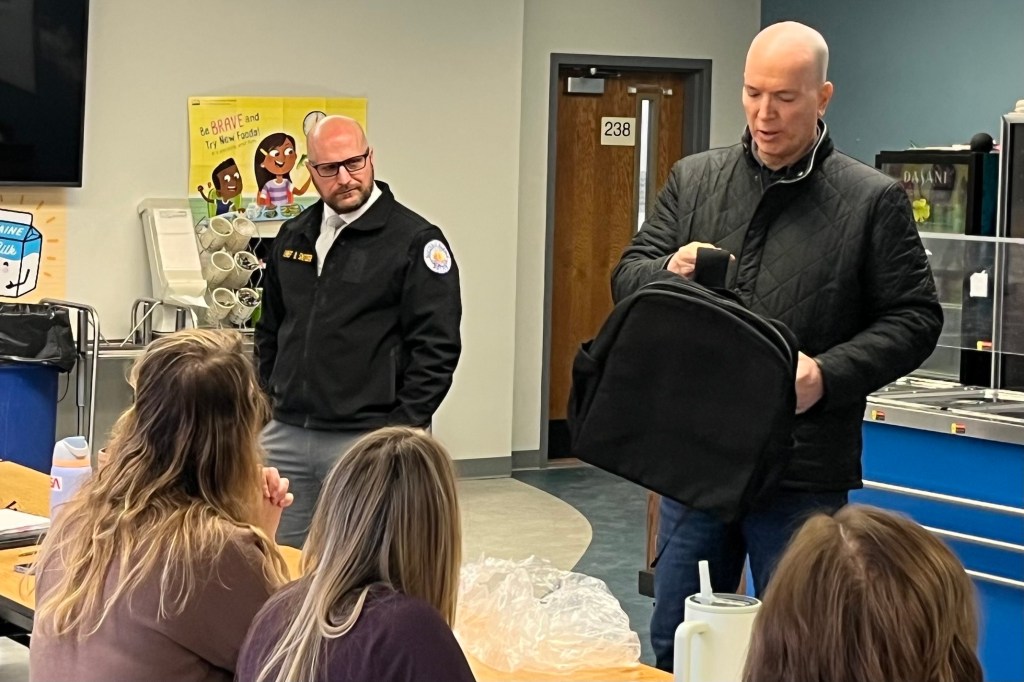
It was an unusual day at Boothbay Regional High School when teachers were shepherded into the library for a televised distribution of bullet-resistant shields.
“We were told that there’s a staff meeting and the news is here, and then we got these backpacks,” recalled Mike Cherry, an English teacher. The police department had received a grant to pay for them.
Ever since that mid-March day, Cherry has had a Mundbora body shield — a backpack with a bullet-resistant pad designed to hang off his arm — sitting on a shelf in his classroom.
Cherry is skeptical that these bags, assembled by Amish craftspeople in Aroostook County, are a panacea to the alarming number of school shootings that occur in the U.S. every year.
Experts question whether teachers can effectively use the shields and if this is where schools should focus their limited resources when it comes to safety and security.
But an added layer of protection, at no cost?
“Anything that might make kids a little safer in an active shooter situation, I’m all for,” Cherry said. “I don’t know about this backpack.”
SHOOTINGS UNCOMMON IN MAINE
There has never been a mass school shooting in Maine, said Robert Susi, director of the Maine School Safety Center, which is an office in the state education department. The state has had very few mass shootings, with the notable exception being in 2023, when a gunman killed 18 people at a bowling alley and bar in Lewiston before taking his own life.
Five shootings have occurred on school properties in Maine since 2013, according to Everytown for Gun Safety, a national organization that supports gun control measures.
Three of those shootings resulted in a death, all self-inflicted by people unaffiliated with the schools, and none of the incidents involved shooters entering school buildings.
Over the last decade, Maine has consistently hovered around 10 gun deaths per 100,000 residents annually, typically between 10th and 20th for fewest deaths compared with other states.
Still, Cherry says, things are different in school today than when he was a kid, before two shooters walked into Columbine High School in Littleton, Colorado, in 1999 and killed 12 students and a teacher.
That event, and the ones since, burrowed anxiety deep into the consciousness of school children and their parents, and wrote that particular genre of violence into the American story.
Missing students or conflict with a non-custodial parent are far more common than school shootings.
“It’s talked about the most, but it happens the least,” Susi said.
BALLOONING MARKET
Though the resonance of school shootings in the American milieu may be outsized, it is energizing a marketplace for ballistic-resistant school supplies.
The body shields in Boothbay schools, which retail for $280, are just one example.
For $329, parents can send their kids off to school with a bullet-stopping three-ring binder. Some classrooms now have bullet-resistant rolling whiteboards that often cost north of $3,000.
Analysts have valued the growing industry in the low billions.
Bullet-resistant school supplies are “being marketed on steroids,” according to Kenneth Trump, president of an Ohio-based school safety and security firm and a vocal cynic of that industry. (He is of no relation to President Donald Trump.)
Jeffrey Maguire, who invented the Maine-made body shields, isn’t selling them to parents. If parents want one for their kid, “go for it,” he says — but he’s rather dispassionate on the matter.
“I’m not trying to equip every child in every classroom with a body shield,” he said in a phone interview last month. “What I’m trying to do is put one of these protective devices in each classroom for the adults in the room to utilize if there’s an emergency.”
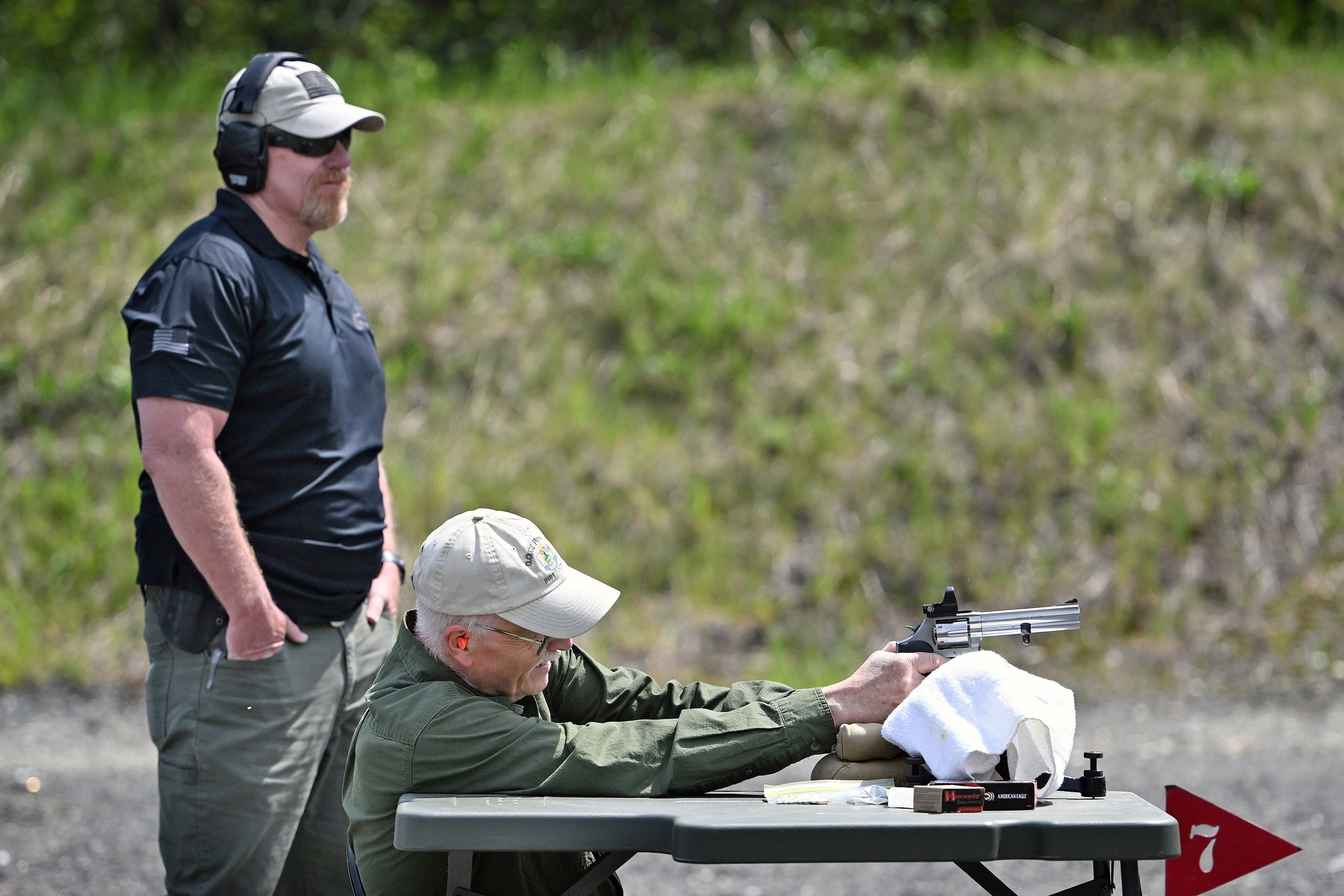
The Portland Press Herald/Maine Sunday Telegram enlisted two experts to test whether the Mundbora backpacks stop bullets as advertised.
Many Maine teachers learn to respond to an active shooter situation using the ALICE model, an acronym for alert, lockdown, inform, counter, evacuate.
Maguire says a body shield is the missing element in that response. He has the zeal of an entrepreneur, and the confoundment of a devotee surrounded by skeptics.
“There’s just not the money for something like this” is something he’s heard a lot.
“This is the kind of thing you should be spending your money on,” Maguire thinks.
So, the combat veteran-turned-bodyguard is approaching people who speak his language: law enforcement.
A ‘NO-BRAINER’?
It was while pitching Maine police chiefs at an industry convention that Maguire met Douglas Snyder, chief of the Boothbay Harbor Police Department.
“He got it,” Maguire said. “He thinks it’s a great thing. He thinks it’s the missing piece of the ALICE strategy as well.”
Late last year, Snyder reached out to Maguire to set up a meeting.

“If we can provide one shield for each classroom, there is that sense of the community cares about you,” Snyder said in an interview.
Snyder reached out to the Mildred H. McEvoy Foundation, according to records obtained through a Freedom of Access Act request after officials initially declined to name the funder.
The board is a family of philanthropists who live in the region and often fund health and education efforts, according to Kate Rice, one of the trustees and a teacher at Boothbay Region Elementary School. The family has long had a relationship with local civic organizations and agreed to fund the initiative.
With over $23,000 secured, Snyder pitched what he called an innovative idea to the school board on Feb. 12.
“Sounds good to me,” one board member said. Another called it a “no-brainer.”
Cherry, the English teacher, is among those who could be called upon to don the shield in a moment of horror.
“I don’t think it’s a silver bullet, I don’t think it’s a fix, but I think that anything that adds to the safety equation to keep kids alive, that’s not something I’m going to mock and scoff at,” he said.
LAYERS OF SECURITY
Maguire is perplexed at the slow uptake of his product in schools. He’s been disappointed by the lack of enthusiasm and those who dismiss his idea. Boothbay schools are the only ones in the nation with Mundbora shields.
His line of business is all about layering security, he says.
Some experts say other layers may be a more worthwhile investment.
The state tends to focus first and foremost on prevention, said Susi, director of the Maine School Safety Center. His staff go into schools, when invited, and train teachers and administrators to build community, implement restorative conflict resolution practices and recognize warning signs.
Although many schools are in need of infrastructure improvements, Susi said his office often recommends inexpensive and easy upgrades — have a system to ensure all adults are identifiable, label all rooms and access points, run through emergency response plans with all staff.
The center does not recommend any particular active shooter response model over another, and is by design agnostic on the use of ballistic-resistant school supplies.
Trump, the outspoken skeptic of ballistic-resistant school supplies, and Peter Joyce, a firearms trainer who spent over 25 years with Portland police, both questioned the ability of a teacher to effectively use the body shield.
“You have to be at the right angle at the right time at the right moment for it actually to deliver what its being marketed to deliver,” Trump said.
Joyce advocates for measures that prevent a situation from escalating to a confrontation. He thinks school buildings should be more secure to begin with — some shooters in other states have entered through unlocked doors — and that staff should be better trained in how to barricade a door.
John Lash, chief of police in Waldoboro, was likely saved by his body armor when he was shot on the job in 2017. He thinks a ballistic backpack on every child could save lives.
“But if you don’t put them on every single student, it doesn’t make a lot of sense to me,” Lash said.
Trump has a term for all this: “Security theater.”
He’s a critic of anything that could create a false sense of safety. Joyce, on the other hand, said that mindset can impact the fidelity of a response.
None of that is lost on Snyder, the Waldoboro chief.
“My goal was to have this be a feel-good thing for our school system,” he said.
The only true cure is “no more violence.” He doesn’t think it’s ever going to happen.
Reuben M. Schafir is a Report for America corps member who writes about Indigenous and rural communities for the Portland Press Herald.
Editor’s note: This story was updated to correct the subject Mike Cherry teaches.

We invite you to add your comments. We encourage a thoughtful exchange of ideas and information on this website. By joining the conversation, you are agreeing to our commenting policy and terms of use. More information is found on our FAQs. You can update your screen name on the member's center.
Comments are managed by our staff during regular business hours Monday through Friday as well as limited hours on Saturday and Sunday. Comments held for moderation outside of those hours may take longer to approve.
Join the Conversation
Please sign into your CentralMaine.com account to participate in conversations below. If you do not have an account, you can subscribe here. Questions? Please see our FAQs.