

With thousands of acres across Kennebec County preserved for public access and wildlife conservation, Kennebec Land Trust properties offer dozens of wandering hikes within a half-hour drive of the state capital.
Ranging from summiting Winthrop’s Mount Pisgah to watching a waterfall in Sidney, the Kennebec Journal asked KLT trail-builder and stewardship director Tyler Kenniston about his favorite local trails to hike.
Here are his go-to KLT hikes for this summer.
REYNOLDS FOREST, SIDNEY
Old mill foundations and excellent bird-watching are things you’d find on KLT’s Reynolds Forest property on West River Road.
But the water feature is why this half-mile loop is one of Kenniston’s favorite KLT hikes. The distinctly tea-tinted Goff Brook rushes over exposed stone and toward the Kennebec River, and many hikers think the water’s just dirty.
It’s much more interesting than that, Kenniston said.
“It’s actually tannins from the (Great Sidney Bog),” he said. “It’s one of the more prominent waterfall-type features that we have on any of our properties.”
Dogs: Allowed leashed or under voice command. Parking: Along West River Road, northeast of intersection with Dinsmore Road. Length: 0.51 miles with full loop. Watch for poison ivy near the trailhead.
HOWARD HILL CONSERVATION AREA, AUGUSTA
Within view of the Maine State House in Augusta is KLT’s most central setting for a summer hike in the Howard Hill Conservation Area.

More than 2 miles of trails already wind through the 164-acre property, opening up to hard-to-believe views of the State House and the rest of Augusta. The unusually undulating plot is owned by the city of Augusta and will soon undergo trail reconstruction to make the paths accessible for people with mobility impairments, Kenniston said, to reduce grades and smoothen rough edges.
“When you invest more up front, which is what we’re doing, the idea is that it’s easier to maintain,” Kenniston said. “The whole water thing is the big issue for trail construction and maintenance — you’re always trying to get water to exit the trail without a lot of force, because that erosion is the issue. So, we’re really focusing on a quality initial construction to reduce maintenance.”
Access is available from three points: the Effie Berry Conservation Area in Hallowell, Sewall Street across from Brooklawn Avenue in Augusta and the trailhead at the end of Ganneston Drive.
Dogs: Allowed leashed. Parking: At the end of Coos Drive in Hallowell, at the State House lot and at the end of Ganneston Drive. Length: Depends on the trailhead, ranging from 0.8-1.6 miles out-and-back to the viewpoint. Watch your footing on steep terrain and wonky walkways.
EZRA SMITH WILDLIFE CONSERVATION AREA, MOUNT VERNON
This 163-acre hilly property covered by the Ezra Smith Wildlife Conservation Area feels more like northern Maine than Kennebec County’s Mount Vernon, Kenniston said.
It comes with a different kind of water feature: a protected wetland with a large vernal pool.
To get to the half-mile Doghair Fir Loop, hikers walk across that wetland on a wooden boardwalk — a great opportunity, Kenniston said, to see habitats that are usually inaccessible. The loop itself climbs an upland section near Hopkins Stream.
“If your only concern was purely environmental, you could argue no one should ever build a trail over wetland,” Kenniston said. “But, that said, we’re always balancing public access and community benefit with pure ecological benefit. There was a lot of interest in the community to get across the wetland where there’s some nice forest upland.”
Dogs: Allowed leashed or under voice command. Parking: On the east side of Pond Road or Route 41, a half-mile south of Blake Hill Road. Length: 1.5 miles, walking loops on both the east and west sides of the wetland. Watch for stone walls and barbed wire — evidence of a pastoral past use of the property.
HALES POND WOODLAND PRESERVE, FAYETTE
The Hales Pond Woodland Preserve, tucked in the woods of Fayette, is managed by KLT as a wildlife conservation area. The remote pond and its surrounding wetlands and forests support inland waterfowl, wading birds, amphibians and all kinds of ferns and bushes. The Maine Department of Inland Fisheries and Wildlife has designated much of the area as protected habitat.
After KLT received the property in a 2022 donation, KLT developed the only public access to Hales Pond, which includes a dock. The 1.3-mile out-and-back hike is one of Kenniston’s favorites.
KLT even has a canoe available for public use on the mostly undeveloped pond. Just call ahead to reserve it.
Dogs: Only service animals allowed. Parking: On the east side of Bamford Pond Road, about a quarter-mile north of Richmond Mills Road. Length: 1.3 miles with full loop. Watch for foraging dragonflies and birds in wetland areas.
MOUNT PISGAH CONSERVATION AREA, WINTHROP
The Mount Pisgah Conservation Area is the big one — the most popular KLT trail, the famous 1949 fire tower, the Mount Washington view.
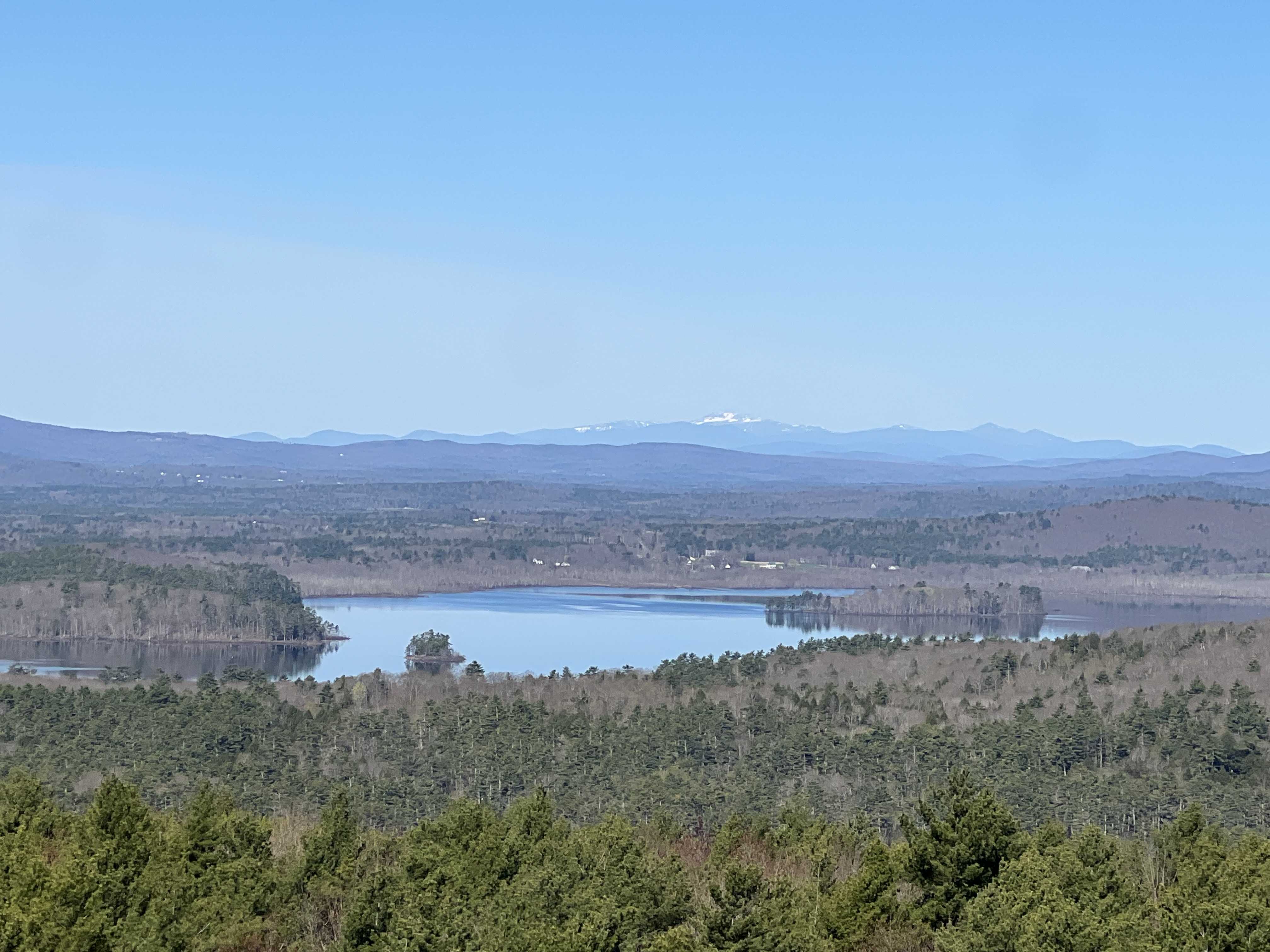
“It’s a busy trail — at least by our standards, maybe not by Acadia’s,” Kenniston said. “I don’t necessarily rank it high in terms of the solitude aspect, but it’s the most like a mountain hike that you’re going to get on our trails — and with the fire tower, which is iconic.”
Three options get you up to that fire tower: the 0.7-mile Tower Trail, which climbs the easier western side of the hill and passes by old sugar maples; the almost milelong Tower Road, a steep old gravel road that leads straight up to the tower; and the rugged 1.3-mile Blueberry Trail, which winds up the southern side of the hill over several streams and an old pasture field.
And then the tower itself provides views for miles. On clear days, Mount Washington is easy to spot over the hills of western Maine.
Kenniston said he suggests the Ledges Trail, a 1.4-mile addition along the steep northern side, as a quieter option for the middle of the hike.
Dogs: Allowed leashed or under voice command. Parking: On the east side of Mount Pisgah Road, about 1.6 miles north of North Monmouth. Length: From 1.4 miles to 3.5-plus miles. Watch for blueberry bush patches and old agricultural stone walls on your way up.

Comments are not available on this story. Read more about why we allow commenting on some stories and not on others.
We believe it's important to offer commenting on certain stories as a benefit to our readers. At its best, our comments sections can be a productive platform for readers to engage with our journalism, offer thoughts on coverage and issues, and drive conversation in a respectful, solutions-based way. It's a form of open discourse that can be useful to our community, public officials, journalists and others.
We do not enable comments on everything — exceptions include most crime stories, and coverage involving personal tragedy or sensitive issues that invite personal attacks instead of thoughtful discussion.
You can read more here about our commenting policy and terms of use. More information is also found on our FAQs.
Show less