
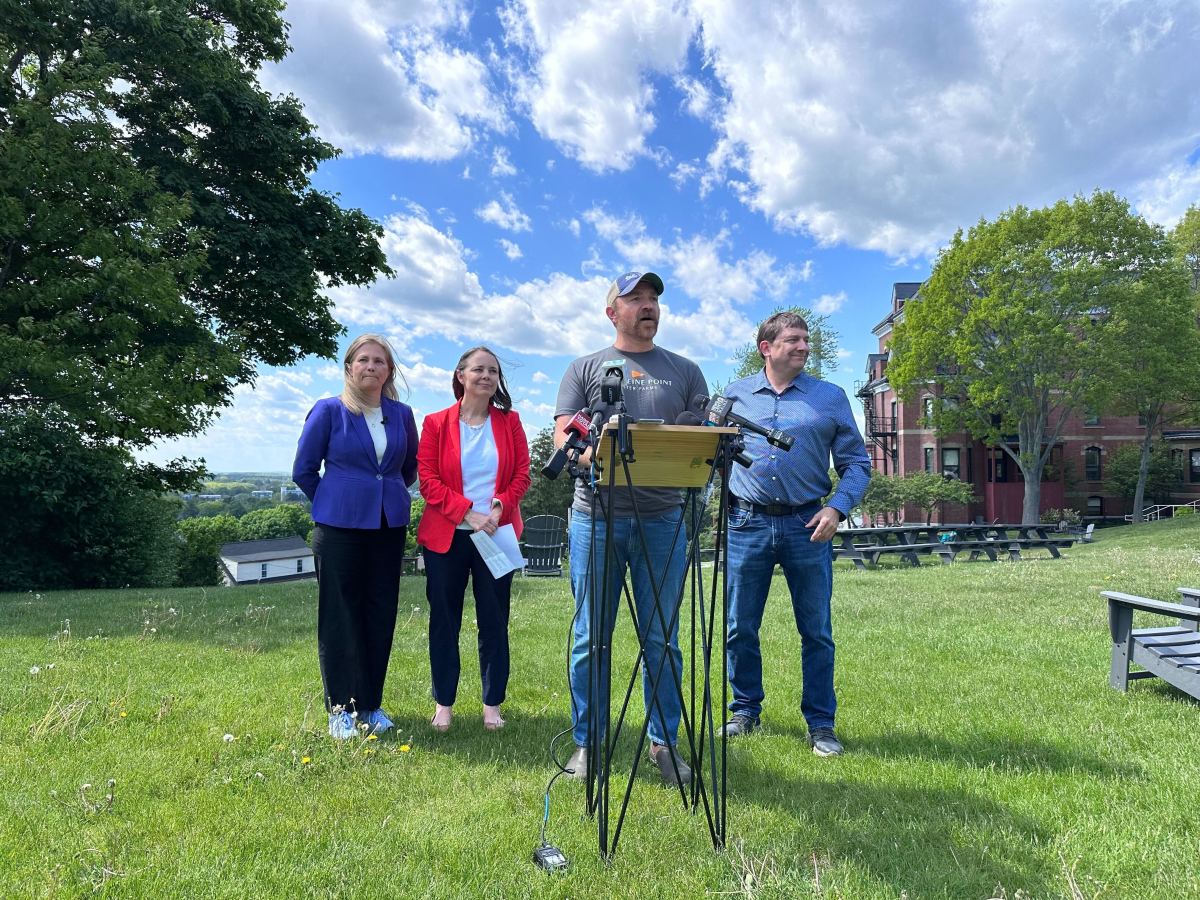
Graham Platner often spoke on the campaign trail about engaging in “a politics of power”: Unswerving advocates of the working class had to seize control of American government from the political establishment, Republicans and Democrats alike.
Now, Platner is trying to squeeze out what likely are his last drops of that power even as he dropped out of Maine’s U.S. Senate race Wednesday night, more than two days since a rape allegation vaporized all his support from elected Democrats.
While Democrats were waiting for him to drop out, the nation witnessed an extraordinary public debate about the party’s strategy — a month after the primary that would have normally put a lid on infighting, and just four months before a general election against five-term incumbent Republican Sen. Susan Collins.
In other words, it feels like Democratic primary season again in Maine. A cast of characters who were defeated in last month’s contests are reemerging as wannabe U.S. senators or sage strategists. But this time, the question is not only who should be replace Platner on the ballot, but how to make that decision in a matter of weeks.
On Tuesday evening, the Maine Democratic Party had doubled down on its call for Platner to drop out by seeking to expose his approach.
“Graham Platner’s team has repeatedly reached out to us in an attempt to put their thumb on the scale of what this process looks like,” the state party’s executive director, Devon Murphy-Anderson, said in a video posted on social media. She said Platner’s embattled campaign would play “no role” in a process that would be “open, inclusive, transparent and fair” before a July 27 deadline to pick a substitute nominee.
A statement from an unnamed campaign official said the campaign had merely inquired about the process.
“At no point has the campaign tried to ‘put its finger on the scale,'” the statement said. “While Graham wouldn’t want to be a part of the process, he would want to make sure the voters and volunteers make this decision — not the political establishment.”
The campaign escalated its pushback on Wednesday afternoon, when Ben Chin, Platner’s campaign manager, wrote a lengthy text message to supporters. He said the state party had “allowed the DC-based Democratic Senatorial Campaign Committee to send staffers to plan a potential nominating process behind closed doors.”
He added: “Both the state and national parties cut our team, our volunteers, and our vast networks of supporters out of the conversation completely.” The DSCC, chaired by Sen. Kirsten Gillibrand of New York, had spent most of the primary election supporting Gov. Janet Mills, whose Senate campaign struggled.
Later Wednesday, Spencer Toth, a state party official who had previously worked for the Platner campaign, resigned from his position at the party, citing the friction with Platner.
“There is no path to beating Susan Collins without honoring and engaging the grassroots movement that has been built across Maine,” Toth wrote in his resignation letter.
The Platner campaign has begun soliciting feedback from supporters about what they think should happen next, and it plans to share the suggestions with the state party, according to Chin’s text.
Murphy-Anderson, of the Maine Democratic Party, responded to Chin’s text by saying in a statement that “the Platner campaign remains focused on distracting from the job of defeating Susan Collins in November with false accusations against us.”
“While we may be frustrated with Graham Platner’s continued efforts to manipulate this process, we are so thankful for his supporters and all of their efforts to defeat Susan Collins — they are a vital part of our party and deserve to participate in an open process to select Platner’s replacement,” Murphy-Anderson wrote.
The statement encapsulated Maine Democrats’ dilemma. Democratic hopes of unseating Collins, long seen as one of the most vulnerable Republican senators in the midterms, could ride on a replacement nominee’s similarity to Platner — or on the candidate’s distance from him.
He energized progressive voters, built a formidable campaign operation and won more primary votes than any past Maine Democrat running for U.S. Senate. Democratic gubernatorial nominee Hannah Pingree, who issued a statement Monday calling on Platner to drop out, suggested that he had “tapped into something real” and that his successor would need to “carry forward” that energy.
On the other hand, with Platner’s candidacy in ruins, Democrats too closely associated with him may face questions about having stood by him through previous scandals as he assured voters that no more damaging revelations would come out.
State Sen. Joe Baldacci, D-Bangor, a moderate who lost the Democratic primary for Congress in Maine’s 2nd District, wrote on social media on Monday that Platner’s attempt to influence the process for choosing his replacement “is only going to tie a lead weight to any nominee.”
As for who that replacement may be, Mainers could be forgiven for feeling some déjà vu.
Three Democrats who until last month were campaigning for governor are now signaling an interest in the Senate seat.
Troy Jackson, the former Maine Senate president whom Sen. Bernie Sanders endorsed in the gubernatorial race, made the most aggressive move to date among the trio, formally forming an exploratory campaign committee on Tuesday. He would likely be Platner’s pick since Platner said he would rank Jackson first in the gubernatorial primary.
Nirav Shah, the former public health official who received the most first-choice votes in that primary, said in a video on Tuesday that he was considering throwing his hat in the still-uncertain ring. And he said the process to replace Platner should feature debates and town halls.
Secretary of State Shenna Bellows said on CNN on Tuesday that she, too, was “seriously considering” a run. Bellows was the Democratic nominee for U.S. Senate in 2014, when Collins defeated her with over two-thirds of the vote.
Also reappearing in the conversation about possible Platner replacements are losing congressional candidates from the 2nd District. Jordan Wood, who briefly ran for Senate before switching to the 2nd District race, wrote on social media on Tuesday that he was “continuing conversations with voters across Maine if I should enter an open Senate race.”
And Paige Loud, a social worker who received 10% of the first-choice votes in the 2nd District primary, filed paperwork to become a Senate candidate.
“… I am prepared to carry forward the same pro-worker, anti-imperialist, antibillionaire vision that has defined my campaign from the beginning,” Loud wrote in a statement posted Tuesday on her Instagram account, which now bears the handle “loudforsenate.”

We invite you to add your comments. We encourage a thoughtful exchange of ideas and information on this website. By joining the conversation, you are agreeing to our commenting policy and terms of use. More information is found on our FAQs. You can update your screen name on the member's center.
Comments are managed by our staff during regular business hours Monday through Friday as well as limited hours on Saturday and Sunday. Comments held for moderation outside of those hours may take longer to approve.
Join the Conversation
Please sign into your CentralMaine.com account to participate in conversations below. If you do not have an account, you can subscribe here. Questions? Please see our FAQs.