

A student at the College of the Atlantic in Bar Harbor has upended long-held beliefs about how the Tyrannosaurus rex moved, suggesting the prehistoric predator navigated its world more like a nimble, eight-ton bird than a heavy-footed beast.
For decades, the cinematic image of the T. rex has been defined by the earth-shaking, heel-first thuds seen in films like “Jurassic Park.” But new research led by Adrian Boeye, a 21-year-old senior, suggests that the 40-foot-long dinosaur actually sprinted on its tiptoes.
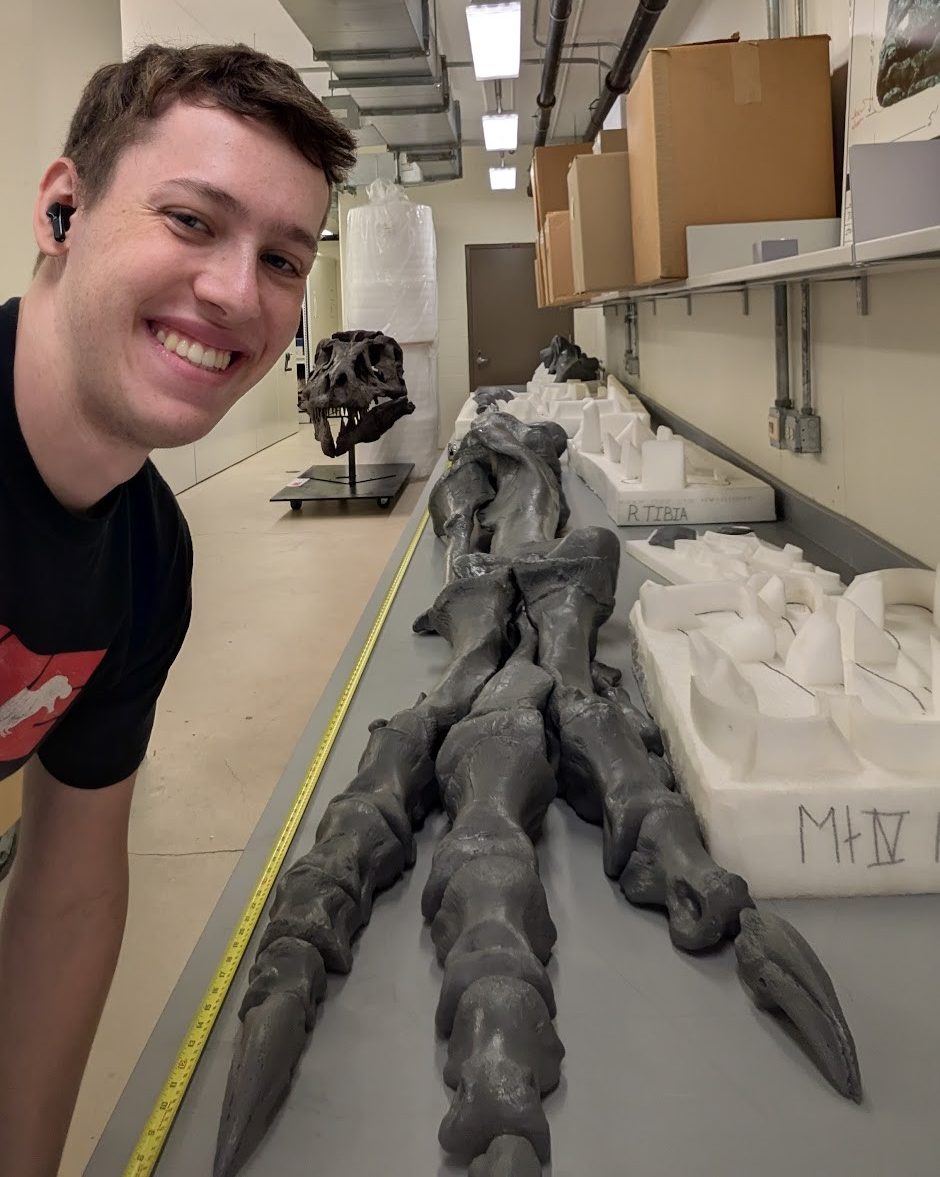
The study, published this week in the journal Royal Society Open Science, likened the creature’s movement to that of a modern ostrich or roadrunner. It’s attracted the attention of scientists across the U.S. and abroad.
For Boeye, the discovery began not in a dusty fossil bed, but during runs through Bar Harbor. As a sophomore, while trying to improve his cadence, he realized that how his foot hit the ground changed his speed and stability. He noticed that while humans are often “heel-strikers,” birds — the closest living relatives of dinosaurs — are “toe-strikers”. When he looked at existing scientific models for T. rex, he found that researchers had almost always simplified the dinosaur’s feet into “rigid blocks” that stomped flatly on the ground.
Using his laptop and a series of complex mathematical equations, Boeye tested how different foot-strike patterns would affect the dinosaur’s movement. By analyzing 3-foot-long fossilized tracks and the leg dimensions of famous specimens like “Sue” at the Field Museum in Chicago, his team found that a toe-first gait increased the dinosaur’s stride frequency.
The result is a dinosaur that moved with rapid, “blur-like” steps. To move quickly, the T. rex didn’t just take bigger steps; it swung its massive legs very fast, rapidly repositioning its center of mass to stay balanced. This bird-like gait would have made the T. rex a much more stable and graceful hunter than previously imagined.
The research also highlights a dramatic “speed gap” in the T. rex life cycle. While a massive adult like Sue topped out at about 20 feet per second — roughly the speed of today’s Komodo dragon — a lanky juvenile could cover 37 feet per second.
“Could a big mama keep up with its rowdy young offspring?” Boeye asked. “Probably not.”
This suggests that young and old T. rexes may have hunted different prey, with swift youngsters chasing down smaller, faster dinosaurs and slower adults ambushing heavy-set herbivores. Boeye noted that youngsters also needed that extra speed to evade the adult T. rexes hunting them.
The path to this discovery was deeply personal for Boeye, a Maryland native who chose the College of the Atlantic because of its proximity to Acadia National Park and its holistic approach to science. He credits the college’s interdisciplinary environment for allowing an undergraduate to lead a project typically reserved for Ph.D.-level researchers.
The paper is dedicated to Scott Swann, a human ecology lecturer at the college who served as a mentor to Boeye and first encouraged him to publish his findings. Swann died last April.
“He showed me how to use that excitement and passion and make the most of it,” Boeye said.
As he prepares to graduate and apply for Ph.D. programs, Boeye hopes his work helps the public see dinosaurs not as monsters from a movie, but as complex biological systems. His next step is to model how the side-to-side swing of a T. rex’s massive tail might have acted like a spring, storing and releasing energy to give the dinosaur an even greater speed boost.
“Tyrannosaurus is far more bird-like than we appreciate,” Boeye said. “The evolutionary link between T. rex and modern birds is clear. … It is a good reminder that if we want to understand the present, the future and where we’re going, we also have to understand how it got started.”
Thomas Holtz, a paleontology professor at the University of Maryland who reviewed the paper for the Royal Society, praised the rigor of the study, noting Boeye’s team validated their equations against living birds and humans to ensure the model could accurately predict known speeds.
Holtz, who wrote his own dissertation on the T. rex’s hind legs in the 1990s, also singled out the breadth of the research, which synthesized data from fossilized tracks, skeletal specimens, and modern animal behavior. He said it is the kind of sophisticated analysis usually reserved for a master’s thesis or a doctoral dissertation.
“To see that coming from an undergraduate is really amazing,” Holtz said.
Kevin Hill, a psychology professor at College of the Atlantic who is Boeye’s adviser, has watched Boeye evolve from an enthusiastic and somewhat awkward admirer of prehistoric life into a respected peer among professional researchers.
“Adrian has gone from turning to authorities on a subject to being in the conversation as an authority with other authorities,” said Hill. “As an educator, you can’t want more than that.”
Though the college lacks a formal paleontology department, Hill noted that Boeye’s self-directed passion has placed him on the global stage. “Adrian did a lot of his own leg work, found connections outside, and showed how this quirky little school could be an asset,” Hill said. “Now, he’s out there playing with the big dogs, and the big dinosaurs.”
Especially the kind that Boeye has shown the world runs like a graceful, 8-ton chicken.

We invite you to add your comments. We encourage a thoughtful exchange of ideas and information on this website. By joining the conversation, you are agreeing to our commenting policy and terms of use. More information is found on our FAQs. You can update your screen name on the member's center.
Comments are managed by our staff during regular business hours Monday through Friday as well as limited hours on Saturday and Sunday. Comments held for moderation outside of those hours may take longer to approve.
Join the Conversation
Please sign into your CentralMaine.com account to participate in conversations below. If you do not have an account, you can register or subscribe. Questions? Please see our FAQs.