


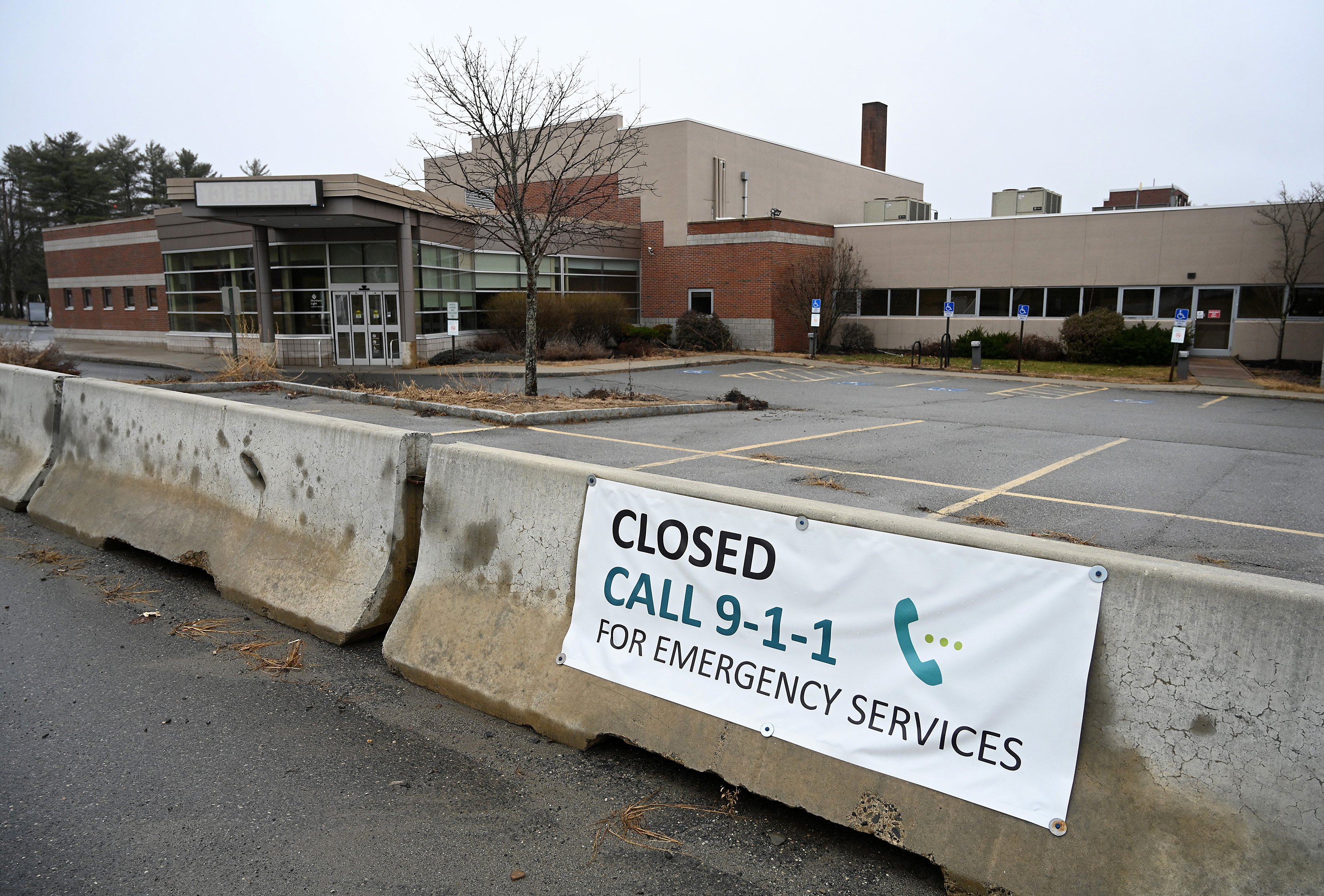
WATERVILLE — The grass outside the sprawling, brick campus is cropped short. Cars still barrel down Kennedy Memorial Drive. But the parking lot is empty, deep cracks puncture the roads and what was once a bustling ambulance bay is now just an awning.
It’s been almost a year since Northern Light Inland Hospital shut its doors, stripping Waterville of its only inpatient beds and 392 employees of their jobs. Providers scattered to new practices across the state but thousands of their patients did not follow, restricted by capacity or distance, or hoping that they would find something more local.
For many, those hopes didn’t pan out.
Amid the mass exodus of health care resources, workers and spending from Waterville since May 2025, community and city leaders have stepped up. They’ve transported patients the extra miles to other hospitals, brought health visits to people’s homes and pushed for other care models. But some say the health system should have done more to lift the burden.
Katie Spencer White, president of Waterville’s Mid-Maine Homeless Shelter, was a member of Inland’s board of directors when she heard the hospital was closing within three months. She said that transition period was an opportunity for Northern Light Health to identify Waterville’s vulnerabilities, engage stakeholders and make things better before Inland was gone.
She said she resigned because that did not happen.
“They’re well-meaning people,” Spencer White said, “who I think have lost sight of the community that’s been left behind.”
DISPERSED ACROSS THE STATE
When Inland closed, its health workers dispersed across the state. More than two-thirds of its primary care providers left Kennebec County, with some landing as far as Portland or Bangor, according to an exit survey list from Northern Light Health. Specialty providers, including cardiologists, neurologists and surgeons, are an average of 35 miles farther away from Waterville.
The 18 primary care providers who stayed with Northern Light Health were allowed to retain their full patient lists, but others moved to practices that were at capacity, leaving 5,000 patients behind.
Dr. Elinor Mody came to Inland as a rheumatologist in early 2025. When the hospital closed, she moved 25 miles away to Northern Light Health Sebasticook Valley Hospital in Pittsfield. Some of her older Waterville patients, living with painful conditions like rheumatoid arthritis but unable to make the drive, fell off.
“It’s been a real loss for patients,” Mody said. “I didn’t even really realize it at the time, because I just started working there, but they were very attached to Inland.”
Inland served a wide range of need. In Kennebec County, nearly 13% of patients were living in poverty and 5% were unemployed, according to the hospital’s fiscal year 2024 tax filing. The next closest inpatient hospital, MaineGeneral Medical Center in Augusta, is nearly 20 miles away.
For people without reliable transportation, Spencer White said, “it might as well be in Portland.”
MaineGeneral Health also provides primary care at its Thayer campus in Waterville, which has an outpatient hospital and emergency department. But even before Inland closed, primary care was at capacity systemwide. CEO Nathan Howell said people across the state are facing the same primary care shortages and looking outside their communities for care.
Today’s waitlist has 4,200 people.

Ellen Paul of Waterville had been trying to reestablish care at Inland since her primary care doctor left in 2024. During her time without a doctor, the 78-year-old’s blood pressure skyrocketed and she started having thyroid issues.
With the hospital gone, Paul can’t stop worrying about what would happen if she had an emergency.
“There is no hospital in Waterville,” she said. “That scares the hell out of me. I mean, that’s really dangerous; there’s a lot of old people. And now, if something happened, if I went through Waterville, I’d end up getting ambulanced to Augusta.”
“That’s expensive,” she added. “Who pays for that?”
HIGHER BILLS
Northern Light Health owns nine hospitals across Maine. Inland had lost $55 million from 2015 to 2024. Its birthing unit closed in March, and the rest of the hospital followed shortly after.
The buildings on the campus sit empty for now.
Since Inland closed, Waterville Fire-Rescue has tripled its ambulance transports outside of the city, Everett Flannery, deputy EMS chief, said. Those rides can be more expensive for patients, who are charged $22 per mile on top of the $1,020 fee for basic life support.
A ride from downtown Waterville to Inland would have cost about $50. The trip to Augusta is closer to $400.
Over the past year, 313 people paid the higher bill.
The department also helps avoid 911 calls through its community paramedicine program, which brings free wellness checks and blood draws to people’s homes, catching issues before they become emergencies. Others seek treatment at Waterville’s lone express care clinic.
But the emergency network isn’t a substitute for primary care, said Kimberly Lindlof, president of the Mid-Maine Chamber of Commerce.
Last week, Lindlof met with a representative for ConvenientMD, a primary care and urgent care clinic that is set to take over a building in Waterville this year. Lindlof was adamant that the physicians be recruited from outside central Maine.
“I said: ‘I’m begging you not to steal the ones that are already here,'” Lindlof said. “‘If you could bring in new, I’d be really grateful, because shuffling them from MaineGeneral to ConvenientMD doesn’t necessarily help the situation. We need new ones coming into the area.'”
James Rohrbaugh, Northern Light Health’s chief financial officer, said that shuffling was part of why Inland struggled to attract staff and maintain its patient volume. “In that community,” he said in a January interview, “there was already access to care in the form of MaineGeneral.”
But MaineGeneral has had to make changes to meet growing demand since Inland closed, Howell said. The health system added six new providers, expanded care to hundreds of primary care patients and increased Thayer’s emergency department capacity by 50%.
To free up more acute care beds in Augusta, Howell said they had to cut an inpatient rehabilitation unit, where patients received therapy after stroke or surgery.
“The reality is,” Howell said, “we’re balancing financial sustainability with patient access. And the problem is when things get unsustainable.”
‘WE CAN DO BETTER’
Through the end of 2025, Northern Light Health continued some care for Inland patients: refilling medications and providing oversight for maintenance of chronic conditions. That’s how Paul was able to access her blood pressure medication before she finally found her new provider in Pittsfield.
Planning for those services started as soon as the health system announced the closure in March, said Suzanne Spruce, senior vice president and chief communication officer.
“After announcing closure, the Northern Light Inland Hospital team worked closely with other health care organizations in the Waterville area to talk about these changes, to make the navigation to new care options as easy as possible,” Spruce said. “There was a community forum held prior to the closing where the public, and other agencies, were given the opportunity to ask questions and seek additional information.”
But aside from that conversation, Spencer White of Mid-Maine Homeless Shelter said, Northern Light Health did not engage with stakeholders in the months before Inland closed. There was not enough notice or interest in collaboration, she said, to fill the gaps that have left many residents relying on paramedic visits and urgent care trips.
Spencer White said she recognizes that health care is experiencing challenges nationwide. Inland wasn’t the only hospital struggling in Maine. But the communities hit hardest by a hospital closure, she said, are also the ones with the most knowledge, imagination and urgency to build a better system. Next time, she hopes they will be given that chance. She hopes there isn’t a next time.
“We all know that there’s hard choices coming down the pike, changes at the Medicaid and Medicare level,” Spencer White said. “We have time right now, knowing that these hard decisions are going to have to be made.
“Let’s use what we’ve experienced in Waterville and say we can do better.”

We invite you to add your comments. We encourage a thoughtful exchange of ideas and information on this website. By joining the conversation, you are agreeing to our commenting policy and terms of use. More information is found on our FAQs. You can update your screen name on the member's center.
Comments are managed by our staff during regular business hours Monday through Friday as well as limited hours on Saturday and Sunday. Comments held for moderation outside of those hours may take longer to approve.
Join the Conversation
Please sign into your CentralMaine.com account to participate in conversations below. If you do not have an account, you can subscribe here. Questions? Please see our FAQs.