


WINTHROP — Elizabeth Durocher, a Winthrop parent and former middle school teacher, thinks the School Board’s proposed policy banning transgender students from playing on teams and using facilities that align with their gender identity is “grossly intrusive.”
“At no point should a policy demand that a district employee be put in a position where they’re trying to determine sex at birth on the fly. Because trying to determine sex at birth, ultimately, is thinking about what’s inside another person’s child’s pants,” Durocher said. “And that birth certificate doesn’t shield them. Because the birth certificate isn’t the first thought. The first thought is, do I have to check the birth certificate?”
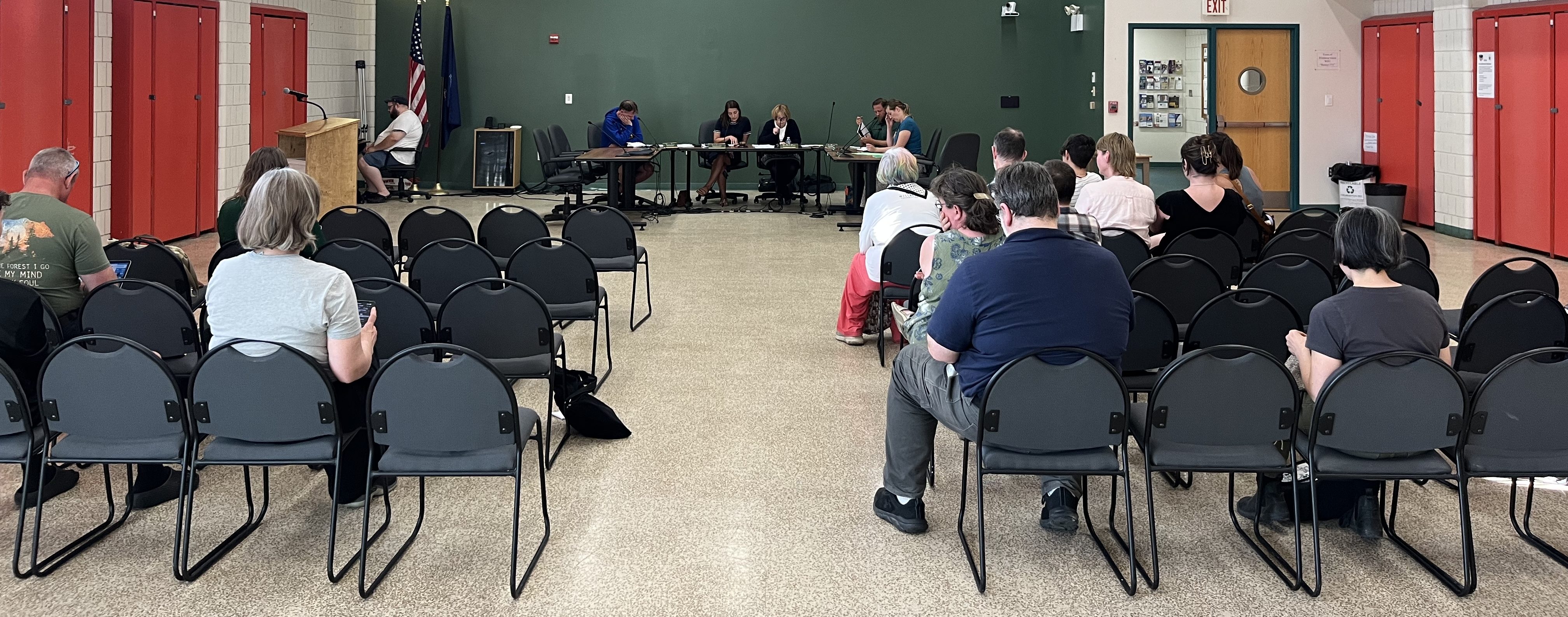
The Winthrop School Board continued its work rewriting the policy Wednesday in a workshop session at the Winthrop Town Office. While no action was expected to be taken on the policy, over a dozen town residents gathered to observe the meeting and give public comment.
Many said they are concerned about the financial and ethical implications of the policy, while no members of the public spoke in favor of it.
The Maine Human Rights Commission is currently suing seven school districts in Maine for their policies on transgender students. The policies were adopted after President Donald Trump issued an executive order on the federal discrimination law Title IX, but they fail to comply with the Maine Human Rights Act.
The Winthrop policy will be reviewed again at the August policy committee meeting and then will be tabled until “if at any future date, we need it,” Superintendent Becky Foley said.
If a decision is reached in the Maine Human Rights Commission lawsuit, then the board would reexamine the policy. Foley also said the policy would not move to a first read “until there’s an issue that arises in Winthrop” relating to transgender students.
Principals at all three Winthrop schools have said they are not aware of any transgender students in the school system, and Joel Stanton, Winthrop High School athletic director, said he also is not aware of any transgender student athletes in his12 years in that position.
Winthrop board members began the meeting by discussing vague language in the policy and whether it should account for specific situations like those involving overnight accommodations. Foley argued the policy was written in such a way to give administration room to handle situations as they arise.
“It was, from my perspective, written a little bit vague to give leeway, to ensure that all students have access to spaces at school facilities that accommodate everyone’s privacy concerns,” Foley said. “I think the more specific you get, the more you might be creating something that makes more people uncomfortable than your intention.”
The School Board previously faced criticism in March for voting to rewrite the policy without giving advanced notice to the public. Despite pushback from residents, the board agreed in April to continue rewriting the policy instead of delaying any action to November, as board member Libby Wright suggested.
A Maine citizens’ initiative by the group Protect Girls Sports in Maine to include a November ballot question asking whether transgender students should be prevented from playing on sports teams and using locker rooms and bathrooms that align with their gender identity was recently invalidated after failing to obtain enough signatures. A Superior Court judge confirmed the decision earlier this month after the group argued against the invalidation.
The Rev. Chrissy Cataldo, a pastor at Winthrop Congregational Church, said the main threat to cisgender female students (students who were assigned female at birth and identify as female) is not transgender children, but often adults in power.
“I would invite you to consider the brave girl who will be a part of this school district one day, and realizes that it’s ridiculous that her school would prevent her from playing the sport she loves. And her parents will agree with her, and they will sue this district and they will win. And the people of Winthrop will pay the price,” Cataldo said.
“We have some of the lowest paid teachers in the area, and I feel that we have clawed our way back from some serious mismanagement of financials. I feel that it would not be beneficial financially for us to make this policy change,” said Amy Griswold, a Winthrop parent.
“The policy, if put in place, will be a millstone around Winthrop schools’ necks,” Cataldo said.

Comments are not available on this story. Read more about why we allow commenting on some stories and not on others.
We believe it's important to offer commenting on certain stories as a benefit to our readers. At its best, our comments sections can be a productive platform for readers to engage with our journalism, offer thoughts on coverage and issues, and drive conversation in a respectful, solutions-based way. It's a form of open discourse that can be useful to our community, public officials, journalists and others.
We do not enable comments on everything — exceptions include most crime stories, and coverage involving personal tragedy or sensitive issues that invite personal attacks instead of thoughtful discussion.
You can read more here about our commenting policy and terms of use. More information is also found on our FAQs.
Show less