
I am a card-carrying member of the Maine Beer Mavens. We’re an intergenerational group of women who gather regularly for a session at one of the ever-growing number of Maine breweries (there were 50 at last count) to talk about hoppy flavor profiles, ponder natural fermentation, and yes, drink good beer.
At every stop on the Maine Beer Trail we learn how the process of making beer is making its mark on the local food scene. Most of the labels on Maine beers lack terms like “organic,” “sustainably harvested” or “green certified,” so let me connect a few of the dots.
There are four basic ingredients in beer: hops, grain, yeast and water.
Since water accounts for up to 95 percent of beer’s content, Nathan Sanborn of Rising Tide Brewing Company says his company’s sustainability efforts focus on water conservation. His team monitors water usage and has consolidated equipment-cleaning procedures so less water and cleaning chemicals can be used to sanitize more gear. These efforts have helped the company cut usage by 35 percent.
But his biggest water-saving effort is facilitated by a heat exchange mechanism that allows heat from one fluid to pass to a second fluid without the two fluids getting mixed together. Malted grain is soaked in hot water (the first step in brewing beer) that is brought to a boil (the second step) and then sent through a series of metal plates in the exchanger, cooling the beer down to the right temperature for fermentation to occur (the third step) and heating up the plates. Then, cold water is pumped through the exchanger, where it picks up the heat from the plates, making it the correct temperature to soak the next batch of malted grain.
Allagash Brewing Company buys renewable energy credits from multiple wind farms to offset the electricity use and resulting emissions of its operations. In terms of repurposing waste products, Allagash gives more than 57 tons of spent (or used) grain per week to local farmers to use as cattle feed; the company also harvests its used yeast and pays a local farmer to take it and use it as fertilizer.
Local breweries are thirsty for more local, raw ingredients, like hops, a crop that 100 years ago flourished in Maine. The Hop Yard, a two-site farm (North in Fort FairField and South in Gorham) dedicated to growing Sterling, Nugget, Cascade, Willamette and Centennial hops, set up its trellises in 2011. (Hops are vines; actually, they are technically what’s known as bines, but that’s another story.)
Fifteen Maine breweries bought the farm’s entire crop – over 10,000 pounds – last year. Farmer Ryan Houghton says he and three partners control weeds between the trellises through tilling and spraying at this point, but recently won a grant to use grazing sheep for that purpose on a trial acre of organic hops.
Interested in talking more about the local beer scene and its efforts to become even more sustainable? Join me, Sanborn, Houghton and Joel Alex of the Blue Ox Malthouse at Rising Tide’s brewery, 103 Fox St. in Portland, at 6 p.m. Thursday. This event is the second in the SoMaine speaker series sponsored by Source and Whole Foods. Tickets cost $10; you can buy them in advance through Eventbrite or at the door.
Christine Burns Rudalevige is a food writer, recipe developer and tester, and cooking teacher in Brunswick. Contact her at [email protected].
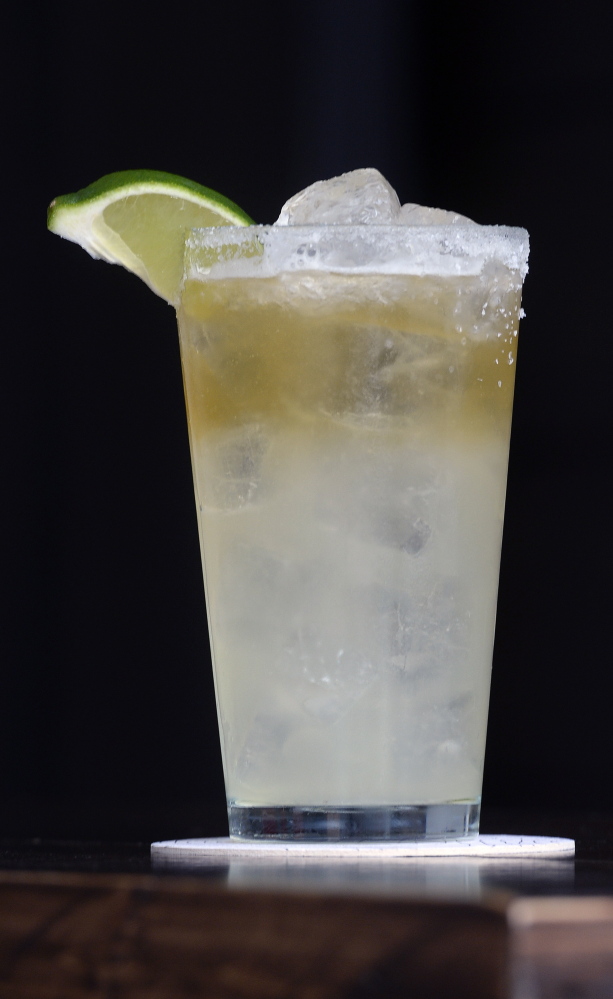
La Vela
Many craft beer drinkers take their brews straight up. But Rising Tide’s Nathan Sanborn trusts that his beer is in good hands with Portland Alpine & Hunt Club’s cocktail creator, Andrew Volk. The goal with this drink, explains Volk, was to create something he’d want to drink in the backyard on a summer afternoon – refreshing and easy to make. Mezcal is often described as tequila’s smokier cousin; the lime and agave bring a margarita to mind. Pairing these ingredients with Rising Tide’s Spinnaker Hefeweizen was a natural choice for Volk because, he says, it’s got a great malt and citrus backbone.
Makes 1 cocktail
Salt
1½ ounces Del Maguey Vida mezcal
¾ ounce fresh lime juice
¾ ounce agave syrup
6 ounces Rising Tide Spinnaker Hefeweizen
Lime wedge
Rim a pint glass with salt. Combine the next three ingredients in a shaker with ice. Give a quick shake and dump contents into the prepared glass. Fill with the Spinnaker Hefeweizen, garnish with the lime wedge.
Comments are no longer available on this story