
I regret to tell you: Vegan cake used to be awful.
Also, vegan cupcakes, cookies, pies, brownies, doughnuts, you name it. Sure there were exceptions here and there. But 20 years ago, if a baked good was vegan, chances are taste wasn’t its top feature.
Oh, how times have changed.
Just the other weekend I overheard a close family member, someone who’d suffered through many a vegan cake for me over the decades, remark with surprise at a birthday party where the bakery-made cake was vegan that “vegan cake is actually good now.”
I agree.
Today’s vegan baking is aided by a wealth of plant-based substitutions stocked on supermarket shelves along with years of work by professionals, cookbook authors and bloggers who’ve figured out how to make vegan cakes that everyone wants to eat.
For those new to vegan eating, baking can seem impossible since traditional recipes rely on eggs, butter and milk. Must Grandma’s cookbook be tossed?
To answer this question and to learn what it takes to make appealing plant-based treats, I turned to three vegan bakers from the Pine Tree State and asked for their secrets. I can’t say whether or not they divulged all their techniques and substitutions, but I did find areas of agreement as well as preferences that distinguish each baker’s style.
Missy Christy Maidana, a former executive pastry chef at Pure Food & Wine in New York City and now the owner of Sol Food, a personal chef business in Arundel, said that baking vegan doesn’t have to mean ditching Grandma’s recipes.
“My grandmother was a really great baker,” Maidana said. “I enjoy taking her recipes and veganizing them. There are so many substitutions now.”
Her grandmother’s banana bread originally called for butter and eggs. “I simply swapped them out with Earth Balance and potato starch,” Maidana said. (See recipe.) She also switched to organic sugar, which is vegan while conventional sugar is sometimes processed with animal bones.
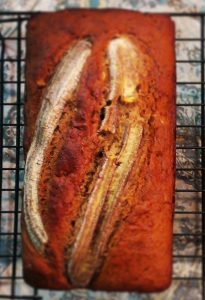
Private chef Missy Christy Maidana veganized her grandmother’s banana bread recipe. Photo by Missy Christy Maidana
Maidana developed raw vegan desserts for Pure Food & Wine – a high profile restaurant that is now closed – through trial and error. But for more traditional baked goods, she prefers taking existing recipes and subbing in plant-based ingredients.
Today plant-based milks can stand in for cow’s milk in cold cereal and baked goods alike, and they come in a cornucopia of varieties including almond, coconut, cashew, hemp and flax. Soy milk and pea protein milk have the highest protein contents, while oat milk has the highest sugar content, an appealing quality to bakers.
Maidana uses oat milk (made by soaking oats in water, blending and then straining the liquid) for baking because of its flavor. Laura Cabot, who owns a catering company by the same name in Waldoboro, also likes oat milk for baking.
“Cakes made with oat milk look better, and the crumb is nice and moist,” said Cabot, who ran Pine Cone Cafe in Waldoboro for 23 years. “Those are the things I’m looking for.”
It also “helps baked goods brown,” according to testing conducted by America’s Test Kitchen for its vegan cookbook, “Vegan for Everybody,” which was released last year.
Any plant-based milk can be swapped one-for-one with cow’s milk in baking recipes.
Amy Alward, who owns Love Kupcakes in Portland, said the bakery prefers to use coconut milk in its vegan cakes, cupcakes and whoopie pies – that last is a new addition.
“We like how it bakes off,” Alward said. “You won’t taste the coconut in something you bake with coconut milk.”
The coconut milk that Love Kupcakes uses is the kind sold in the dairy cooler or plant-based milk aisle, not the thicker coconut milk sold in cans, which is common in curries and Southeast Asian soups.
Like Maidana, Alward and her staff often veganize traditional recipes.
“It’s very easy substituting out butter and eggs,” Alward said. “We have a lot of the basic knowledge in-house. If we need to, we do a Google search and look at vegan substitutes.”
The go-to butter replacement at Love Kupcakes is Earth Balance, a brand of vegan butter substitute made from vegetable oil and thickeners. Cabot favors Earth Balance, too.
Maidana’s preferred swap for butter varies. For buttercream frostings, she uses Earth Balance. For a batter, she uses refined coconut oil with a pinch of salt.
In her 2017 cookbook “Veganize It!”, Robin Robertson includes a recipe for Easy Vegan Butter that includes both refined coconut oil and salt, alongside other ingredients.
All can be substituted without adjustment in place of butter.
Substitutes for eggs vary depending on what role the egg plays in the recipe, such as binding, leavening or both.
“For a banana muffin, I use bananas” as a substitute for eggs, Cabot said. “For something more savory, I’d go with flax or chia or soy (protein powder). I use agar agar or arrowroot for a gelatin-like finish on a fruit tart or pie. Agar agar is better for uncooked dishes and arrowroot is better for cooked.”
Alward said she doesn’t have a standard one-for-one swap for eggs. Instead Love Kupcakes’ vegan recipes use a combination of cornstarch, baking soda and vinegar to replace the binding and leavening properties of eggs. (Recipes for cakes that use baking soda and vinegar in place of eggs are thought to originate during the food rationing of World War II or possibly the Depression; a famous chocolate version is known both as Crazy Cake or Wacky Cake.
At Sol Food, Maidana substitutes 1 1/2 teaspoons of potato starch mixed with 2 tablespoons warm water for each egg called for in a traditional recipe. If she’s out of potato starch, she makes a standard vegan flax egg. (See fact box for instructions.)
“Some people like to use applesauce or bananas or sweet potatoes in place of eggs,” Maidana said, “but I feel they change the flavor and consistency.”
In the classic “Vegan Cookies Invade Your Cookie Jar,” authors Isa Chandra Moskowitz and Terry Hope Romero use cornstarch or arrowroot powder in “more delicate cookies” and ground flaxseeds in “dense cookie dough loaded with whole grains, nuts, or chips.”
To replace cream cheese in a raw cheesecake, Maidana uses soaked cashews mixed with nutritional yeast, acidophilus and lemon.
Similarly, Cabot makes cheesecake from homemade cultured cashew cheese. To make sour cream, Cabot blends silken tofu with an acid component, such a lemon juice. She uses blended avocado to create a creamy chocolate mousse.
These days, it seems bakers have figured out how to reproduce almost any baked good or treat in a delicious vegan version. With one exception.
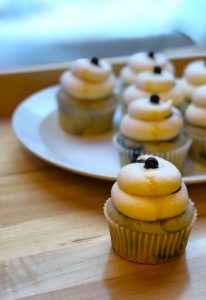
At Love Kupcakes, vegan blueberry-maple cupcakes are a customer favorite. Photo by Taylor Witham
At Love Kupcakes, Alward said the bakery is struggling to perfect its vegan caramel.
“The problem when you’re making caramel and using coconut milk and coconut sugar and things like Earth Balance, is the tremendous costs,” Alward said. “Making a quart of that vegan costs five to six times as much” as a dairy-based version.
Home cooks may be able to afford the occasional splurge, but such costs can swiftly subtract from the bottom line of a commercial kitchen. Alward, who is committed to using top quality ingredients, remains hopeful the cost will eventually come down.
“I want to deliver something everyone can try,” Alward said.
The high price of vegan caramel aside, those looking to make vegan baked goods will find today’s ingredients and techniques make for plant-based desserts both vegans and non-vegans will enjoy. And for any vegan baked good skeptics faced with a vegan treat at a restaurant or party, Maidana offers simple advice: “Be brave and just try it.”
Because – I am happy to tell you – vegan cake is actually good now.
Avery Yale Kamila is a food writer who lives in Portland. She can be reached at:
twitter.com/AveryYaleKamila
RECIPES
Sol Food’s Grammy Ferry’s veganized banana bread
Throw overripe unpeeled bananas in the freezer. The peels will turn black, but once you thaw the bananas, the peels will slide right off and you’ll have bananas for bread (or smoothies) at the ready.
Scant 3/4 cup organic sugar
1/4 cup Earth Balance, at room temperature
1 1/2 teaspoons potato starch
2 tablespoons warm water
1 teaspoon vanilla extract
3 very ripe bananas, mashed, plus 1 whole ripe banana (optional)
2 cups all-purpose flour, sifted
1 teaspoon baking powder
1 teaspoon baking soda
1 teaspoon salt
1/2 cup whole walnuts
Heat the oven to 375 degrees F. Grease and flour an 8 x 4-inch loaf pan.
Cream together the sugar and Earth Balance in a large mixing bowl.
In a separate small bowl, whisk the potato starch, warm water and vanilla extract.
Add the potato starch mixture and the mashed bananas to the creamed sugar.
Sift together the flour, baking powder, baking soda and salt. Then add to the creamed mixture until just combined.
Fold in the walnuts.
Pour the batter into the prepared pan.
Slice the optional whole banana lengthwise and place two strips on top of the length of the bread.
Bake about 45 minutes or until the bread is golden on top and a toothpick inserted into the center comes out clean.
Laura Cabot Catering Cinnamon-Rhubarb Pie
Makes 2 large pies
2 single-crust pie crusts
FILLING:
8 cups large-dice chopped rhubarb, stringed
Zest of 1 lemon
3 1/2 scant cups organic sugar
1 tablespoon vanilla extract
1/2 teaspoon cinnamon
1/2 teaspoon nutmeg
Pinch salt
1 1/2 cups quick-cooking tapioca
CRUMB TOPPING:
2 sticks (1 cup) vegan butter, plus 2 tablespoons
2 cups all-purpose or whole wheat flour
2 1/2 cups light brown sugar or organic sugar of choice
1/4 teaspoon ground cinnamon
1/4 teaspoon freshly ground nutmeg
1 cup rolled oats, crushed in hands
1 cup roughly chopped walnuts
To make the crust, either use your favorite recipe, replacing the butter with a vegan substitute, such as Earth Balance, or buy vegan pie crusts.
To make the filling, combine all ingredients. Cover tightly and let sit at least an hour, or overnight stirring a few times. It will thicken as it sits.
To make the streusel, use a pastry cutter to cut the vegan butter into the flour until the lumps of butter are the size of peas. Add the sugar, cinnamon, nutmeg, oats and walnuts and toss together. The mixture can keep in the refrigerator, covered, for days.
Preheat the oven to 375 degrees F.
To make the pies, line two (9-inch) pie pans with rolled-out crusts, leaving 1 inch of crust extending over the edges of the pie plates. Crimp the edges of the pie crust in an attractive manner. Divide the filling mixture between the 2 pies, then top the pies with the streusel, divvying it up evenly between the 2 pies. Top each pie with a pat, about 1 tablespoon each, of vegan butter. Bake until the topping is browned and the filling is bubbling. Start checking at 40 minutes, but depending on your oven, the pies may need as long as 55 minutes.
Let the pies cool for several hours before cutting them. Slice and top with vegan vanilla ice-cream (such as Rice Dream brand vanilla).
Love Kupcakes’ Vegan Blueberry-Maple Cupcakes
Makes 2 dozen cupcakes (or rather kupcakes)
3 1/4 cups flour
2 1/4 cups sugar
3 tablespoons cornstarch
1 teaspoon baking soda
1 teaspoon baking powder
2 3/4 cups coconut milk
1/2 cup canola oil
2 teaspoons white vinegar
2 tablespoons vanilla extract
1/2 cup frozen blueberries
Pre-heat the oven to 335 degrees F. Line 24 muffin cups with cupcake liners or grease the pans well.
Whisk together the dry ingredients in a bowl. In a separate bowl, combine all the wet ingredients. Slowly add the wet ingredients to the dry and mix until there are no lumps. Fold in the blueberries.
Bake the cupcakes for 21 minutes or until a toothpick inserted into the center of a cupcake comes out clean with just a few crumbs clinging to it. While the cupcakes are baking, rotate them every 7 minutes to ensure even baking. Other clues to know when the cupcakes are done: remove them from the oven right before they spring back when you touch them. They should still be slightly tender on the top; keep in mind, they continue cooking in their tins even after you take them out of the oven. Wait until they are cool enough to touch, then remove from their tins to finish cooling. Once they are room temperature, you are safe to start frosting.
MAPLE FROSTING:
This makes a generous amount of frosting but Love Kupcakes frosts the cupcakes generously.
1 pound Earth Balance
6 cups confectioners’ sugar
1 tablespoon coconut milk
2 teaspoons vanilla extract
1 teaspoon natural maple extract
Add the Earth Balance and confectioners sugar to a stand-up electric mixer. Turn the machine on its lowest setting to start to combine the two, while making sure the sugar doesn’t go flying everywhere. Increase the speed gradually. Once the butter and sugar are incorporated and fluffy, add the coconut milk and the vanilla and maple extracts. Beat on high for 30 seconds until everything is combined. Do not overmix.
How to make a flax egg
FOR A SINGLE EGG, mix 1 tablespoon ground flax seed with 3 tablespoons water. Let set.
Comments are no longer available on this story