

Votes are being tallied up after an Election Day that featured strong turnout for Maine’s primary and municipal elections, but many results won’t be clear for days as ranked-choice runoffs become necessary.
Graham Platner clinched the Democratic nomination for U.S. Senate, with the Associated Press calling the race for the political newcomer around 9:20 p.m.; he will face off against five-term Republican Susan Collins in November.
In the gubernatorial race, five Democrats and seven Republicans are vying for spots on the November ballot to succeed Gov. Janet Mills, who is termed out of office. Early results show Bobby Charles, an attorney and former U.S. assistant secretary of state, with a healthy lead on the Republican side, while the Democratic race was tightly bunched and expected to go to a ranked-choice runoff.
The primary to determine which Democrat will face Republican former Gov. Paul LePage in the 2nd Congressional District race to succeed U.S. Rep. Jared Golden is headed to a ranked-choice runoff.
Follow along for live updates from our reporters across Maine and go to pressherald.com/election2026results for the latest results.
Election night results starting to taper off
As midnight approaches, results — which had been rolling in steadily since about an hour after polls closed — have slowed. With things quieting down, we’re going to wind down live coverage and leave you with the latest updates from the top races:
- Graham Platner clinches Democratic nomination to take on Susan Collins in Maine Senate race
- Bobby Charles surges to the top of Republican governor primary
- Extremely close Maine Democratic governor primary likely headed to ranked-choice runoff
- 2nd District Democratic primary going to runoff to determine who faces Paul LePage in November
All our results can be found here.

Many city councilors and school board members said this year’s budget season was particularly difficult and painful.
The board voted to close James O. Kaler Elementary School and cut nearly 80 positions to shave off about $8.4 million to keep the tax increase to 6%.

The Republican nominee will face the tall task of beating U.S. Rep. Chellie Pingree, D-Maine, in November. Pingree, a 71-year-old progressive from North Haven, has represented the 1st District for nine terms, and has won most reelection bids with ease since her first congressional race in 2008.
Read more here.

The approved budget represents a 7.1% increase in spending. Salary and benefit increases and special education costs were significant cost drivers this year.
In Pownal, Melissa Jordan beat out Meaghan Arena, 309-283, to win an RSU 5 school board seat, according to unofficial results Tuesday night. In Durham, Anne Ware was elected to the board in an uncontested race.

The school board will now be left to renegotiate the budget and pose it to voters again in a special election to be set at a later date.

Cummings, meanwhile, received 579 to challenger Joshua Allen’s 502. Another 221 voters skipped that race or wrote in another candidate.
The town council and school board unanimously voted to support this budget earlier this spring.

Fayette voters elect select board, school board members
FAYETTE — Brian Holman and Daniel Rooney won seats on the board of selectmen in Tuesday’s election. Holman received 319 votes and Rooney 262.
In the school committee race, Nancy Cronin and Robin Holman were elected. Cronin received 260 votes, Holman 217 and Ali Bichler 120.

Saco voters approve $59.9 million school budget
Saco voters overwhelmingly approved the city’s proposed $59.9 million school budget during Tuesday’s election.
According to initial results, 3,700 voters were supported the budget, while 1,046 were against. Another 123 voters left the budget question blank.


Raymond to hand-count ballots amid high turnout
Raymond will hand-count its local ballots on Wednesday. According to Town Clerk Melanie Fernald, an unexpectedly high turnout exhausted the town’s supply of preprinted local ballots.
Races include a special select board election, in which an ousted select board member competing to serve the final year of his three year term, as well as the town’s votes on the RSU 14 school budget.
Majerus-Collins, a Bates College and Boston University of Law gradudate, ran on a platform prioritizing cost-of-living and immigrants’ rights. A “fearless progressive,” the young attorney told the Sun Journal that “when the going gets tough, and the far-right summons its money and power to attack the most vulnerable people in our community, I don’t flinch and I don’t stay on the sidelines.”
Read more here.

The budget was first pitched in March at $57.9 million. Following community input, MSAD 51’s board of directors and staff trimmed it, cutting items including new classroom furniture, bus monitors and special education equipment to reduce the plan by 2.1%.
The approval is similar to last June, in which North Yarmouth voters again disapproved of the budget but Cumberland voters carried it to passage.
There were 941 total ballots cast on the question, including 34 blanks or voids.
The vote does not require the town to take a specific action but gives the select board direction as it considers options.
“Bobby won Lewiston two to one!” his campaign manager, Joel Stetkis, shouted while monitoring results on a phone.
The smaller crowd of supporters staying late at the watch party joined together to sing “The Star-Spangled Banner” and then pray in a small circle.
A few of his supporters shared a common sentiment: They only marked Charles on the gubernatorial ballot and did not rank any Republicans behind him, following Charles’ suggestion ahead of Tuesday.

Lewiston OKs school budget on 2nd try
LEWISTON — Voters on Tuesday passed the $128.4 million proposed Lewiston school budget in a vote of 2,872 to 2,680 after a previous proposal was defeated in May.
Next year’s school budget represents an increase of 9% over the current year’s spending and a 4.4% increase to what the city will raise through taxes to support the budget.
According to the initial results, 759 voters said the town should cover the full municipal cost of no more than $35,000, while 411 voters said the town should cover half that amount. Another 680 voters said municipal funding for the celebration should be cut altogether.
The Kennebunkport Selectboard will use the results to determine the language for a funding referendum that voters will decide on come November.
Read more here.


Town Council Chair Brooke “Tig” Filson was reelected unopposed to continue representing Cumberland Center.
Voters elected Sara Staples and David Noonan to represent Cumberland on the Maine School Administrative District 51 Board of Directors.
Staples received 2,080 votes and Noonan 1,553. Meredith Koerner received 1,440 votes and was not elected.
The town also narrowly approved its $13 million municipal budget, with 1,418 votes in favor and 1,299 votes against.
The final budget came after months of deliberation between the school board and Town Council, which resulted in nearly $2 million in cuts to the initial budget.
The school budget is expected to result in a 2.7% tax increase. Taking into account the municipal and county tax assessments, residents can expect to see a 5.2% tax hike on their property bills.
Voters also approved Falmouth’s $55.6 million school budget, 3,581-983. The budget increased 6.19% from last year.
“We are confident we are going to win this primary,” Charles said to cheers.
Before reiterating his desire to eliminate Maine’s income tax, deport undocumented immigrants and lower energy costs, Charles also alluded to how the Republican primary turned nasty at times amid attacks between Charles, who skipped several televised debates, and his opponents.
“Every one of my fellow Republican candidates would be a better governor than Janet Mills,” Charles said.
“Except for David Jones,” one supporter replied, referring to the Falmouth real estate leader who went after Charles earlier in the primary.
Charles nodded to the candidate who could complicate his efforts to win the November election should Charles win Tuesday: Sen. Rick Bennett, an independent and former Republican from Oxford.
Bennett is tied to Augusta “insiders,” Charles declared.
His supporters had a simple response when he wrapped up his speech: “Bobby! Bobby! Bobby! Bobby!”
“Hearing their concerns and their worries, their hopes and their dreams, has always inspired me to never stop fighting for them — whether that’s expanding health care, protecting access to abortion, making historic investments in housing, delivering free school meals and free community college, or expanding broadband.
“I am grateful to Maine people and incredibly proud of what we have accomplished together. I will continue to fight with everything I have to improve the lives and livelihoods of Maine people.”
He was followed closely by healthcare executive Jonathan Bush, with former Maine Senate majority leader Garrett Mason, entrepreneur Owen McCarthy, businessman David Jones and former Paris Selectman Robert Wessels trailing further behind in the seven-way primary.
Read more here.


Several prominent state Democrats were in the crowd at Pingree’s party, including House Speaker Ryan Fecteau, D-Biddeford; House Majority Leader Matt Moonen, D-Portland; and Senate Majority Leader Teresa Pierce, D-Falmouth.
Moonen praised Pingree’s work in the Legislature, where she was House speaker from 2008 to 2010, in remarks to the crowd.
“Hannah was a champion for doing the right thing, for fairness and for equality,” he said. “She is prepared to hit the ground running on all of the challenges we’re facing right now.”
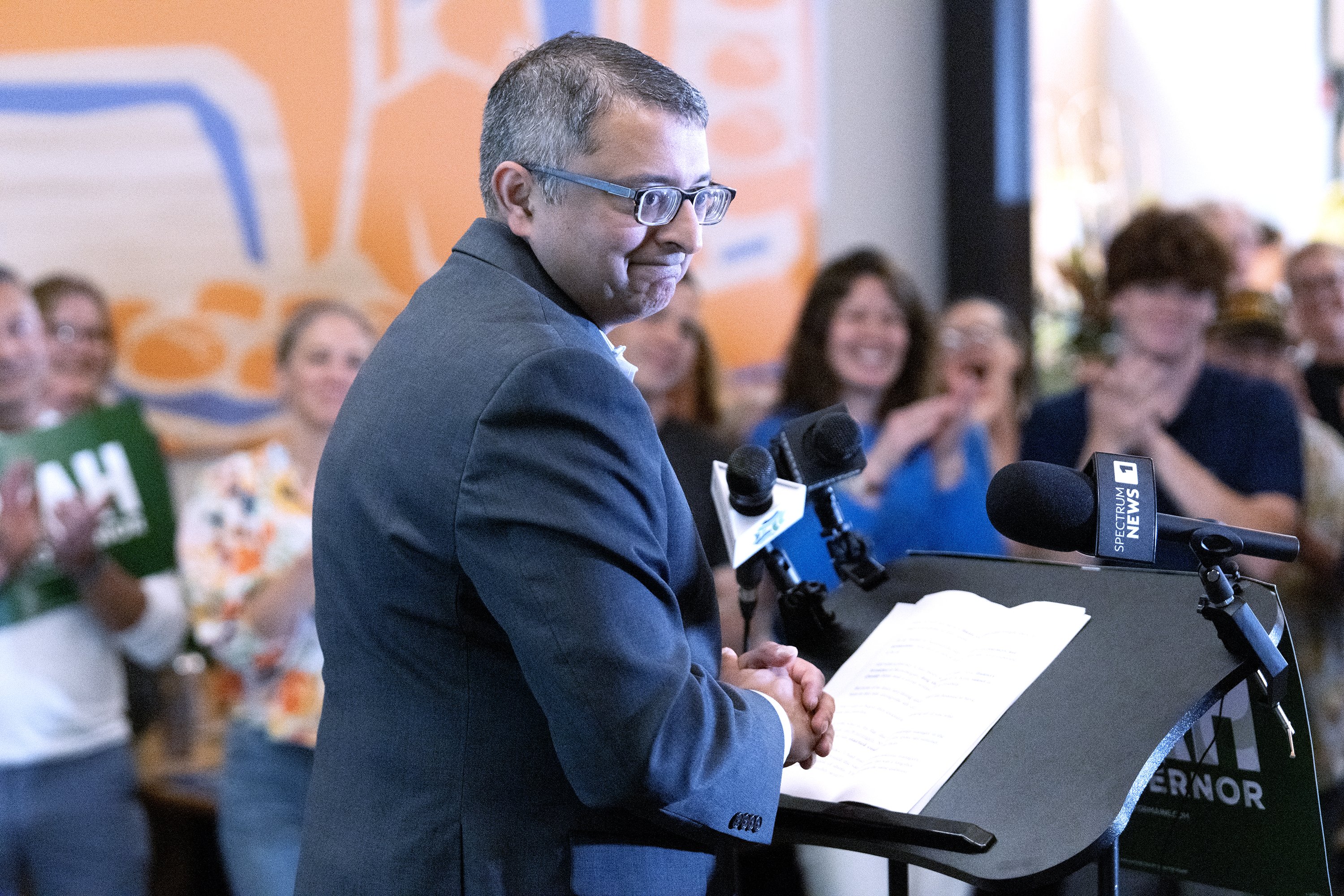
Shah entered his watch party in Wild Oats Bakery & Café, where roughly 200 of his supporters were gathered, shortly after 8:30 p.m. He thanked his campaign staff and his wife and recapped his platform, vowing to be a problem-solver in the Blaine House and a “firewall” between the Trump administration and Maine.
The event featured a buffet and beverages, with supporters filling a room in the Brunswick establishment and sitting around tables on its patio.
In separate interviews, two devoted Shah backers provided nearly identical accounts of their support for him: They admired his handling of the COVID-19 pandemic as a top state public health official, as well as his intellect and attitude — and they objected to the alliance formed by three of his primary opponents with Senate candidate Graham Platner’s endorsement.
“I really did not like the way they, the other three candidates, grouped together,” said Barbara Kent Lawrence, an 83-year-old writer. Secretary of State Shenna Bellows, state Senate President Troy Jackson and former state House Speaker Hannah Pingree formed a coalition last month asking their supporters to rank the other two candidates after them on the ranked-choice ballot.
“I think that’s nasty business,” said Ineke Schair, 77, a longtime Freeport resident. “I think they really did this to draw votes away from Nirav Shah.”
Shah’s wife, Kara Palamountain, a professor, introduced him to the crowd.
“We need serious leaders who don’t take themselves too seriously,” she said.

“I’ll never be able to explain exactly how big of a deal this is to me, for all of you to be here and be working on this with us,” Jackson said.
Jackson talked about building a political system that better represents working-class Mainers. He expressed frustration that bills that would have improved the lives of workers had been repeatedly blocked by both Republican Gov. Paul LePage and Democratic Gov. Janet Mills.
“I’m more frustrated today than when I first started 20-some years ago, because that power influence does not want to loosen their grip,” he said. “Together, we can loosen that grip.”
Jackson delivered his speech without a microphone after raising glasses and taking selfies with supporters, who held signs noting that Jackson was endorsed by progressive U.S. Sen. Bernie Sanders of Vermont.
He stood in front of a projector screen with CNN showing the results from Maine. At one point, the crowd erupted when early results showed fellow union-backed Democrat Graham Platner with more than 70% vote in the U.S. Senate primary.
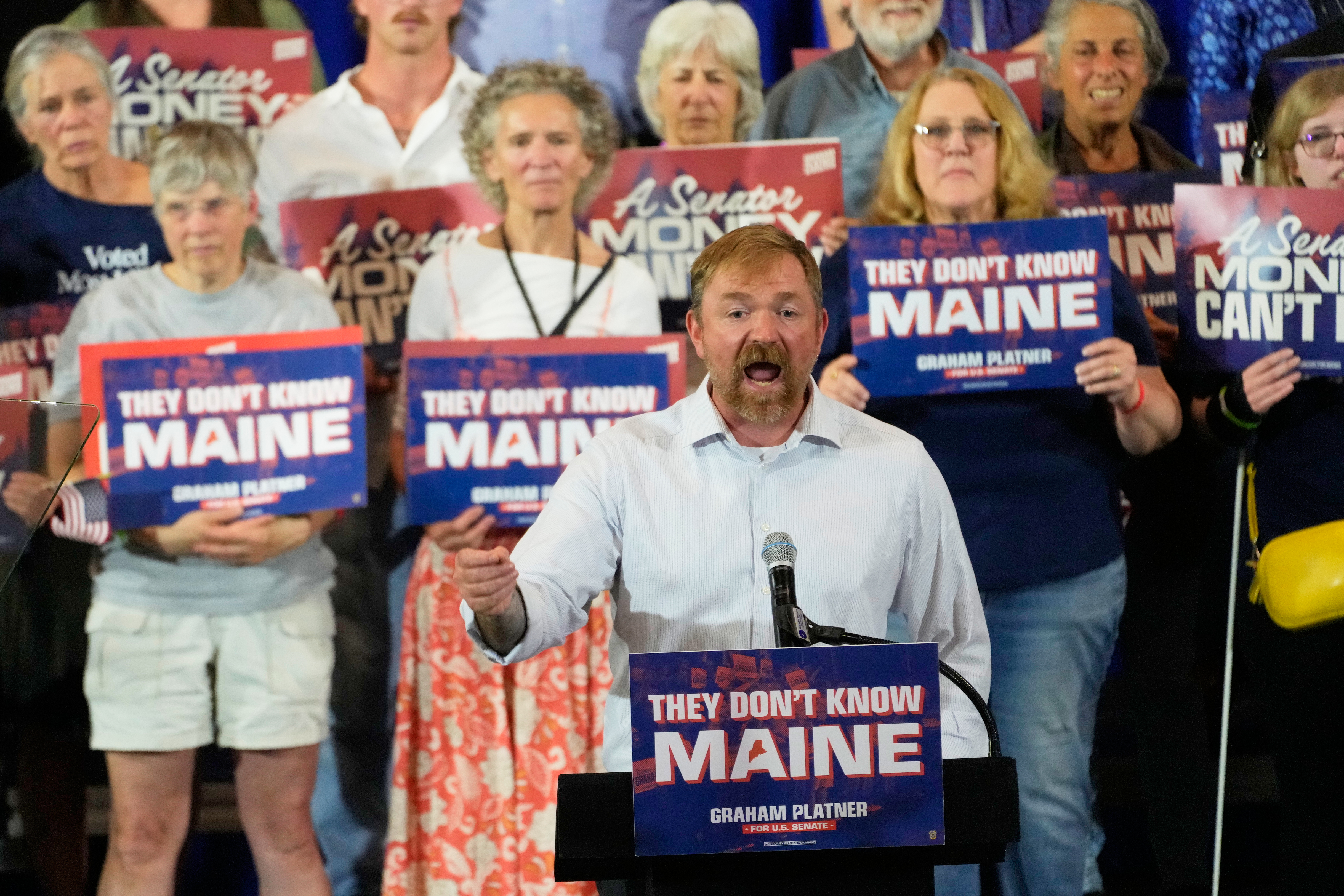

“Our nonpartisan election observers report positive voting experiences and professional, well-run election administration by Maine people serving as municipal and town clerks, election wardens, and poll workers,” said Chrissy Hart, the league’s executive director.
Volunteers reported wait times of greater than 10 minutes at nearly a dozen locations, with some having a roughly 45-minute wait time, including in Camden, Falmouth, Poland, Portland, Waterboro and Yarmouth.
The league said there were multiple instances of electioneering attempts by candidates at several polling locations, and an instance of voter intimidation in Augusta, but “no major disruptions to the election process” were noted.
Volunteers also reported multiple instances of confusion with Maine’s semi-open primaries. The league said that’s likely because voters mistakenly equated “unenrolled” and “independent” when referring to the Green Independent Party. Only unenrolled voters are allowed to vote in the primary of their choosing, while voters enrolled with the Green Independent Party can only vote in that party’s primaries.
It’s hard to draw broad conclusions from only one city that’s also home to one of the candidates in Baldacci. Returns from other towns across Maine could offer more complicated patterns of cross-race preferences.
Still, the sample of Shah-Baldacci voters largely expressed support for U.S. Senate candidate Graham Platner while acknowledging a bit of wariness over the most recent revelations tied to his past behavior.
“I do appreciate that he admitted, for the most part, when he’s done wrong,” said Jim Marcotte, 56, of Bangor, calling that honesty “refreshing compared to what we’re seeing on the other side.”
Marcotte ranked Shah and Baldacci first in their respective races, while his daughter, Sarah Marcotte, 26, said she liked Troy Jackson in the gubernatorial race after hearing his policy positions and that he appeared with U.S. Sen. Bernie Sanders in Portland.
“I’m concerned about Platner, but I think I would vote for just about anybody to get Susan Collins out of office,” Sarah Marcotte said.
Bangor resident Abby Zelz and her husband, Eric, credited Shah for his communication skills, especially during the COVID-19 pandemic. Abby Zelz, 68, added the Democrats had “an incredible slate” of gubernatorial candidates and that she’d be happy with any of them as governor.
Eric Zelz, a 66-year-old freelance illustrator whose past jobs included working for the Bangor Daily News, said Platner has done “stupid things, but at least he owns them.”
The Zelzes are both supporting Baldacci, whose election night party at Sea Dog Brewing in Bangor was slowly starting to pick up around 8 p.m. after polls closed.
Baldacci couldn’t escape critics at his own party, though: His brother, Peter, motioned to the candidate as he arrived and pointed at his blue dress shirt.
“Put on a tie,” Peter Baldacci told his brother, who laughed off the suggestion as a predictable critique from a member of an Italian family.

Had Rush been able to vote in the Republican gubernatorial primary, he says he would’ve gone with Owen McCarthy, since they’re from the same area of Maine and the two’s families know each other.
“His mother was my lunch lady,” he said.
Rush said he was uninterested in Republican frontrunner Bobby Charles: “It bothers me that he is not from Maine, and I think he’s a lobbyist.”
Amy Novak says she was Susan Collins “all the way” in the U.S. Senate race. “I don’t vote for Nazis,” she said, referring to Graham Platner’s tattoo resembling a Nazi symbol.
On the Democratic side, William Stevens, 64, says he’s not optimistic that Platner will win and cast his vote for Janet Mills, saying “she still has a chance.”
After the polls closed at 8 p.m., volunteers moved quickly through the high school gym to count the votes. Some carried extension cords wrapped around their hands; others had long strips of paper draped around their necks. Amid the bustle, first-time volunteer Alexandra Hollauer sat alone at a desk, counting from a stack of spoiled ballots.

“No matter what, this was a phenomenal campaign,” Bush said. “It’s been the joy of my life.”
Susan Pitman Lowenthal, of North Haven, has known Bush for decades and said he’s the best candidate for the job.
“He’s a very capable, passionate guy who will get done what he says he’ll get done,” said Pitman Lowenthal. “He’s the best guy to reduce taxes and empower people so businesses will come here and invest in the state.”
Former state Sen. Lisa Keim, R-Dixfield, said she loves Bush’s “positivity and his energy and the clarity of his mission.” She said she was waiting on “pins and needles” for the outcome.
“With ranked-choice voting, I know there’s a lot of people who have a first choice they’re really clear on, but no one really talks about their second,” she said. “So I don’t really have a good feel for it.”
“Democrats are going to have a huge year in 2026,” Bellows told reporters shortly after arriving. “I think I’m going to be the nominee, and I’m excited about our future.”
Bellows, the secretary of state, tasked her deputy secretary of state with overseeing Tuesday’s primaries so she could campaign.
With all of the votes cast and tallying underway, Bellows said she’s excited to spend time with her campaign staff who helped craft policies and volunteers who helped get out the vote.
“This is going to be a fun night,” she said. “It’s a celebration of the hard work that got us here and excitement about the future ahead.”
Polls are closed
Polls closed at 8 p.m. after an Election Day in which many area officials reported markedly high turnout for a nonpresidential primary election.
Results will now start to trickle in from across the state.
Several names on the ballots were in attendance greeting voters, including House District 95 Democratic candidate Kiernan Majerus-Collins and Senate District 21 Democratic candidates Shanna Cox and Mana Abdi.
The three said voters turned up in droves throughout the day, marking a hopefully high turnout.
“We’re seeing a lot of voters who are energized and ready to vote on both sides, but I feel like our voters are coming out and I’m feeling good about it,” Majerus-Collins said .
“A lot of people are excited to vote,” added Abdi.
Voter Christine Moreau said it was the gubernatorial race that interested her the most in this election cycle.
“I like Bobby Charles. … He’s got moral values, and I’m tired of ‘woke,’” Moreau said, adding that she hopes Charles can work on city problems. “Gun control, taxes, the school. There are certain things that need to get fixed and addressed.”
Moreau said she also came out to vote against the school budget.
Nicole Lemay said the school budget was one of her top priorities, too, but from the other side.
“We’re either going to invest in our children or we’re going to seal their fates,” Lemay said, adding that teachers need more support.
Polling showed a tight race, so final results are not expected Tuesday night. If no candidate secures a majority in the first round of voting, the race will be decided in a ranked-choice runoff — a process that could stretch into next week.
The bay doors of the former garage rolled open as the crowd began to arrive shortly before polls were set to close at 8 p.m. Awaiting them were platters of fruit, wraps and other sandwiches, as well as locally distilled spirits.
Campaign staffers taped up signs along the bar and over a mural of mountains, a stream and pine trees as “Start Me Up” by the Rolling Stones and “More Than a Feeling” by Boston played over the sound system.
King’s backing is meaningful for Platner because the writer is one of the state’s most famous sons and outspoken Democrats. Previously, King announced he was backing Hannah Pingree in the Democratic primary.
City Clerk Darci Wheeler said there was a steady flow of voters throughout the day — something not often seen during primary elections. The Bath Middle School voting center had to use a stockpile of unused absentee ballots after running out of Election Day ballots because of the increased turnout.
As of about 7 p.m., 1,855 in-person votes had been cast, with an additional 600 absentee ballots received.
Spencer Dahmen, 24, a lifelong Bath resident, ranked Troy Jackson at the top of his ballot, citing his progressive policies.
“I like that he doesn’t come across as a politician with the way he talks and how he phrases things,” Dahmen said.
Brenda Cummings, 62, said it was hard for her to pick which Democrats to rank for governor before ultimately deciding on Shenna Bellows as her top pick.
“I feel like all of those people have really great characteristics that would make good governors,” she said. “Too bad we can’t have a committee of governors.”
“They hit a pole near City Hall, and it nearly hit Sarah (Moore, Hallowell’s code enforcement officer),” City Clerk Lisa Gilliam said. “Went right between her legs.”
Gilliam said city staff seemed shaken up but that everyone was OK.
And then Gilliam and her election clerks went right back to work, checking in voters and processing ballots.
Robin Frank, 65, said she was drawn to the polls by the big names, particularly Democratic U.S. Senate hopeful Graham Platner. She said she is both energized by Platner’s campaign against wealth inequality and tired of the media coverage of his controversies.
Kendall Smith, 32, who showed up to the polls with Frank, agreed. He isn’t as bothered by reports about Platner’s past as national media outlets appear to be, he said.
“I’m disturbed, honestly, by the spin on this whole thing,” Frank said. “I wouldn’t put it past the Democrats to have done this all to themselves.”

Rykerson, who’s running for Senate District 35, said he hopes the Democratic Party will listen to voters’ desire for change.
“I think that we need a lot more change in the Democratic Party. I was a (state) representative for eight years, and I led the charge for impeachment of (Republican former) Gov. Paul LePage. That didn’t go over well with the Democratic Party. They thought it was too bold a move, but I believe in bold moves,” Rykerson said. “I hope the Democratic Party will hear the voters.”

Bowdoin students help at polls
Ian Bridges and Omar Frostman are Bowdoin College students interning at the Brunswick Town Clerk’s office. On Election Day, they’re helping at the polls to ensure everything is running smoothly.
Video by Evelyn Dyer

“I think what’s happening at the federal level is based on hate and cruel ideas and cruel behavior, and I don’t think we’ve sufficiently stood up to it,” said Ives, 65, a retiree who voted at the Boys & Girls Club on Broadway. “If we hadn’t elected the people who are in power now, I would feel more strongly about the personal, moral choices. But if we try to make sure everyone is morally perfect, we are going to continue to have what we’ve got.”
“In a perfect world, I would object to his past,” Ives added.
Turnout at the Boys & Girls Club, in the city’s east end near Portland Harbor, was fairly heavy for a primary, said warden Kate McCarty. By about 4:45 p.m., the polling place had seen 992 voters, which compares favorably to recent primaries.


By about 4 p.m., about 80 of Albany’s 367 active voters had cast votes, including absentee ballots.
“We need some change,” Clement said.
Clement will face Democrat Luke Jensen in the November general election. Both are former Lewiston city councilors.
Thomas Burg, a Lewiston High School math teacher, said he voted primarily to support the $128.46 million school budget.
“This vote is super important to me because I’m a school teacher and the budget is on its second vote,” Burg said. “I’ve already seen a few of my colleagues get the ax.”
Some 26 positions were eliminated during budget talks this year.
“When we already have class sizes that are growing and growing, it’d be kind of nice to at least maintain,” Burg continued. “It’s about the resources to the students, in my mind.”
Echoing many voters, Ron and Mona Morin said they came out to vote in order to affect some change in both Augusta and Washington, D.C.
“I think we need to start getting along in this country,” Ron Morin said. “There’s too much separation and division. We need some people in the right places doing the right job.”
“I’m saying, ‘Go Democrats,’” Mona Morin added, sharing a laugh with her husband.
In Augusta, a city nearly evenly split between Republicans and Democrats, the race between Blanchard, a self-declared “anti-woke” candidate, and Bérubé-Pierce, endorsed by local Democrats as pro-public education, could serve as a political bellwether — including for the local school budget, which was cut by more than $3 million by the City Council this spring. Blanchard supported the cuts; Bérubé-Pierce derided them.
Video by Ethan Horton and Tyler Wells Lynch
Rachel Nichols, a registered Democrat who grew up attending Augusta schools, said she voted against the budget because she feels it’s too low. She hopes that city leaders will boost funding for the school department.
“I don’t think you could ever pay too much for public education,” said Nichols, who attributed her admittance to an Ivy League university to having attended well-funded Augusta schools.

Resident Julie York, who works for the Poland School Department, voted in favor of the school budget.
“It was more taxpayer-friendly this year compared to other years,” she said.

Though he doesn’t consider himself a Republican, Justin Young chose to receive the Republican primary ballot and supported David Jones in the gubernatorial race.
“He’s a really trustworthy guy. … He’s very straightforward and honest with everything,” Young said .
Though he’s no fan of incumbent Republican Sen. Susan Collins, Young said he thinks progressive policies, such as those championed by Democratic candidate Graham Platner, would have a bad impact on businesses.
Marion Holmes also felt leery about Platner, though for very different reasons: She said the recent accusations about his past interactions with women and some of his old social media posts were troubling.
“I don’t want somebody in Washington embarrassing me,” she said. “I don’t want Susan Collins either, but I don’t want (Platner) doing that. I’d rather have Mills if he’s going to do that.”


“I like it,” Gerrish said. “I think it works for Maine. It seems to be working.”
Gerrish said she was curious to see how the Senate and gubernatorial races turn out.
Meanwhile, a voter who identified himself as Richard F. reflected on his changing political affiliation over the years. Despite coming from a conservative Democratic-voting working class family, Richard said he voted Republican the past few elections after losing his health insurance during Barack Obama’s presidency and accruing significant medical debt.
Over 300 people had voted in Mallett Hall by midafternoon, in addition to over 100 absentee ballots, which totals to roughly a third of Pownal’s active registered voters, Taylor-Chase said.
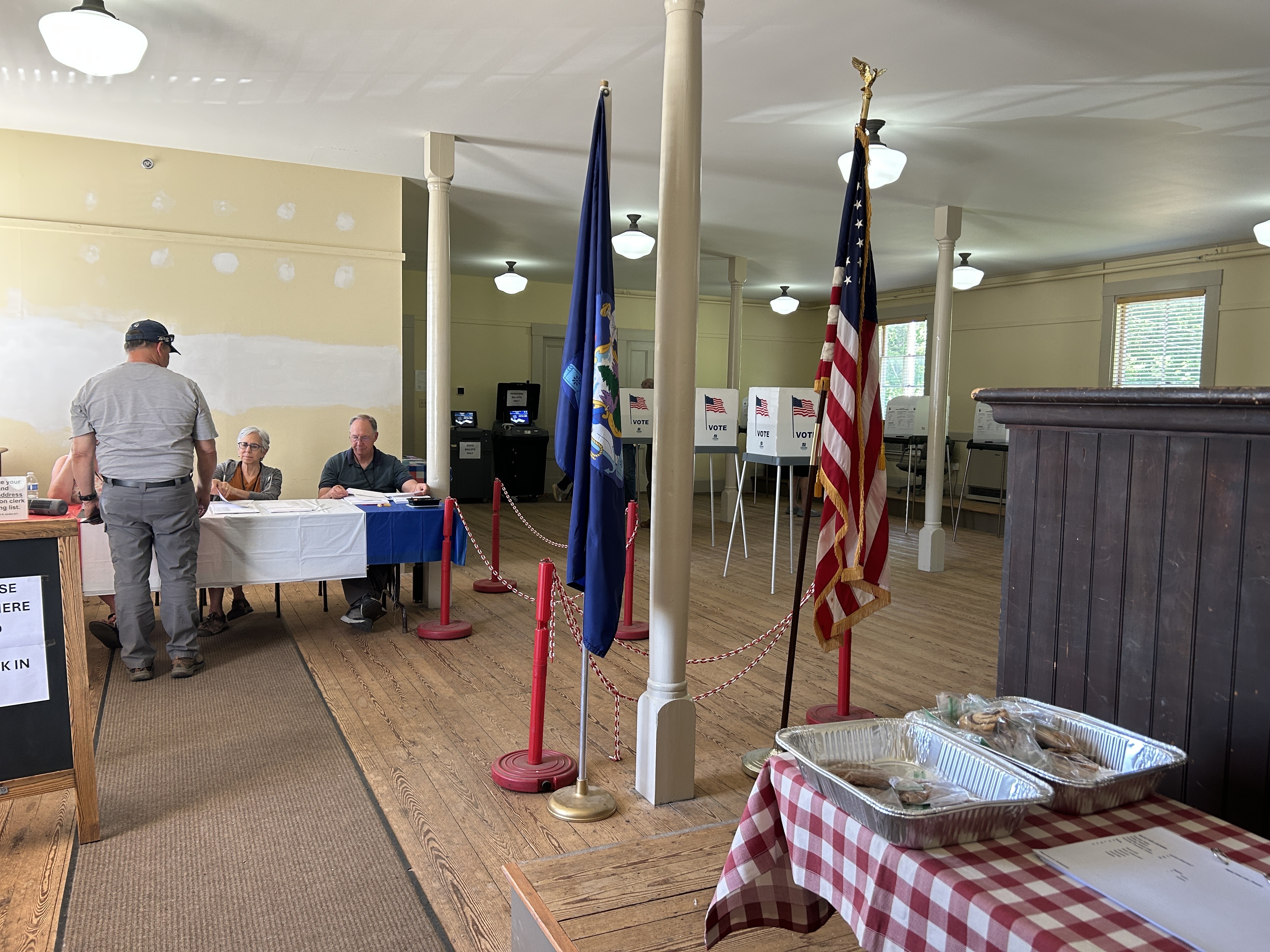
One of them, 73-year-old Gordon Scannell, said he ranked Graham Platner first in the Democratic primary for U.S. senator.
Scannell had initially backed Gov. Janet Mills, but he saw Platner speak and was impressed by the oyster farmer’s “strong, powerful message” and continued to support the candidate amid recent controversies.
“At this point, you know, what’s coming out keeps on being more damaging, but it is what it is, and I still think he’s the presumptive nominee” to challenge Sen. Susan Collins, Scannell said.
As for the cookies? Not for him.
“I’m playing hockey tonight, and I gotta watch what I eat before I play,” Scannell said.

In addition to primaries and municipal elections, a big draw for Harrison voters was question 2 on the town ballot, which asks voters if they favor a committee being drawn up to consider withdrawal from Maine School Administrative District 17.
“It sets $50,000 aside to fund the plan, (so voters) see what it would look like,” Friel explained. “Actually withdrawing would require another town vote.”
But several voters exiting the polls Tuesday morning indicated that potential withdrawal from MSAD 17 was not a high priority for them.
One voter who confirmed she supported the question to form a committee said she’s concerned a community like Harrison might be less of a draw if its elementary schools consolidate with another town.
“There’s nothing wrong with being a retirement town or tourist village, I guess,” she said. “But a community school is what would draw younger families here. I would rather see us have an elementary, middle and high school combination.”
The prospect of Harrison withdrawing from MSAD 17 first began to be raised in 2024, when the Maine Department of Education told the district that it would only cover the cost to build a new elementary school if the district discontinued using village schools.

“Nobody’s been negative,” she said.
Voters exiting onto the blacktop said they had some mixed feelings with their votes — in particular how to rank their primary votes for governor and U.S. Senate.
Todd Atkins said he voted for Graham Platner for Senate, but that the string of controversies leading up to the election caused him a little apprehension.
“We’re all flawed, and all you can hope for is that people recognize when they’ve done something wrong and try to do better,” he said. “So, I’m going on that faith.”
A voter who declined to provide her name said her vote for Platner was more of a vote against Sen. Susan Collins and the policies she supports.
“I would rather have my vote be a positive one, but this is dire,” she said.
According to city spokesperson Jessica Grondin, Portland had received 4,274 absentee ballots as of the end of the day Monday.
There’s been a lot of interest in this year’s school referendum. He said he heard voters discussing it.
Gordon Smith, 74, said he voted against the budget because he doesn’t have children in the district. “The taxes are high enough,” he said.
Kristina Grimaldi, the parent of a Helena H. Dyer Elementary School kindergartener, said that she voted in support of the school budget. She said she’s been following the process pretty closely, so she’s seen that a lot of work has gone into it.
“I feel like we need the budget to pass to achieve the necessary goals of the district,” she said.
Richard Neault, 71, has lived in South Portland for nearly 50 years. He thought the school budget was relatively fair.
“It’s important to make sure our children have a strong education,” he said.
“When (Bath Iron Works) and the schools get out, it’ll be busy,” Smith said.
Cameron Provost was one voter who casted her ballot during the afternoon lull. Provost, 22, recently graduated from the University of Maine and came home to Brunswick to vote.
“As a young person, it’s important to share your voice and things you believe in,” she said.
Provost ranked Troy Jackson first for governor. For senator, she ranked Gov. Janet Mills first, then Graham Platner.
“Some of the recent news made me reevaluate (Platner),” she said.
On the local side, Provost said she was particularly in support of a bond referendum for Region 10 Technical High School, noting the importance of the jobs the school trains students to enter.
In Democrat-heavy Portland, voter support in the governor’s race was spread out among candidates Nirav Shah, Hannah Pingree, Troy Jackson and Shenna Bellows.
“He makes perfect sense,” said Anita Fournier, a retired electrologist who ranked Shah first. Fournier said she was impressed with Shah’s leadership while he was the director of the Maine Center for Disease Control and Prevention.
“He did what he needed to do to support us, and I think he can do that again,” she said.

Many Democratic voters also said they enthusiastically voted for Graham Platner in the U.S. Senate primary, despite his recent controversies, including sexting women outside his marriage and ex-girlfriends describing unsettling behavior in their relationships with him.
Daniel Coffrin, 33, said it makes sense to him that the controversies surrounding Platner are top of mind for many people.
“It highlights in some ways that he’s a real unknown quantity,” he said. “It’s his first run for higher office, and the Senate is huge. It’s so important to have someone you can respect and trust. It feels right now like there’s a little bit of a trust deficit.”
Still, Coffrin said he has seen Platner speak a couple times and supports his platform and “broad working-class consciousness.”
“I’m enthusiastic, but it’s one of those things where you’re like, ‘C’mon, man,’ ” he said.

That’s why Dr. Nirav Shah has her top vote in the governor’s race. “He understands the healthcare economy and the roles of the state and federal government,” she said.
She’s voting for Graham Platner for Senate, and she’s already thinking about November. “I’m worried,” she said, adding that she does not want another term for Sen. Susan Collins.
By Tuesday afternoon, 1,100 votes had been cast at Cape Elizabeth’s only polling location, said Melissa Newsome, the interim town clerk. The town has also processed 1,400 absentee ballots.
Newsome said it’s been lower turnout than usual for a primary election, but she expects a rush in the evening once residents finish their work day.
“There’s a lot of time left in the day,” she said.

Sayer’s father, Mark, said he was very proud of his son and said he had been bringing Miles with him to vote for years, discussing with him how voting is one of the most important rights an American citizen has.
Greg Dixon, who voted for Platner in the Senate primary, said of the candidate, “It’s pretty hard to find perfect.”
Ken Gamache voted for Bobby Charles in the gubernatorial primary and Joshua Pietrowicz in the primary for the 1st Congressional District. Gamache said he voted for Charles because of his performance in the Republican primary debate, while he supported Pietrowicz as a young candidate “bringing new ideas.”

Natasha said while Maeve is too young to know what voting is, taking her to the polls sets a good example for her to model when she’s old enough to vote. Also, they didn’t have daycare today, so they went to the polls together.
Clarke voted in favor of the School Administrative District 11 budget, which was the only local question at the polls in Gardiner Tuesday, though she noted Maeve is still a few years away from going to school in the district.
Patricia Mansir, 69, a Democrat, said she came out to vote, in this case with her husband, who is a Republican, because she always votes.
“If you don’t vote, you shut your mouth,” she said of the importance of voting.
She voted for Janet Mills for Senate, and Angus King III for governor.
She said she voted for Mills because she admires her stamina, and King because she likes him. However she said she’s a fan of Susan Collins, the Republican candidate for Senate, and she’d probably have voted for her, if she could have.
The Kells said they ultimately want to see Sen. Susan Collins defeated in November, saying she’s bowed to the Trump administration.
“Senator Collins served us well on the state level, but not on the federal level,” Kerry Kells said.
On Brunswick’s school budget, the Kells took a more conservative approach, voting down the $61.2 million proposal. They said high property taxes are the reason.
“The town has overspent on the police department, the fire station,” Kerry Kells said. “Our taxes are $8,000.”
“There was a lot of confusion, it’s unfortunate,” Cutler said as a steady but slow stream of voters came into the Boys and Girls Club gym to vote. “There was no one for them to vote for.”
Cutler said some voters were also confused by ranked choice voting. She pointed out that instructions on how to vote by ranking your choices for candidate were in each voting booth. But some voters made mistakes. If they realized they’d made a mistake, they were allowed to turn in their ballot to a poll worker, for it to be deemed spoiled and get a fresh ballot to give it another try.
Cutler said turnout, while much slower than in a general election, was strong for a primary.
“It feels like both parties feel this is a critical election,” Cutler said.
“The line has been going around the corner,” Deering said.
Steve Boardman, 72, said he thinks local races, such as the town board of selectmen, are especially important. He voted for one of the incumbent candidates for the board but did not disclose who.
“I was impressed by him when I met with him about the details of how they could try and control the budget,” said Boardman, a Buxton resident for 46 years.
Seth Robinson, 40, came to vote with his two five-year-old children. He said he wished the ballot had shown the party affiliation of MASD 6 school board candidates so that he could have felt more informed.
Mills said she was planning to vote in her hometown of Farmington later Tuesday, and then would be going fishing.

Kennebec County Register of Deeds Matthew Boucher and District 64 House of Representatives candidate Shawn Packard also made appearances later in the day.
In conversations with voters, Boucher highlighted affordability and housing issues, while Packard focused on transparency and accountability in government.
But while Packard felt voters are unhappy with their current government, he said they’re also hopeful and ready for change.
But when Platner was revealed to have a Nazi tattoo, Mann, who is Jewish, was very upset. She tore the Platner sign out of her lawn.
When Platner said that the tattoo was a mistake and covered it up, Mann was all the more ready to get out and vote for him.
“I like to see people changing,” Mann said.
“I don’t know why people are voting for it to fail because, just make it easier for the educators, you know,” she said.
Jones is registered as a Green Party voter and couldn’t vote for the Democratic nominees she supports, though she is hopeful they win their primaries, she said. In the Democratic primary she supports Graham Platner for U.S. Senate, Troy Jackson for governor and Paige Loud for Maine’s 2nd Congressional District.
“I think Troy Jackson and Graham Platner are going to be the bridge to more progressive politics in Maine and working class solidarity across the state as well because they’re truly the two candidates that have spoken the most about values that align mostly with me,” she said.
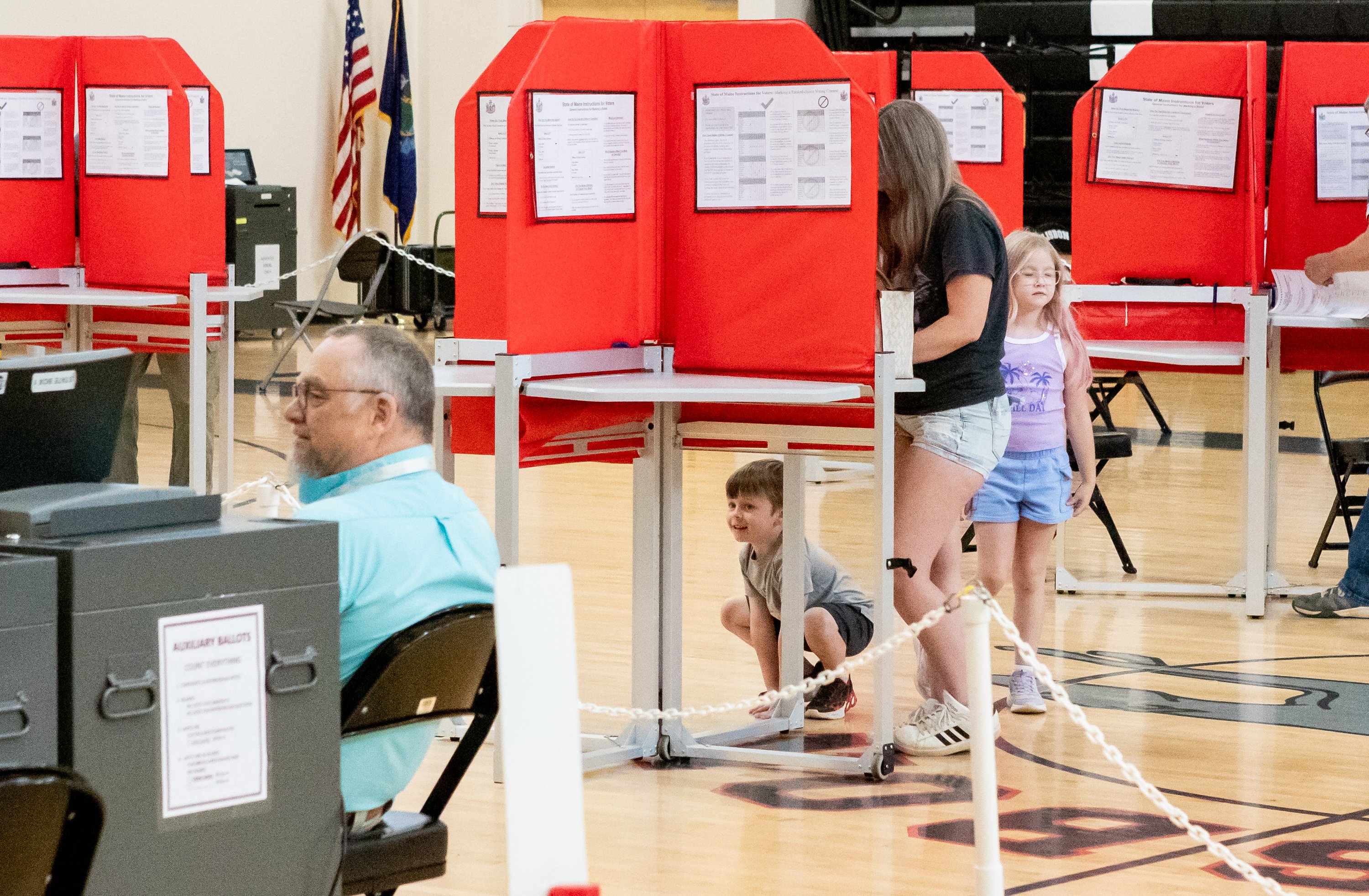
Martha Young voted against the school budget because she felt it was too high, she said.
Though she didn’t disclose which primary candidates she voted for, she said it was hard to get good information on all the candidates. She doesn’t have a television and didn’t see those campaign ads.
“I rely on printed information and local town hall-type of situations and there’s not a lot of that anymore,” she said. “Everyone’s online and puts all their information online and I’m not crazy about that. I like in person, listen to what someone has to say rather than look at their website.”
Marie Boyer felt more energized to vote in the primary than on the school budget, she said. She voted in the Republican primary, but did not say who she voted for, although she felt confident about her vote, considering the candidates’ beliefs, religion and actions.
She said the country is declining and needs people who are willing to keep an eye on the future. Conservative candidates do that best, she said.
She also voted against the school budget because it was too high, emphasizing sports too much and not enough on education, she said.
Raymond Harvey voted for the school budget but felt it was too high, he said.
Raymond Harvey voted for Graham Platner, even though he’s not totally sold on the candidate, he said. He voted for Hannah Pingree to be the Democratic nominee for the governor’s race.
“It’s tough,” he said. “There’s a lot of candidates out there and I think some of them would do a good job and some probably wouldn’t but I voted for the ones I thought would probably do a good job.”
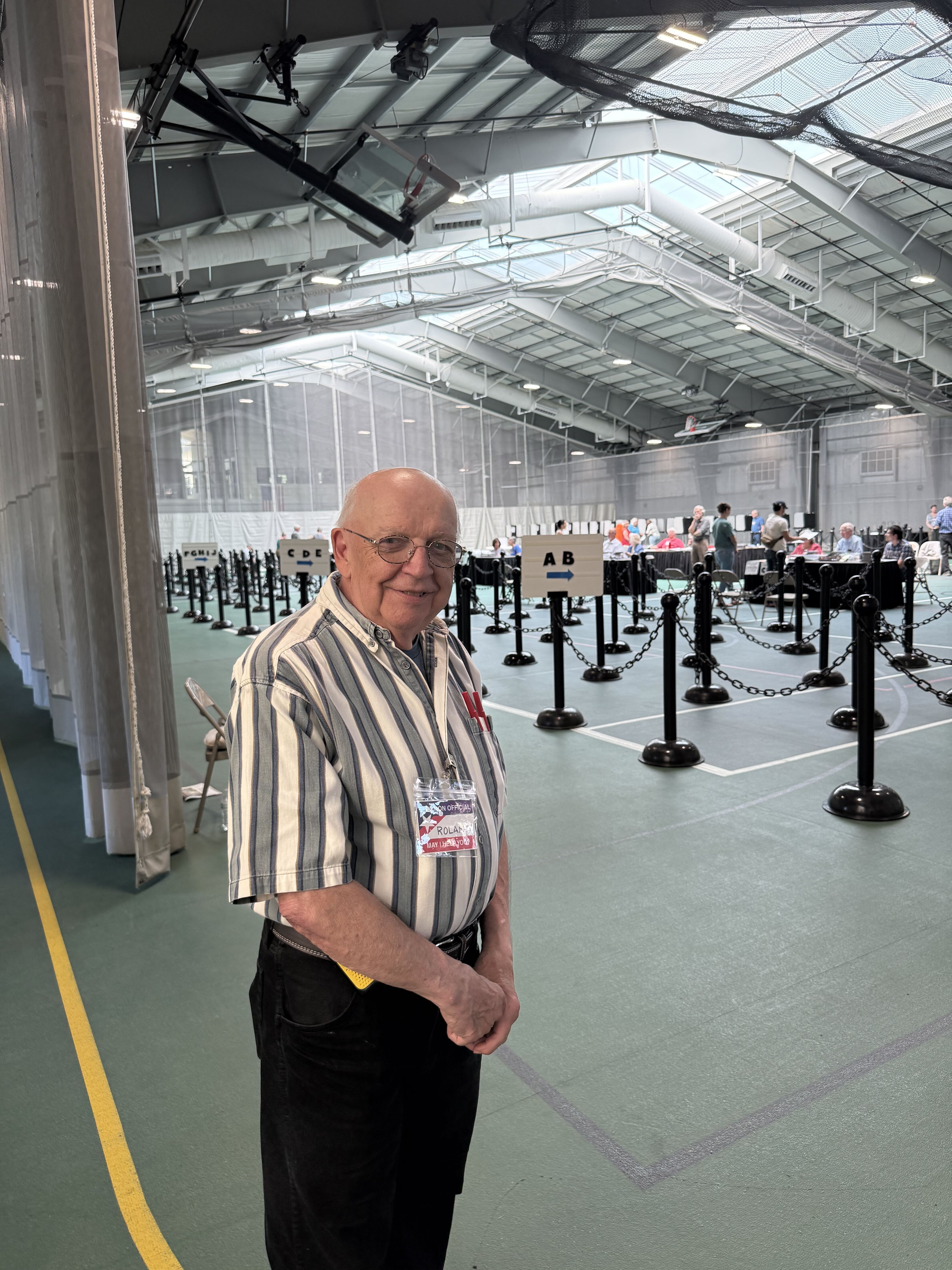
“It’s a long day,” Hallee said. “But it’s rewarding.”
Voter turnout in Waterville Tuesday has been what Haley would describe as “a steady trickle.”
After voters turned in a “very low” number of absentee ballots, just 768, Hallee is not surprised. He usually sees double or triple that number.
But he isn’t worried. After 40 years, Hallee knows to expect lower turnout from a primary election.
And as he has no current plans to retire from his post, he’s sure he’ll see more voters in November.

Half of the VFW’s parking lot will be reserved for voters, while the other half will be saved for the cruise-in. Town Clerk Audra Fleury said the arrangement will not impact anyone’s ability to vote.
“There was a small mixup in the scheduling. I called a couple weeks ago to check in, and they said ‘Whoops, we forgot about the cruise-in,” Fleury chuckled. “Maybe it’ll get some more people in the door.”
In addition to the statewide primaries, Winslow voters are deciding whether or not to adopt the proposed school budget.
Turnout in Winslow has been “slow but steady,” Fleury said. Some 500 residents had filled out absentee ballots before Tuesday, she said, and another 500 or so had voted in person before noon.
Turnout has been on par with other non-presidential election cycles, Fleury said, although, she joked, the cruise-in could prompt a last-minute spike.
“I always vote, as much as I can,” he said.
Wayne Heath and Sally Heath, both 70 and Gorham residents for 18 years, also voted for Platner.
“We need change,” Wayne said. “(We need) to get the guy out of the White House.”
“There are some concerning things that are coming out (about Platner), but I feel like that’s true of most politicians,” said Elizabeth Withee, 36, who also voted for the presumptive Democratic nominee.
Louise Frank, 67, a Woodstock resident for three years, said she voted for Graham Platner this morning at Woodstock Town Office.
“Everyone makes mistakes in life. I understand his struggles, and I give him grace,” Frank said. “I think he’s gruff. I think he’s kind of messy, but I think he’s honest. Something’s got to change, and I have hope that he will do it.”

“We’re just going around to see how voting’s going, answer any questions and thank the clerks and the poll workers who are doing such amazing work today, for a very long day,” she said.
She is filling in for Secretary of State Shenna Bellows, who is seeking the Democratic nomination for governor. Bellows will not take part in the tabulation of any ranked choice voting in the primary.
McBrien’s focus has mostly been on supporting clerks and election workers, and hadn’t spoken to many voters, she said. She encouraged people to thank their clerk for their time and effort if they see them.
Voting appeared to be busy and going smoothly at the polling locations she had visited by 11:30 a.m.
“There’s just really good, steady turnout of voters in all the polling locations,” she said. “No problems, just lots of people showing up to vote, which is wonderful to see.”
She went on to say, “I’ve been telling everyone as I leave, my wish for all of them is that they have a very boring election day. We want good turnout but no drama, no surprises, that’s everyone’s dream.”
McBrien does not expect to know which races will go to ranked choice Tuesday night and who the final winner of any possible runoff could be until at least next week.
Elections in Maine tend to go well because residents know the rules and expectations, she thinks.
“Maine voters usually turn out in really high numbers,” she said. “We have a really engaged, civic minded population here.”
A municipal ballot article would allow for a major renovation and expansion of the Ogunquit Playhouse, which some voters in town said was one of the driving forces that motivated them to vote.
Barbara Berman, 90, has lived in Ogunquit for 20 years and has been coming to the town since she was 15 years old. Besides believing every American should vote, Berman said that her main reason for coming to the polls was to make sure the Ogunquit Playhouse can continue improving.

“Who’s funding the capture of signatures?” “Are you a 501 or a 404?” “Where does your major funding come from?” “Do you take corporate donors?” “How much have you been paid per signature?” “How much are you paying per signature?”
Moore told him he was a field organizer with Health Care for All Maine, which receives mostly small-dollar donations. He said he was not being paid nor paying for signatures.
But he wasn’t too surprised by the voter’s skepticism: Last month Maine’s Secretary of State invalidated a referendum about transgender sports participation over flaws in the signature collection process, and last fall the office received complaints about deceptive signature gathering by an anti-cannabis petition group.
The questioner, Sam Aborne, 48, ran for city council in Portland last year. Aborne said he’s skeptical of everything lately, and that the rate of citizen petitions means the state Legislature hasn’t been doing its job.
More than 300 absentee ballots had been returned by the time Richards got to the polls this morning, she said. Despite the higher turnout, she still expects to have all ballots tallied tonight after polls close.
The polls there had been pretty quiet Tuesday morning, she said.

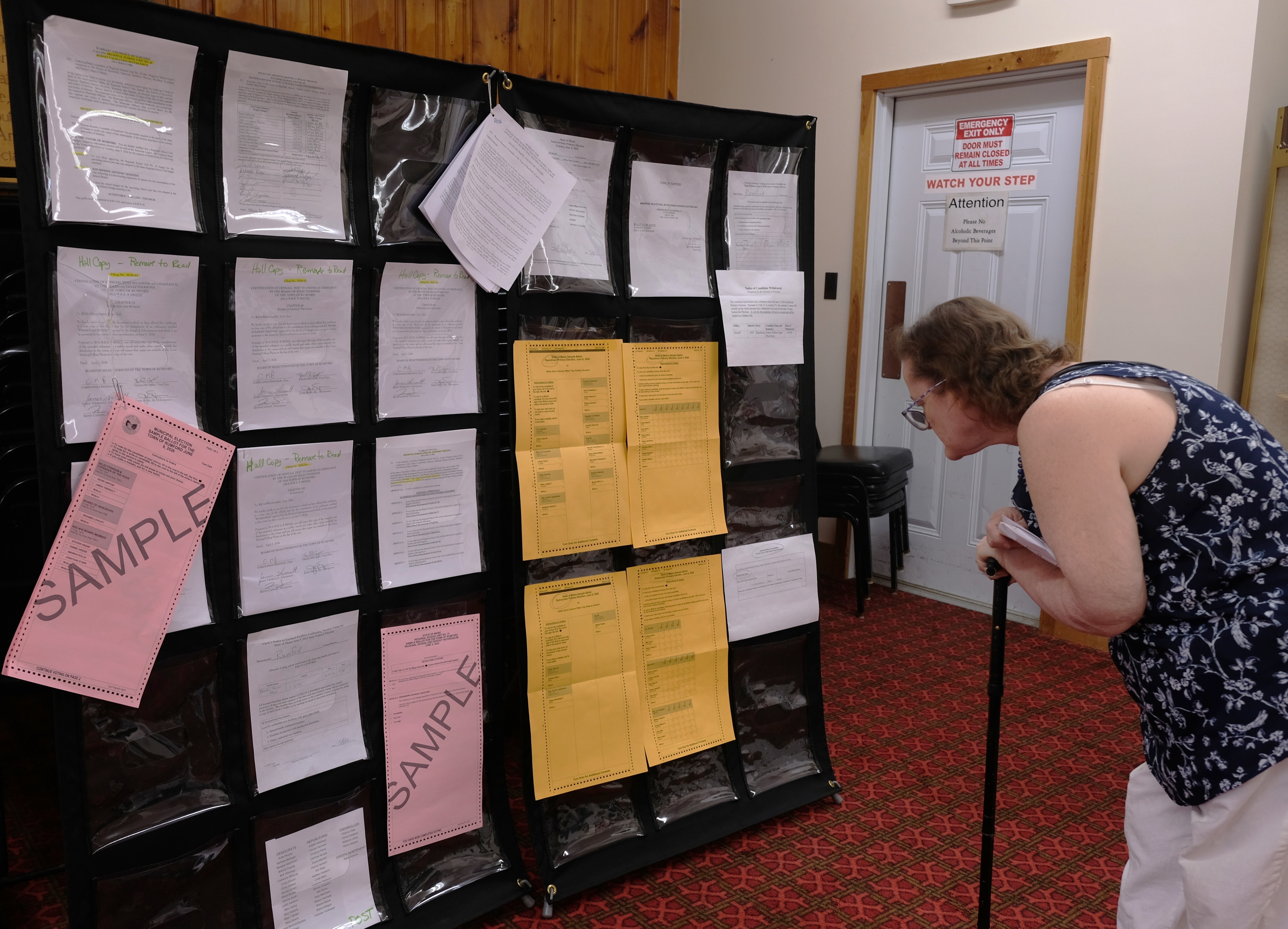
Poll clerk Frank DiConzo said turnout has been “steady from the start. I think it’s going to be this way all day.”
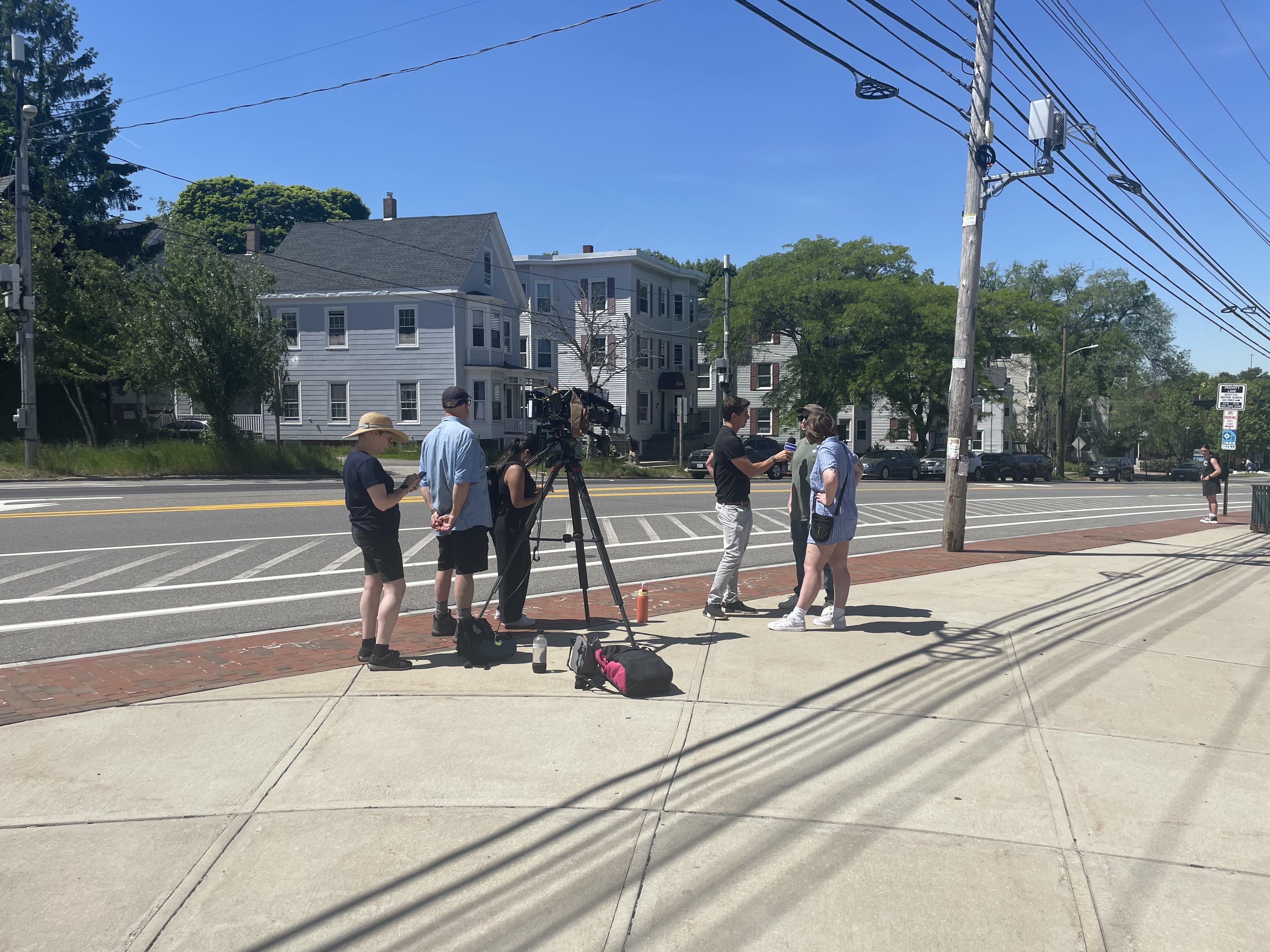
Inside, however, the warden described things as uneventful and surprisingly smooth, with the only issue being confusion around ranked choice voting. About 380 ballots had been cast as of 10:40 a.m., which the warden said was as expected.
As a former teacher herself, Joan Griffin McCabe said it’s important to support the school budget because strong education helps kids grow up to be good citizens. She’s hopeful that it will pass the second time.
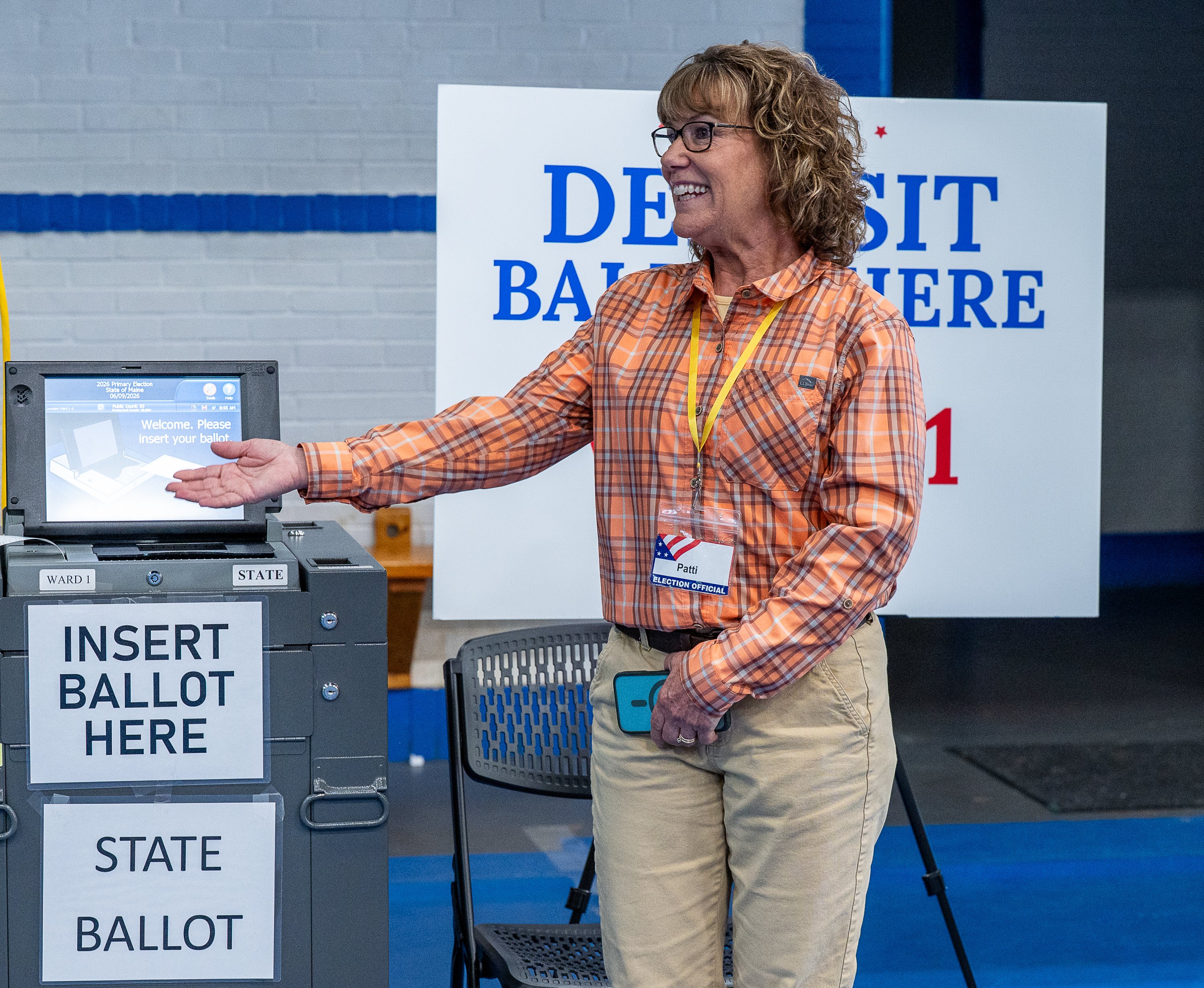
“I believe that we really need to identify the different and growing needs of our students and our school community, which is all of us, whether we have kids in the public schools or not,” she said.
In the primary, she voted for a progressive slate of candidates in the Democratic party, including Graham Platner, Shenna Bellows and Jordan Wood. In the local primary, she voted for Mana Abdi.
She said those candidates will represent people whose voices haven’t been heard on a regular basis but need to be. She is hopeful that they will make meaningful progress on universal healthcare, affordable childcare and other affordability issues.
“Our lives in the United States need to be more equitable,” she said. “And the things that we need to support everyday living needs to be more accessible and that’s what I’m looking for.”
Despite the controversies that have swirled around Platner recently, she said he is one of the best people to address those needs.
Jim McCabe was excited to vote for Platner after the candidate took what he felt was unfair heat from national news outlets.
“I don’t think the national press senses Maine really wants some basic change in terms of things like healthcare and he’s standing up for that,” he said. “And I was really happy to be able to vote for that.”
Mills didn’t have the “backbone” for that, he said. Platner has a lot of energy and can push for the kind of change he wants to see, Jim McCabe said.
Frances Wataru came out to vote for the school budget and the primary, opting for Jonathan Bush as the Republican nominee for governor, she said. After seeing his political ads she grew to support him.
“I like the way he spoke,” she said.

More than 20,000 ballots had not yet been returned as of Monday.
A total of 258 absentee ballots were returned and rejected by the office, and 359 ballots that had not been returned were also rejected, the data shows.
Spaulding said votes, including those submitted on absentee ballots, cannot be changed once cast.
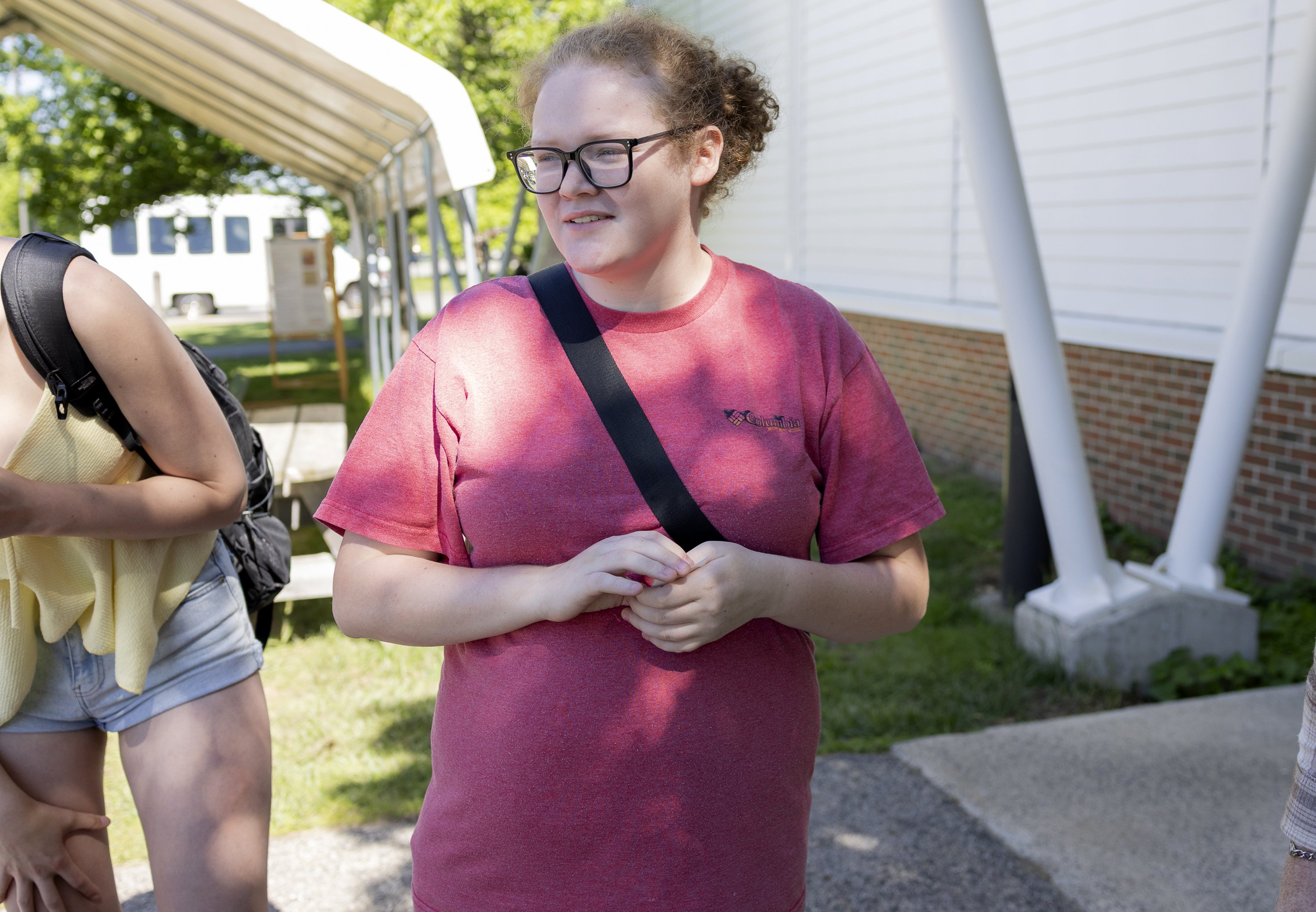
“I like who he is,” she said of Platner. “The past is the past.”
Mary Shea, 65, cast a protest vote for Mills, who suspended her campaign but is still on the ballot.
“She’s not the right person for the moment, but I don’t feel good about Platner,” said Shea.
Shea said she would vote for Platner if he was the nominee in November, however.
“Collins has to go,” she said.
Diana and Tom Allen, both 81, both voted for Mills.
“Janet is the best candidate there is,” said Tom Allen, who was also excited to support Secretary of State Shenna Bellows for governor.
After gathering signatures outside the polls on a petition for universal healthcare, Deirdre Nice, 63, entered the school gym and cast a vote for Platner.
“He has the chance to be a generational candidate for change,” she said.

Town elections, which include a two-way race for one seat on the select board, were of lesser interest for Liebert, a Skowhegan resident of about two years. She said she did not do any research on municipal affairs beforehand.
“I don’t know why I didn’t do that before I voted,” Liebert said.
For David Curtis, 66, who left the polls shortly after, it was a similar story. He has only lived in Skowhegan for about six months — he lived in Wisconsin and Boston previously — and said he is still getting up to speed on local matters. Curtis said, though, he never misses an election.
Platner got his vote, too.
“It’s our only voice,” said Curtis of his dedication to voting. “It’s our only way to stop what’s going on.”
Pelotte, along with other town officials and about 150 residents, was up late Monday night for Skowhegan’s annual town meeting, which typically is scheduled the night before the June primary. The meeting ended around 10:30 p.m. and polls opened at 7 a.m. Tuesday.
With personal plans Wednesday night, Pelotte said she is looking forward to resting Thursday.
Michael Hoehne, an election observer with the League of Women Voters who lives in Wilton, agreed with Pelotte’s assessment of the day so far, with no concerns to report.
“This is Maine,” he said.

The political scene needs in Augusta needs to change, he said.
Wayne Davis, a Republican, said he came out to vote to try and get the right people in office.
“I want change,” Davis said. “I would like to see everybody in Augusta to work together.”
Davis said he was also concerned about the school budget. He said older people, especially those who have farms, are feeling the squeeze. “When is the school budget going to be enough?” he asked. “It is killing us.”
“I am not listening to others,” he said. “I am using common sense and doing my research.”
Voters were given the opportunity at the polls to sign a petition to regulate recreational marijuana.
Ryan, a petitioner who refused to give his last name, said he was getting more signatures than he thought he would.
Sally Christner, an Androscoggin County commissioner, said she came to vote for Garrett Mason.
“I never known anybody know so much about so many things,” she said.
Lee Myles said he is an independent and was surprised to learn he could vote in party primaries. Last year was the first time the state allowed it.
“Any time there is opportunity to vote, I make it,” he said.
Hierstein was at the polls in Auburn on Tuesday with the Maine People’s Alliance.
Through volunteers like Hierstein, the organization is asking voters what issues are important to them. Some of the responses she’s received include healthcare and childcare.
“Regardless of their political leaning, that’s what they are saying,” she said.

“You can see about 40 booths here, we’ve probably cycled through them three or four times already,” Patterson said. Turnout so far has been higher than expected.
Trisha Robertson, 46, came to Berwick a year ago after living in North Berwick with her children. She said the school board and school budget are what motivated them to come to the polls.
“There’s a lack of education and too many social emotional aspects going into the schools,” she said. For her, the school budget is a “big fat no.”
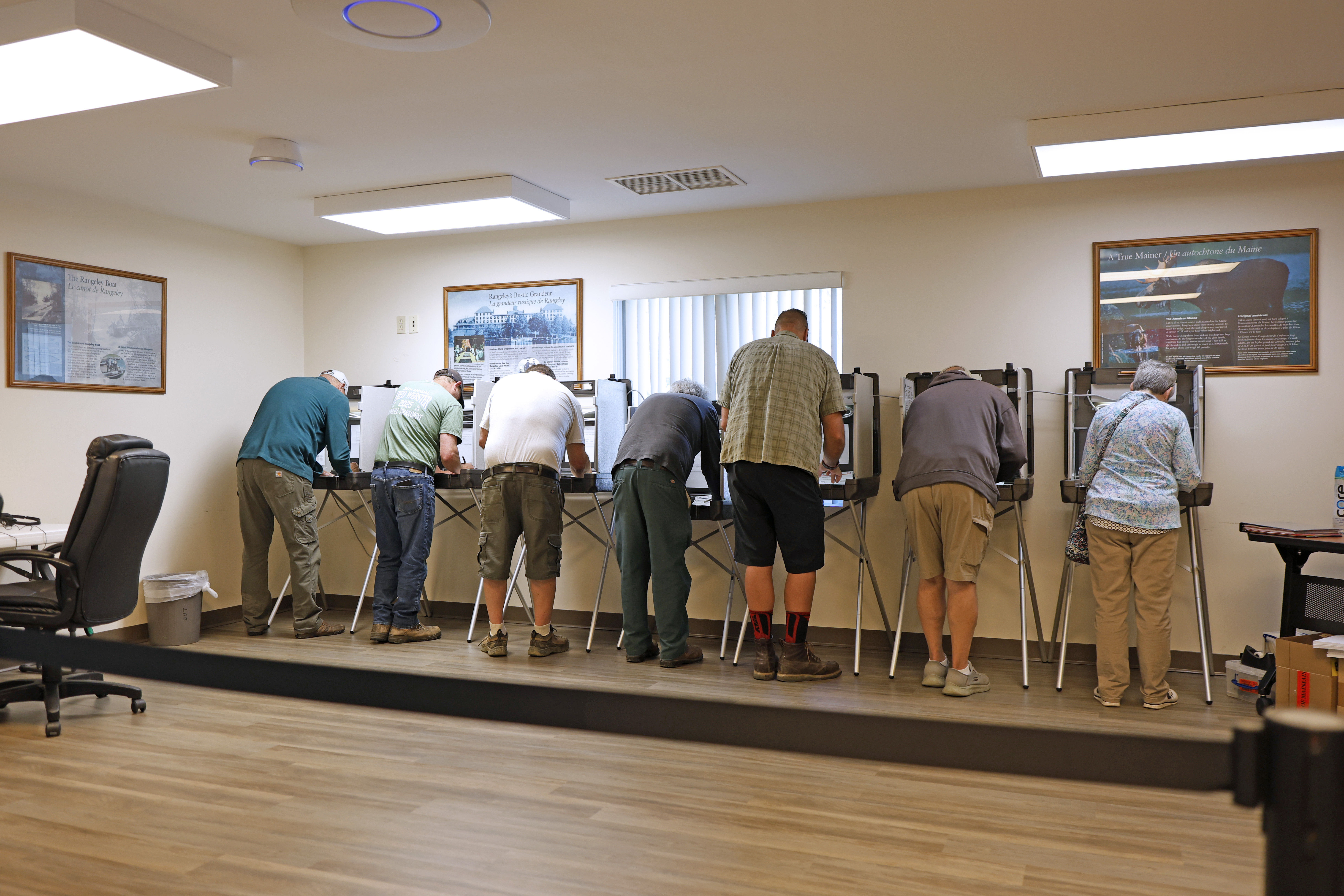
“You hope you’re picking the best option, but you never know if it’s actually going to be the best,” she said.
Dutile said she was weary as she cast her vote. She said one of her biggest concerns was getting the right information from a sea of conflicting views, and candidates sticking to their policies.
“How do you know that the people you’re voting for are actually gonna follow through with what they say they’re going to do?” she asked.
Absentee voting is more popular now because of the pandemic, but she expects to exceed that number of voters today, she said.
“I don’t know what’s specifically driving people out, but there are a number of candidates on the ballot that are driving interest,” said Carrington.
Residents of Auburn could vote in three locations across the city, including Auburn Hall, where voting for two of the city’s wards took place in two rooms.
Bob Hayes, one of the city’s wardens for the election, counted 60 voters as of 8 a.m. By 8:45 a.m., he estimated that 20 to 30 more voters showed up.
“When we opened the doors for voting, we had maybe eight people on each side of the rooms, waiting,” he said.
In addition to federal and state primaries, the town also has contested Town Council and school board races on the ballot.
“I’ve been totally thrown by how busy it’s been,” Doten said.
Béla Morgan, 18, registered to vote this morning at the the town office before casting his first-ever ballot. While it was a new experience, the element of filling out the bubbles felt familiar, he said.
“It’s kind of like taking a test at school,” Morgan said.
But the days of multiple choice tests are hopefully behind him, he said. He graduated from Greely High School on Sunday.
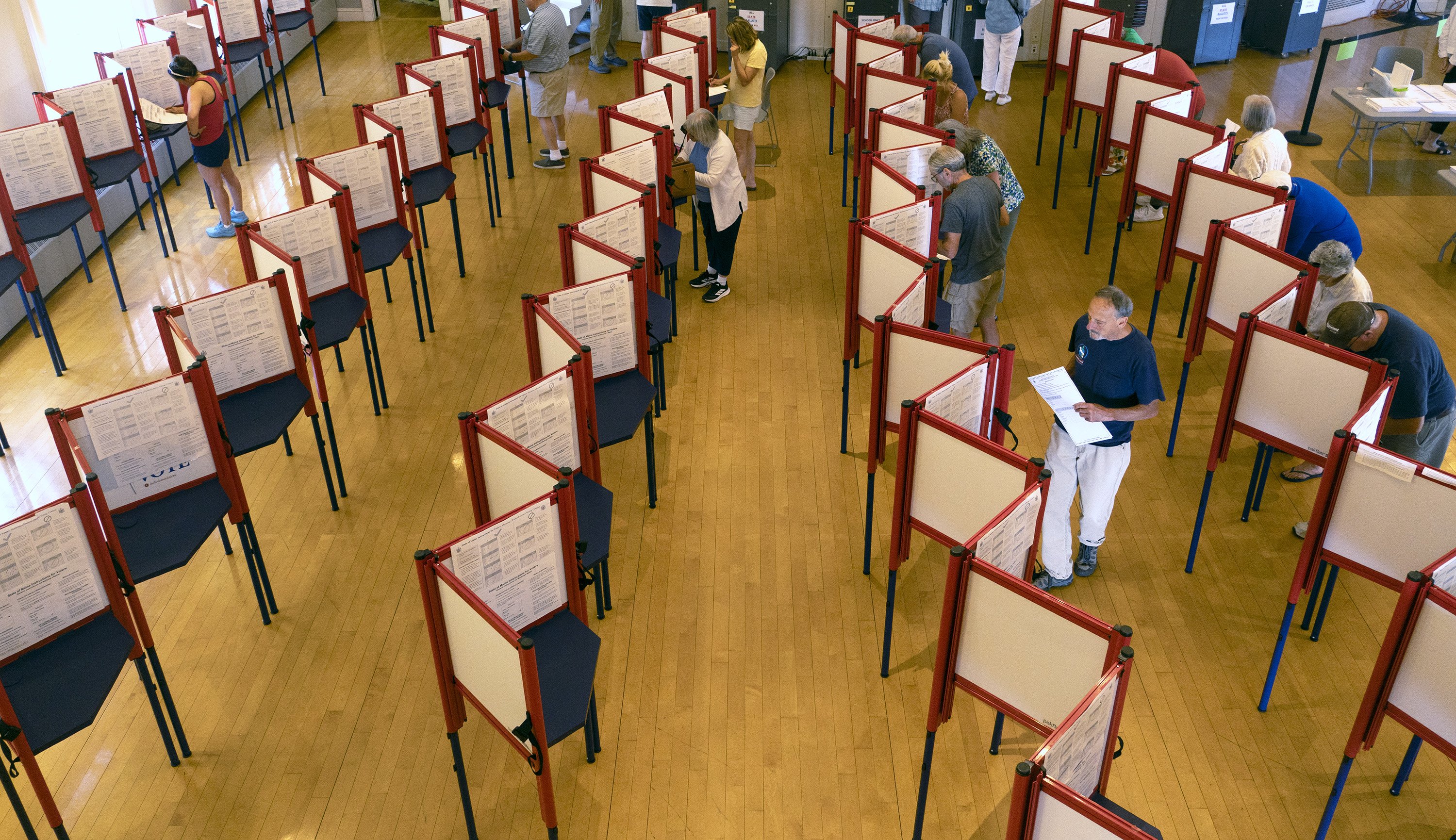
“We’re new to the area and we wanted to get involved,” Desjardins said shortly before 9 a.m.
Getting involved was a theme at the Kennebunkport polls.
“It’s important to vote,” Joe Diaz, 46, said.
Diaz supported Graham Platner on Tuesday, because he believes Platner is the strongest candidate in the Democratic primary.
“We need someone to flip the switch,” he said.

He mostly cared about the Senate Democratic primary, and he said he knows Graham Platner is going to win. “He’s pretty much unopposed,” Smith said.
Smith’s wife, Beverly Bayley-Smith, is less sure, but she’s still optimistic about Platner’s chances.
The couple votes often, but this is their first time voting in the primaries. This year, they came because of Platner.
The Senate Democratic primary drove other voters to the polls at Scarborough High School around 7:45 a.m. Tuesday, but not all shared the same feelings about Platner.
“Voting for Platner is looking past everything Trump is accused of and has been found guilty for,” Meredith Topol, 32, said.
Some voters echoed Topol’s disillusionment. Others still stand by Platner despite recent negative stories about his past.
Eugene Thorne said he has been a supporter of Gov. Janet Mills throughout her political career. But this time, he voted for Platner.
“I respect her, but it’s time for someone else to take the lead,” Thorne said.
Dean Sherwood, one of Lewiston’s election wardens, said it’s difficult to put an estimate on the voter turnout.
“It’s still so early,” he said at 7:15 a.m.
City officials said that absentee ballots will be counted at Lewiston City Hall at 3 p.m.
“It’s my duty to. I always vote in all elections,” he said.
But this year, he’s feeling sad about the November elections. He’s not sure who to vote for or what to believe.
“I don’t believe either party,” he said, referring to both the Democratic and Republican parties.
As for the local ballot, Raymond is one of the few people on Tuesday morning who voted in favor of the Lewiston school budget.
Though he admits the budget is “too high,” he realizes that children come at a cost.
“We need our schools,” he said.
As for the Lewiston school budget, he voted it down, saying that it’s “too high” with the cost of property taxes.
“I don’t have any kids in the school system so why should I vote for it?” he said. “I’ve done my due diligence.”
She said the cost of living has gotten out of hand, and there needs to be a change.
“Growing up, $3.80 an hour got me through the week,” said the 62-year-old Saco resident. “Now, I’d be on the street.”
Albert said one of her biggest problems with politics is the parties.
“I’ve voted on both sides. I have no qualms against Democrats or Republicans,” she said. “We’re electing them to do the job for us. It’s not on us to do the job for them.”
The weather service projects Tuesday’s high to reach 87 degrees in the Fryeburg, Lewiston and Waterville areas and 85 around Augusta and Farmington. Coastal communities, including Portland, can expect a high of around 80, while communities at higher elevations, like Jackman and Rangeley, may need to settle for the high 70s.
Read the full story.
Cramer, 52, said both the school budget and the primaries were important to her, but that the primary had her conflicted.
“I think a lot of Maine Democrats – and I can’t speak for everybody – are conflicted,” she said. “The recent bad press for Graham Platner has not been inspiring, I guess.”
At the end of the day though, she said ranked choice voting made her feel a bit more in control of her vote.
“We’re all rowing in the same direction as far as defeating Susan Collins,” she said. “I’m doing what I can to make my voice heard.”
Tuesday’s election, he said, started off “medium-busy.”
By 7 a.m., about 75 ballots had been cast in Kennebunk, and an additional 2,500 absentee ballots were being counted.
“It will get busier as the day goes on,” Brown said. “Some people don’t like mornings.”

He lives on Danforth St, a few blocks away from the Reiche Community School voting location.
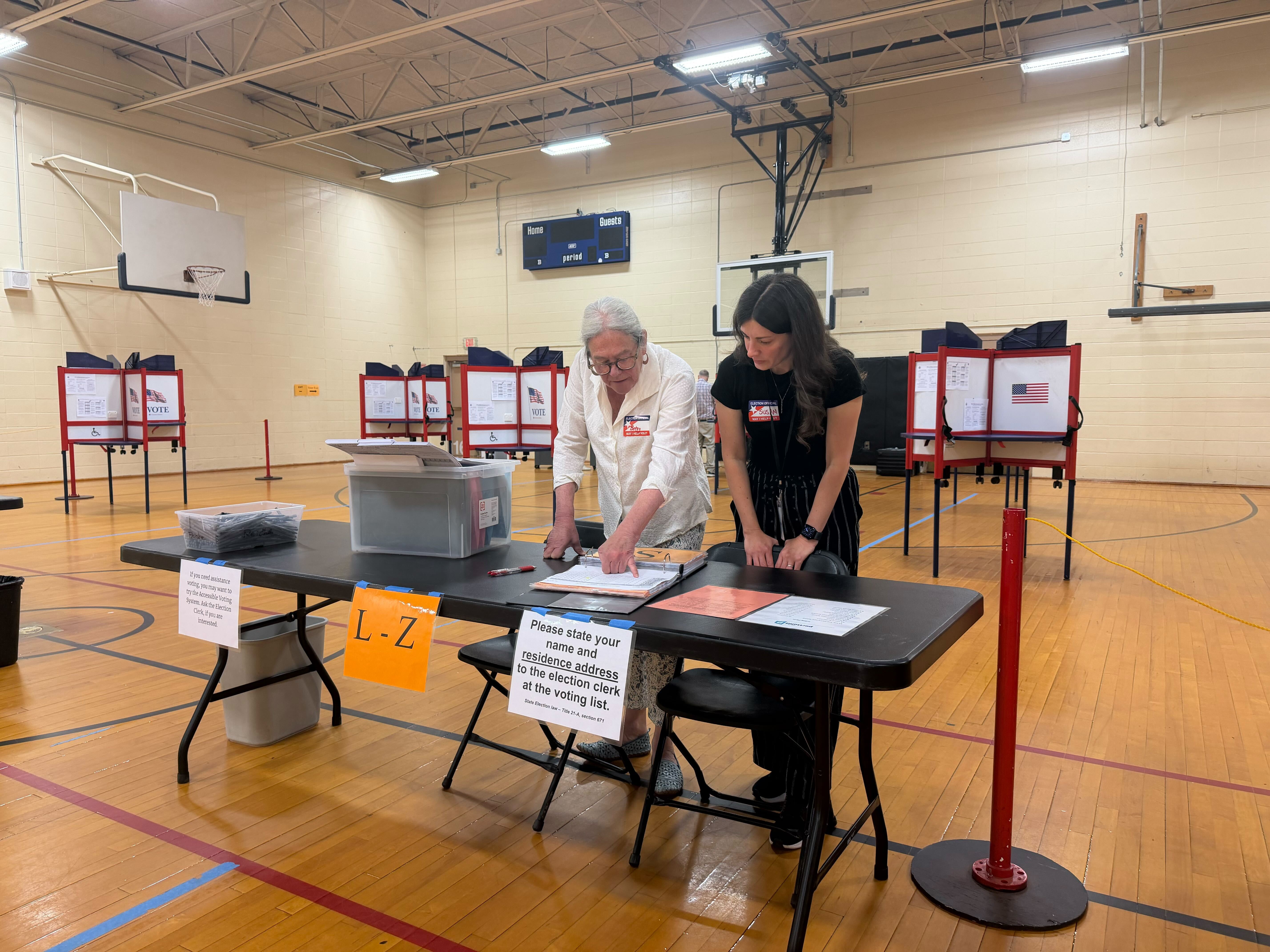
He’s voting for Graham Platner for U.S Senate and Hannah Pingree for governor. The latest revelations of Platner’s past are no bother to him.
“Gimme a break,” Thomsen said, rattling off a list of President Donald Trump’s unsavory deeds by way of comparison.
Betsy Krementz, 69, is one of them.
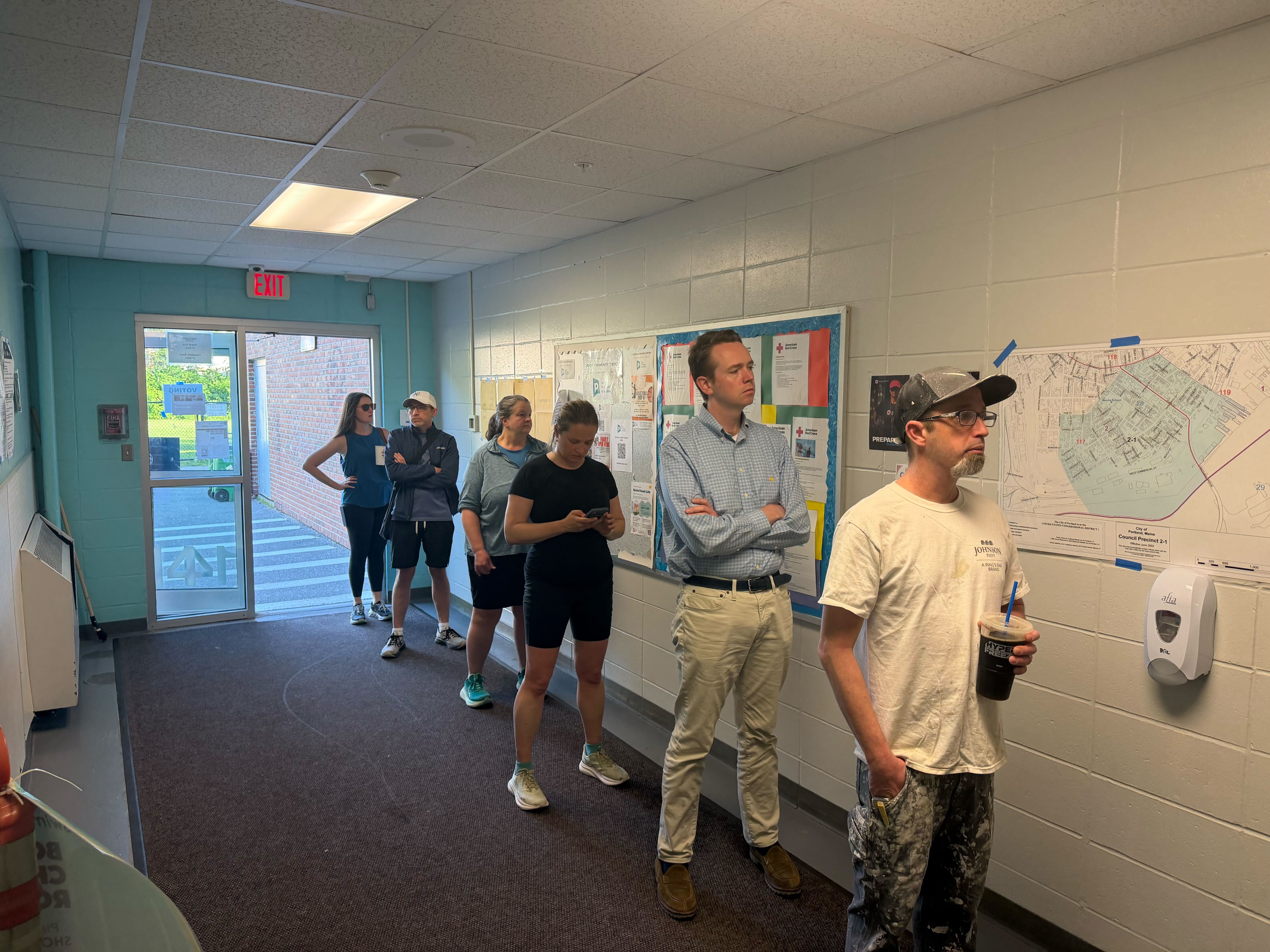
She snatched an Angus King III For Governor sign planted in the grass outside the school that violated that state’s ban on political activity within 250 feet of a voting location.
Krementz registered as a Republican in 2008 because she wanted to attend a party caucus and figured the excitement about then-candidate Barack Obama would make the Democratic caucuses too busy. Then she saw a call for poll workers, and the requirement that there would be an equal number from each major party.
“It’s pretty hard to find a registered Republican in the West End,” she said.
Krementz will work all day until after the polls close at 8 p.m.
“I feel like I did a good deed,” she said.


We invite you to add your comments. We encourage a thoughtful exchange of ideas and information on this website. By joining the conversation, you are agreeing to our commenting policy and terms of use. More information is found on our FAQs. You can update your screen name on the member's center.
Comments are managed by our staff during regular business hours Monday through Friday as well as limited hours on Saturday and Sunday. Comments held for moderation outside of those hours may take longer to approve.
Join the Conversation
Please sign into your CentralMaine.com account to participate in conversations below. If you do not have an account, you can subscribe here. Questions? Please see our FAQs.