
Boy did I step in a pile of compost when I started digging around to figure out how a companion planting scheme in your summer garden could turn into a party on your plate at harvest time. I’d anticipated clear-cut scientific explanations on how sowing basil seeds among tomato plants helps both thrive in the garden and complement each other in a Caprese salad.
Companion planting is the art of plotting which vegetables you’ll cultivate closely together based on how one’s growing patterns, chemical emissions and attractiveness to pests plays on the health, yield and flavor of its chosen garden chum.
The benefits of companion planting in Maine have been documented by gardeners and smaller-scale growers, for sure. They turn to favorite gardening books like “Carrots Love Tomatoes” by Louise Riotte and a plethora of online companion-planting charts to learn that leeks planted among carrots will help repel carrot flies. They draw on personal experience as evidence that most members of the brassica family do very well intermingled with aromatic herbs like thyme, dill and rosemary. And, they heed neighbors’ warnings to always plant tomatoes, but never alliums, near the asparagus bed.
But my typical sources for walking this former English major through the science behind sustainable agricultural practices – the University of Maine Cooperative Extension and the Maine Organic Farmers and Gardeners Association – both said they don’t hand out professional guidance on companion planting because the evidence of its efficacy is mostly anecdotal.
The lag time between what she knows works in her greenhouse and fields and the science available to prove it doesn’t surprise Jackie Robinson, a fourth-generation farmer who operates Leaves and Blooms Greenhouse in Dover-Foxcroft.
“The agrochemical boom, I think, slowed down the process of investigating how and why some of these couplings have worked really well for hundreds of years,” Robinson said. She is confident science will eventually verify why some of these companion plants’ root systems work in cahoots to enrich the soil and foster hospitable growing conditions for each other. In the meantime, she’ll continue to grow strawberries and spinach together and Johnny Jump-Ups among the mache, because she’s happy with the results in her beds and in her kitchen.
In his book, “Will Bonsall’s Essential Guide to Radical, Self-Reliant Gardening,” Bonsall, a subsistence farmer in Industry, doesn’t offer up a list of companion plantings. He’s not convinced they are all in symbiotic relationships where both plants benefit from the match. Many just co-exist happily because they don’t compete for the same resources. Take peas and carrots, for example. Companion planting guides say they are convivial because peas fix atmospheric nitrogen, which carrots need, Bonsall writes. And carrots, since they are taproots, can pump up calcium, potassium and magnesium needed by the peas. But Bonsall argues the nitrogen is only available to the carrots once the pea plant dies and the alkaline minerals would only get back into the soil if it came back to that spot as compost.
The reason carrots and peas get along is more subtle. As long as the soil nitrogen is adequate, the carrots can consume it all because the peas are self-catering in that regard. “It’s a meshing of needs and talents,” Bonsall writes.
There are fillers – crops that grow only until the space is needed for their companions. These are typically early or late crops like lettuce, spinach, radish and scallions harvested before cucumber, melon or winter squash plants spread out. There are other pairings whose plant shapes (tall versus low) or root zones (shallow versus deep) vary and therefor dovetail nicely in the same space. And, regardless of the level of biological synergy, this inter-planting provides a measure of crop insurance that comes as a benefit with any biodiversity.
But Bonsall says he’s not above planting companions based on how they look. One of his favorite triple companion plantings – because it is beautiful and he considers his plots his canvas – is flowering coriander grown for seed, flanked by red beets with bi-colored greens, and framed by spiky celery plants (See salad recipe). This particular outlook brings me full circle to why I started digging on companion plants in the first place.
Bonsall says it’s uncanny how often plants that go well side by side in the garden suit each other on the plate, too. “I often look to culinary compatibility for hints as to companion planting,” he wrote. So as a rule of thumb, if their flavors conflict on the plate, don’t plant them too close together in the garden.
Christine Burns Rudalevige is a food writer, a recipe developer and tester and a cooking teacher in Brunswick. Contact her at: [email protected].
Beet and Celery Salad with Coriander Dressing
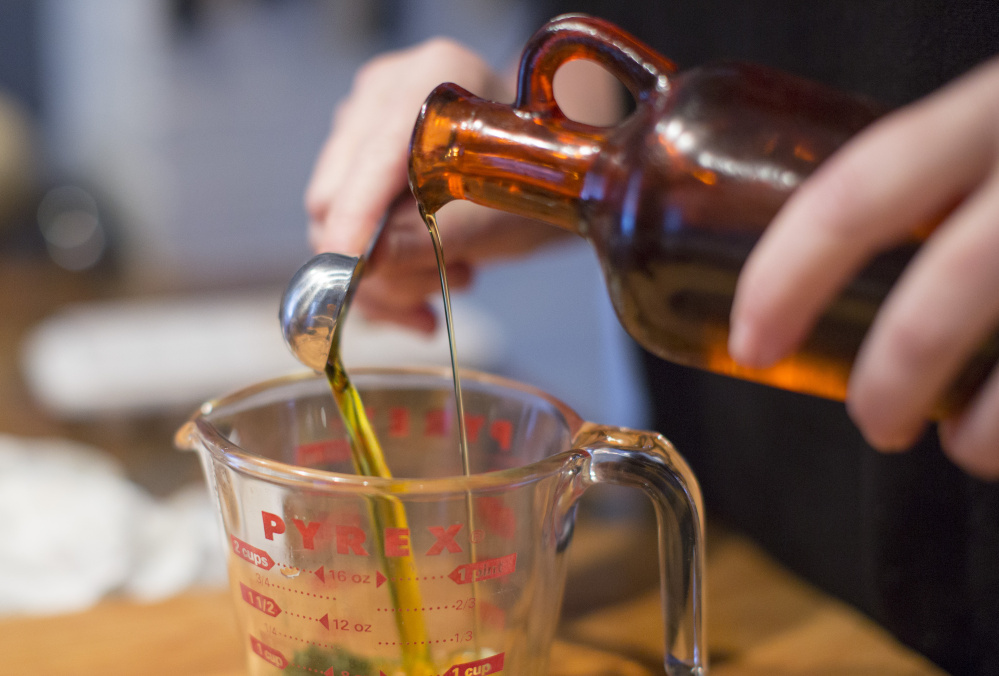
Olive oil, and sherry or white balsamic vinegar are added to a carafe for the cilantro dressing.
I keep the beets raw, dress them at the very last minute to avoid bleeding, and use all the leaves I can find so that nothing goes to waste. Good knife skills are handy for making this salad, as is a sharp knife.
Serves 4
3 medium oranges
1 tablespoon toasted coriander seeds
3 tablespoons extra-virgin olive oil
2 tablespoons finely chopped cilantro, leaves and stems
2 teaspoons sherry vinegar or white balsamic vinegar
Kosher salt and freshly ground pepper
1/2 bunch of celery with leaves
2 medium beets with leaves
Zest the oranges and reserve zest. Slice the top and bottom off each orange. Working 1 at a time, set the oranges on the flat bottom you have created. Remove the peel and pith by making cuts lengthwise between flesh and peel, following fruit’s contour. Hold the fruit over a bowl to catch the juice (and enjoy drinking it). Now slice lengthwise between each segment and the membranes on either side, a technique called supreming, letting the segments fall into the bowl. Set the segments aside.
Use a mortar and pestle or a spice grinder to crush the coriander seeds into a powder. Combine the ground coriander, oil, cilantro, vinegar, any oranges juices you’ve collected and 1 tablespoon of orange zest in a small bowl. Season with salt and pepper to taste. Set dressing aside. (Freeze any remaining zest in an ice cube tray, 1 teaspoon zest mixed with 1 teaspoon water for future use.)
Disengage the celery stalks from the bunch. Pull the leaves off and add them to the bowl with the orange segments. Slice the celery stalks on the bias so that you get crescents about 1 1/2-inches long. Add them to the bowl with the segments.
Wash the beet stems and leaves. Cut the stems on the bias like the celery. Tear the leaves into bite-sized pieces and set on a towel to drain. Scrub the beets to remove all the dirt (no need to peel!). Slice them into 1/8-inch rounds. Cut each round into 1/8-inch-thick matchsticks.
Arrange the beet greens around the edge of a shallow bowl. Spread the beet matchsticks around the bottom of the bowl. Toss orange segments, celery leaves, celery and beet stems with the dressing. Spoon this mixture over beet matchsticks and serve.
Comments are no longer available on this story