


Jan. 4, 2025
It took me five precious Saturday hours, start to end, to make stuffed cabbage, and that’s not counting going to the grocery store or doing the dishes. Making them requires putting together the stuffing, a mixture of ground meat, raw rice and onions (easy); separating the cabbage leaves without tearing them and shaving down the ribs (challenging); making the sauce (easy); and filling and shaping each cabbage roll (the fun, though time-consuming, part).
It was a chilly winter morning, so I didn’t resent the time in my kitchen. That said, the list of things I needed to get to before the work week started was a mile long, as always, so I was irked at how holishke (their Yiddish name) were hijacking my precious free time.
Still, when I rolled the first one into a cute little bundle and secured it with a toothpick, there is no denying that I was pleased with myself, and as the rolls piled up, my pleasure grew. I used a Dorie Greenspan recipe, which seemed to echo the sweet-and-sour flavors I remember from my mother’s stuffed cabbage, one of my favorite dishes from childhood.
I like them so much that I included them among a dozen items on my culinary bucket list, dishes I’d been meaning to attempt forever, or it seemed that way, but just hadn’t. In this case, it was easy to see why: Stuffed cabbage are a project and a half.
My mother herself no longer remembers her stuffed cabbage, though she repeated the words “cabbage rolls” after I asked her about them, and it was clear the sound of the words was still familiar. Only three of her four daughters remember her making them, and none of us has her recipe. Two of my sisters suggested I make Jane Brody’s Unstuffed Cabbage recipe instead – “same ingredients, less fuss,” my sister Leslie emailed, who said she’d made a batch the day before.
But Brody’s dish would miss the point. I myself only realized the point in the midst of cooking as random ingredients and battered 1950s kitchenware from the kitchen I grew up in hovered before my eyes. Didn’t she add crushed gingersnaps? And a handful of raisins? Whatever happened to that deeply rutted wooden bowl she used for the ground meat mixture, and the dinged yellow-handled double blade chopper to combine everything?
Mom is slipping away. That’s the point. Her recipes are slipping away. Our childhoods are long slipped. If I make her stuffed cabbage, can I bring any of it back?
I served the holishkes to my book club. We’d read Peaks Island writer Eleanor Morse’s achingly painful “White Dog Fell from the Sky,” which is set in South Africa and Botswana during apartheid. The meal met the moment: We needed comfort. Book clubbers called them “tasty,” “filling,” and “delicious stuff.” Still, when my partner Joe called that evening from Boston to ask me how they’d come out, I found myself saying, “Fine. They were fine. But they didn’t taste like Mom’s.”
PART 2
My mother, Leba Grodinsky, died on March 31 this year, a snowy, stuffed cabbage kind of a day. She would have been 97 not quite a month ago. I spent her birthday in Gouldsboro interviewing a winemaking couple, an afternoon she’d have loved. Still, it didn’t sit quite right, as though I’d neglected to send her a birthday card (instead of merely sending it late, as usual). A few weeks later, I found myself making stuffed cabbage again.
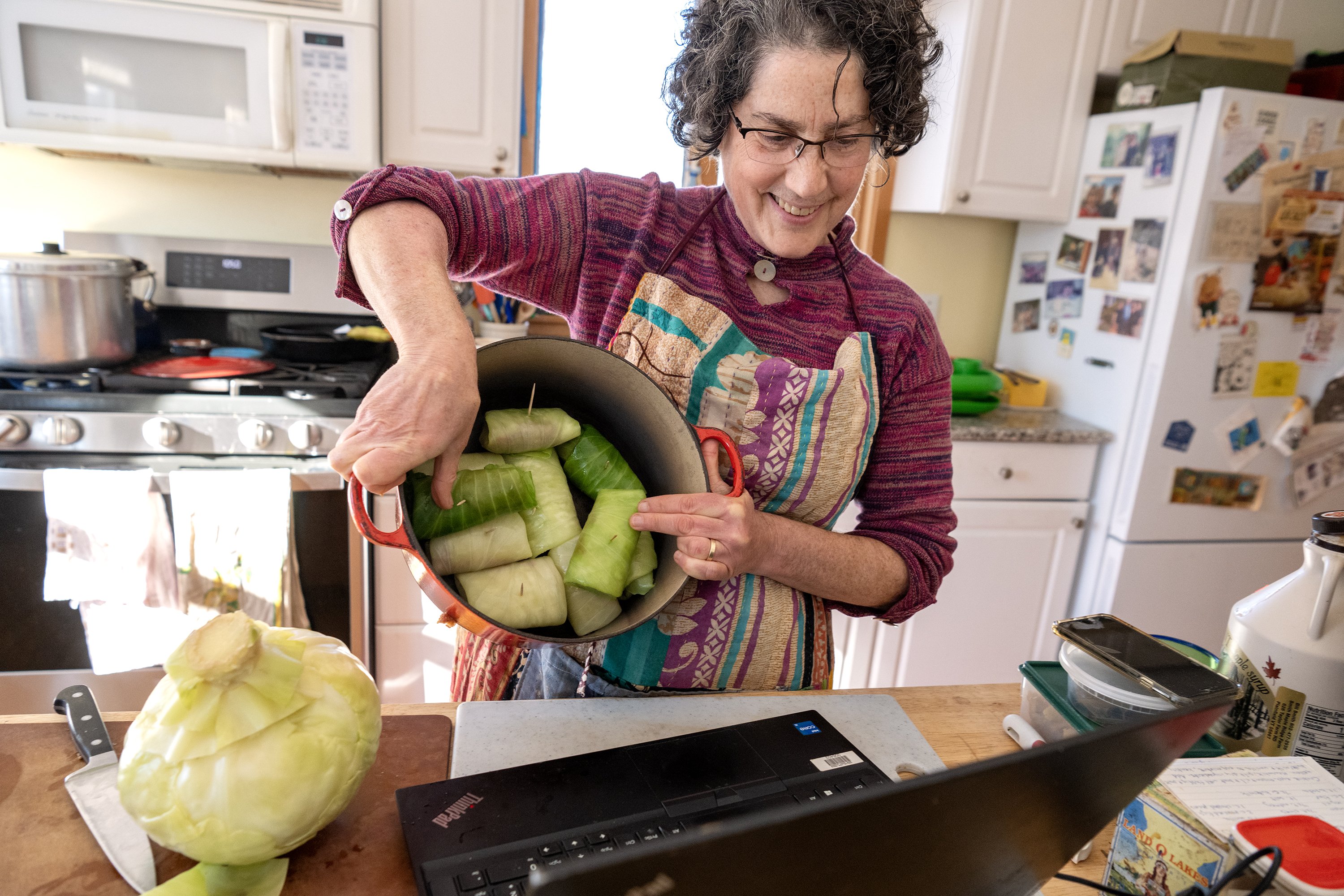
This recipe called for gingersnaps and seemed to have even more of that sweet-and-sour quality I remembered. I put on a sweater I’d taken from Mom’s bureau after she died, wrestled the basketball-sized cabbage from the refrigerator shelf where I’d wedged it, and called my faraway sisters on Zoom. We would attempt to re-create Mom’s stuffed cabbage together.
It was an ideal day for the warming, substantial dish, a day after Maine’s first snowstorm and two weeks before Chanukah. Traditionally, Chanukah is celebrated with fried foods like potato pancakes (latkes) and donuts (sufganiyot), but the holiday lasts for eight days; surely one meal could be given over to stuffed cabbage. (After writing this, I read in one of my cookbooks that the dish is actually associated with Sukkot, the Jewish harvest holiday, because stuffed items represent abundance.)

I made the filling and the sauce before my sisters and I connected. We’d visit virtually as I stuffed the cabbage leaves, which seemed a companionable cooking task. We are four (no longer) girls, just 5½ years total between us. My sister Carolyn was knitting and mostly quiet; her relationship with my mother was more complicated than mine. My sister Leslie was prepared, the Unstuffed Cabbage recipe in front of her. My sister Susan had technical trouble. We were all in character (OK, OK, before my sisters call me on it, I’ll confess I had technical trouble, too).
“Can you really see me?” Susan said, after struggling to turn on her phone’s video. “Yeah, we see you,” Leslie replied. “You need to brush your hair.” That was, without question, The Most Mom Moment of the entire hour.
My parents both had long, mostly lucky lives, but any readers who have helped parents in their extreme old age know what a great and often heartbreaking burden it is. In our family, the caregiving lasted more than a decade, and while we siblings remained close and maybe bickered no more than we ever had (which is to say, a lot), it took a toll. I’d been wondering since before my mother died if we could ever find our way back.
Last summer, we spread my parents’ ashes along Lake Champlain in Vermont, a place they loved. It was a good start. In the fall, my niece married, which brought us together for a happy occasion— about time. Now, it was the first week of December, and here we were again.
On the phone, we catalogued the things my mother cooked when we were very small and fussy (shepherd’s pie, Kraft Dinner, shish kebabs) and the things she cooked as she, and we, grew more adventurous (mulligatawny, hummus, meatless meals). We marveled that she and her two sisters, who grew up in a household with a cook, all became marvelous, exceptionally enthusiastic cooks themselves.
We talked about our childhood Chanukahs and the Thanksgiving where the dog got the turkey. One of us said it was raw. One of us said it was cooked. One of us had forgotten the episode entirely. No one could remember what we ate instead that year.
Each family forms its own very particular world, and for a little while I sank back into ours: the glamour of my mother dressed for the opera and the smell of her perfume; our dad’s shoe polishing routines, old-fashioned even then; the way we all fed the dog under the table and the way we all denied we’d done it.
If I were the sort of person who used self-help words like “healing” and “journey,” I’d use them now. Stuffed cabbage, as prosaic as a dish can get, brought me comfort in the making. It brought me comfort after I hefted the heavy casserole into the oven and for the next two hours inhaled its cozy, oniony meat smell. (Earlier, Leslie had said the boiling cabbage smell put her off the dish for years.) It brought me comfort yet again at dinner when I set two holishkes on a pile of fat, buttery egg noodles, doused everything in the sweet, tomato-y sauce, and dug in.
TAKING STOCK
It wasn’t until after I embarked on my culinary bucket list that I noticed a couple patterns. For starters, more than one-third of the items I’d attempted required fiddly stuffing and/or rolling: spring rolls, jelly roll cake, onigiri, stuffed grape leaves and stuffed cabbage. Given the labor, small wonder I’d put off attempting these dishes.
Also striking was how making many of these items turned into a social event. Add to most of those I just named, homemade pasta and home-canned tomatoes. Immediate or extended families, groups of church ladies, and others get together to fill, roll, process, sing, gossip, feast and, it must be said, compete.
Not long ago I heard the Romanian TikTok star Carolina Gelen talk with Splendid Table host Francis Lam about cabbage roll rivalry. “My mothers and her sisters, they would brag about how many cabbage rolls they rolled,” she told him. “‘Oh, I made 250 today. How many did you make? What? 180? You’re slacking.'”
That could be my sisters and me when we cook.
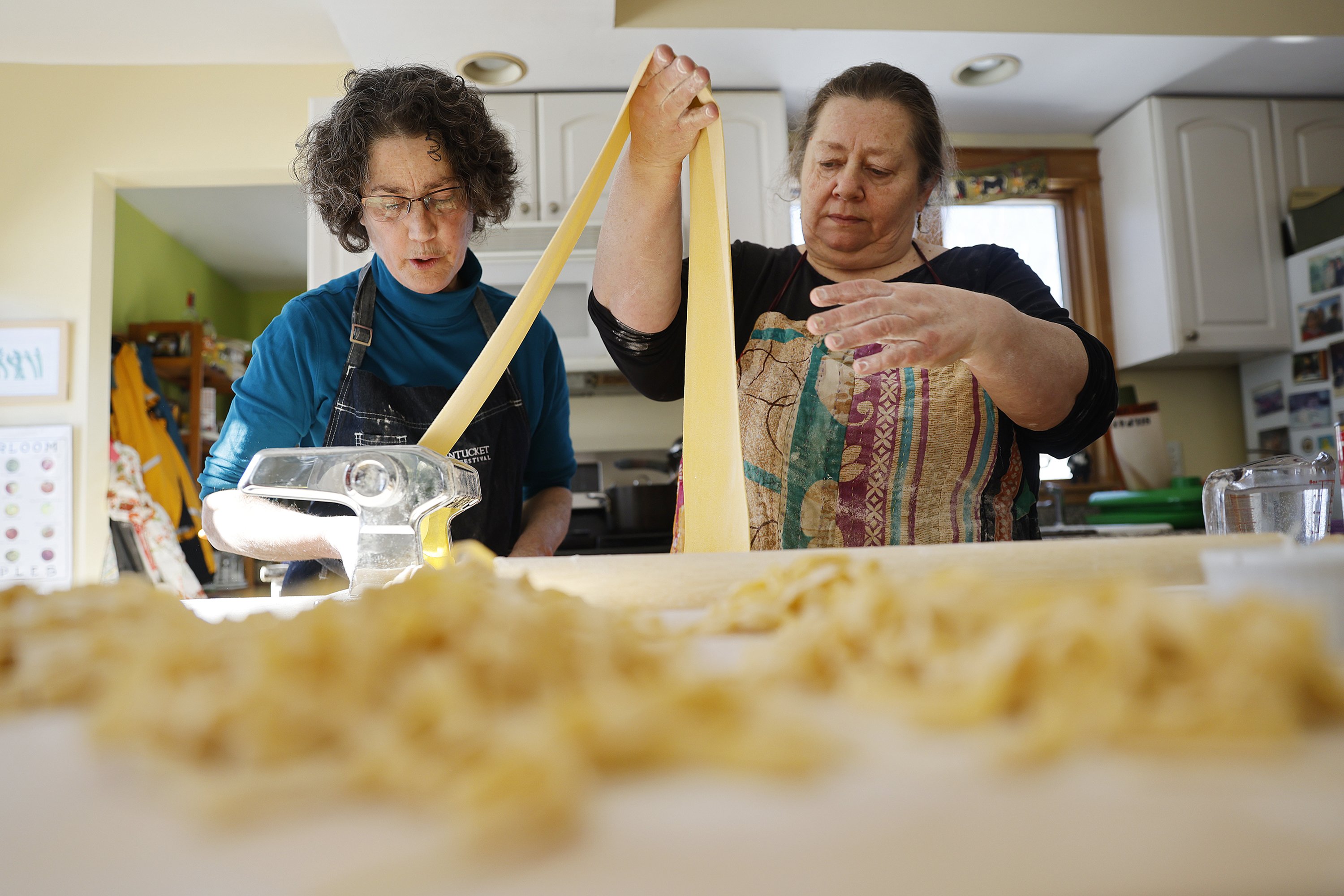
I got a taste of this sense of community as the year went by, making pasta with chef Sara Jenkins of Nina June in Rockport and her mother, food writer Nancy Harmon Jenkins; making goat’s milk caramel with Community Plate co-founder Margaret Hathaway. These occasions, and others, made me wish they weren’t occasions, that I cooked alone less often.
A community of readers was also excellent company. One emailed to tell me that she and her daughter were inspired to start their own lists, including pad Thai, egg foo young and an attempt to replicate Tandem Bakery’s (dangerously delicious) biscuits. Another sent me the recipe she uses to make naan at home. ) A third invited me to come along next spring when she forages for wild grape leaves for Greek dolmades.
I’m writing this on Dec. 5. It’s the time of year when we look both backward and forward. The Ten Best Books of 2025. The first year both my parents were gone. The 20 Hot Food Trends coming your way in 2026. The year I plan to forage for wild grape leaves; knock the final two items off my overly ambitious culinary bucket list; make stuffed cabbage again, this time more in line with the way I cook now, a vegetarian version with mushrooms and kasha.
And in 2026, I hope to see more friends, more family and more readers in my inbox, at my table, next to me at the kitchen counter. Holishkes, I’d learned, symbolize abundance.
STUFFED CABBAGE
The recipe is from Dorie Greenspan’s “Everyday Dorie” very slightly adapted. It’s excellent, but definitely elevated from the traditional dish I grew up with. Back in the day I can’t imagine my mother would ever have used Savoy cabbage, shallots, sausage meat, basmati rice or sea salt in her version. Greenspan suggests making the dish a day ahead to let the flavors develop and give you a chance to spoon off any fat.
For the cabbage bundles:
1 large head green cabbage, regular or Savoy
1 ½ pounds ground chuck
1/2 pound sausage meat, sweet, hot or a combination
1 medium onion, finely chopped, rinsed and patted dry
2 shallots, finely chopped, rinsed and patted dry
2 garlic cloves, finely chopped
1 1/2 teaspoons fine sea salt
1/2 teaspoon freshly ground pepper
1/4 teaspoon cayenne pepper
1/2 cup basmati or other long-grain rice
Grated zest of 1 lemon
1/4 cup ketchup
1 ½ tablespoons soy sauce
For the sauce and add-ins:
Two (28 ounce) cans whole tomatoes with their juice
1/3 cup unsweetened apple juice
3 tablespoons brown sugar
2 tablespoons cider vinegar
1-2 teaspoons caraway seeds
1 teaspoon fine sea salt
Pinch of cayenne pepper
1 onion, sliced, rinsed and patted dry
1 apple, grated
To make the cabbage rolls, bring a large pot of water to a boil.
Meanwhile, pull off and discard any tough outer leaves from the cabbage. Place the cabbage in the boiling water and cook for 3 to 5 minutes. This should allow you to pull off the outer leaves after you remove the cabbage from the pot. You may have to return it to the pot and boil again several times to pull off the 18 or so leaves you’ll need. (The interior leaves are too small and too dense to work.)
Working with one leaf at a time, carefully shave down the thick center rib in order to make the leaf more pliable for rolling. Set these large prepared leaves aside and then thinly slice the remaining cabbage to set aside for sauce.
Put the ground sausage and chuck in a bowl, add altogether and mix as though you are making meatballs — be thorough but try not to overwork the stuffing.
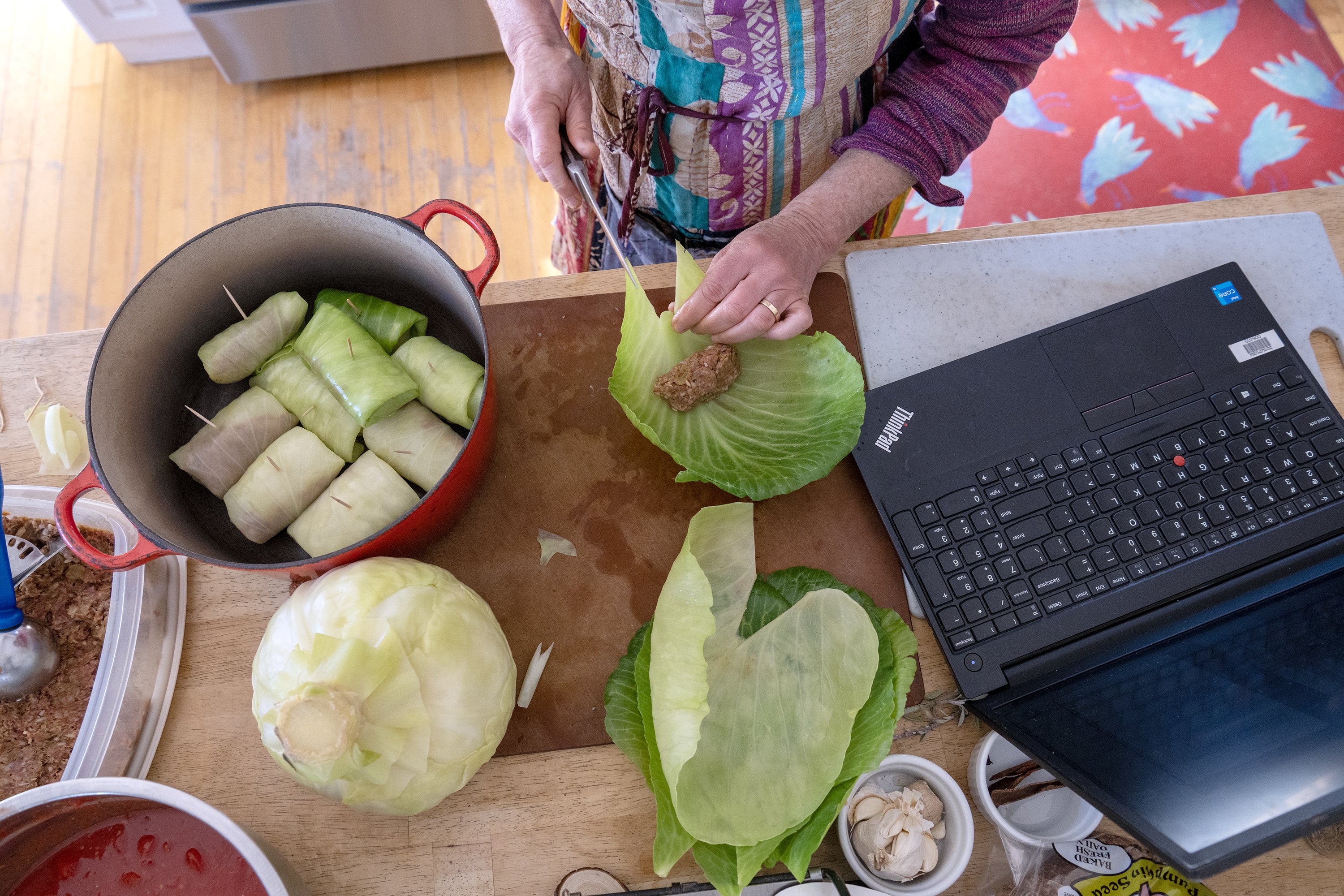
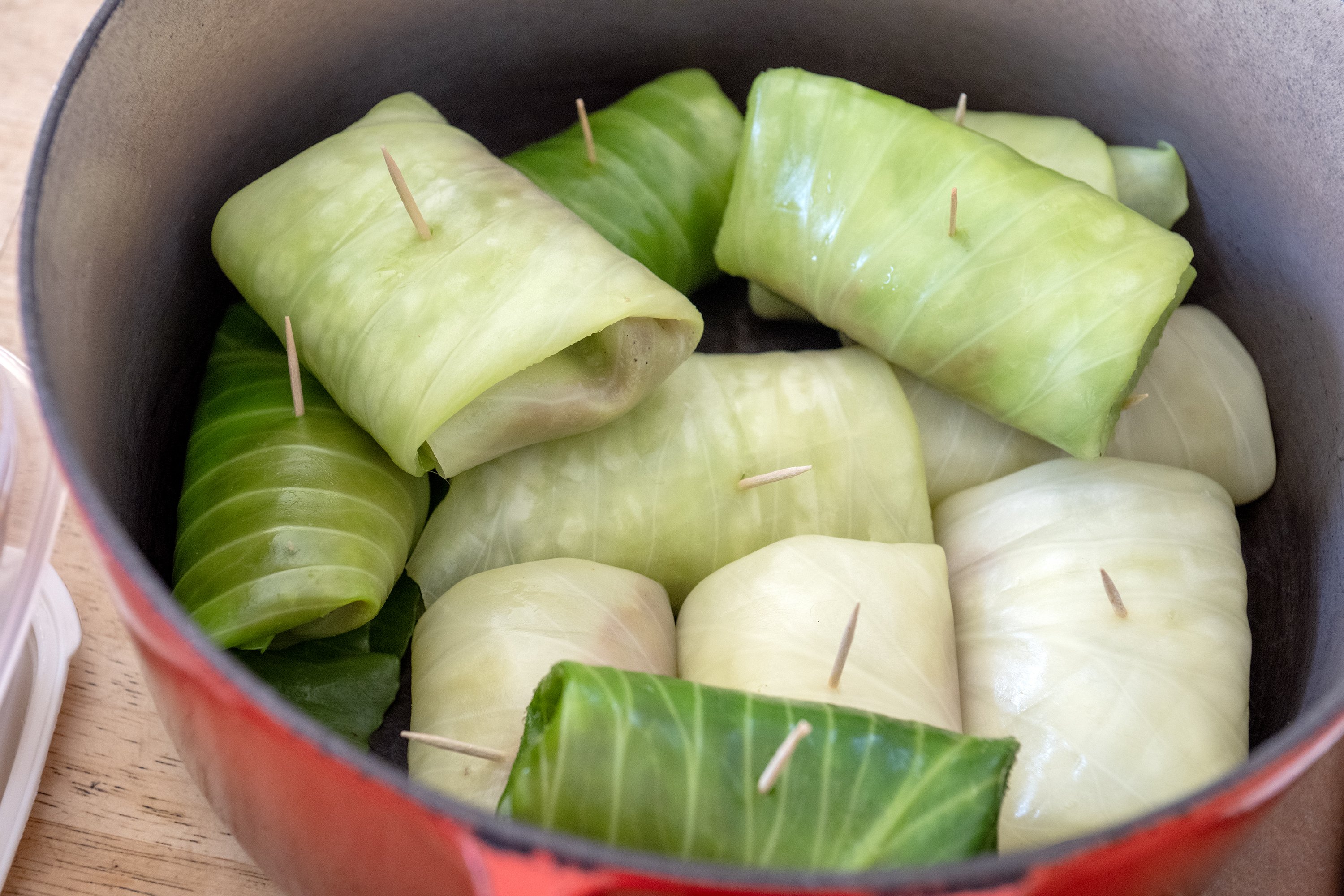
To construct the bundles, lay a cabbage leaf inner (cup) side up on a work surface. Shape about 1/4 cup stuffing into a little log. Lay the log horizontally across the cabbage, keeping it within the bottom third of the leaf and lift the bottom of the leaf up and against the meat. Fold the two sides over the log and start rolling the log up in the leaf until you reach the top. (Imagine you are rolling a burrito. Better yet, google “stuffed cabbage rolls” and find a zillion videos that will show you this procedure.) Make the leaves as compact as you can; secure with a toothpick. Repeat with the remaining leaves and stuffing.
To make the sauce and cook the bundles, preheat the oven to 350 degrees F.
Open the cans of tomatoes and, using kitchen scissors and working in the cans, snip the tomatoes into small pieces (or use your hands to break them up). Pour the tomatoes and juice into a large bowl and stir in the apple juice, brown sugar, vinegar, caraway seeds, salt and cayenne. In another bowl, toss together the sliced onion, grated apple and reserved sliced cabbage.
Pour one-third of the sauce into a large Dutch oven. Cover with half of the apple mixture and top with half of the cabbage bundles. Repeat with half of the remaining apple mixture and the rest of the cabbage bundles. Finish with a layer of the remaining sauce and the remaining apple mixture. Cover with a piece of parchment paper cut to fit snugly inside the pot and against the ingredients (or seal the pot with aluminum foil). Cover with the lid and slide the pot into the oven. (It will be heavy!)
Let the stuffed cabbage cook undisturbed for 3 hours. Taste the sauce, which will be thin, and add more sugar, vinegar, salt or cayenne if you think it needs it.
The stuffed cabbage can be served now or cooled, refrigerated and reheated when you’re ready to eat it.

We invite you to add your comments. We encourage a thoughtful exchange of ideas and information on this website. By joining the conversation, you are agreeing to our commenting policy and terms of use. More information is found on our FAQs. You can modify your screen name here.
Comments are managed by our staff during regular business hours Monday through Friday as well as limited hours on Saturday and Sunday. Comments held for moderation outside of those hours may take longer to approve.
Join the Conversation
Please sign into your CentralMaine.com account to participate in conversations below. If you do not have an account, you can register or subscribe. Questions? Please see our FAQs.