

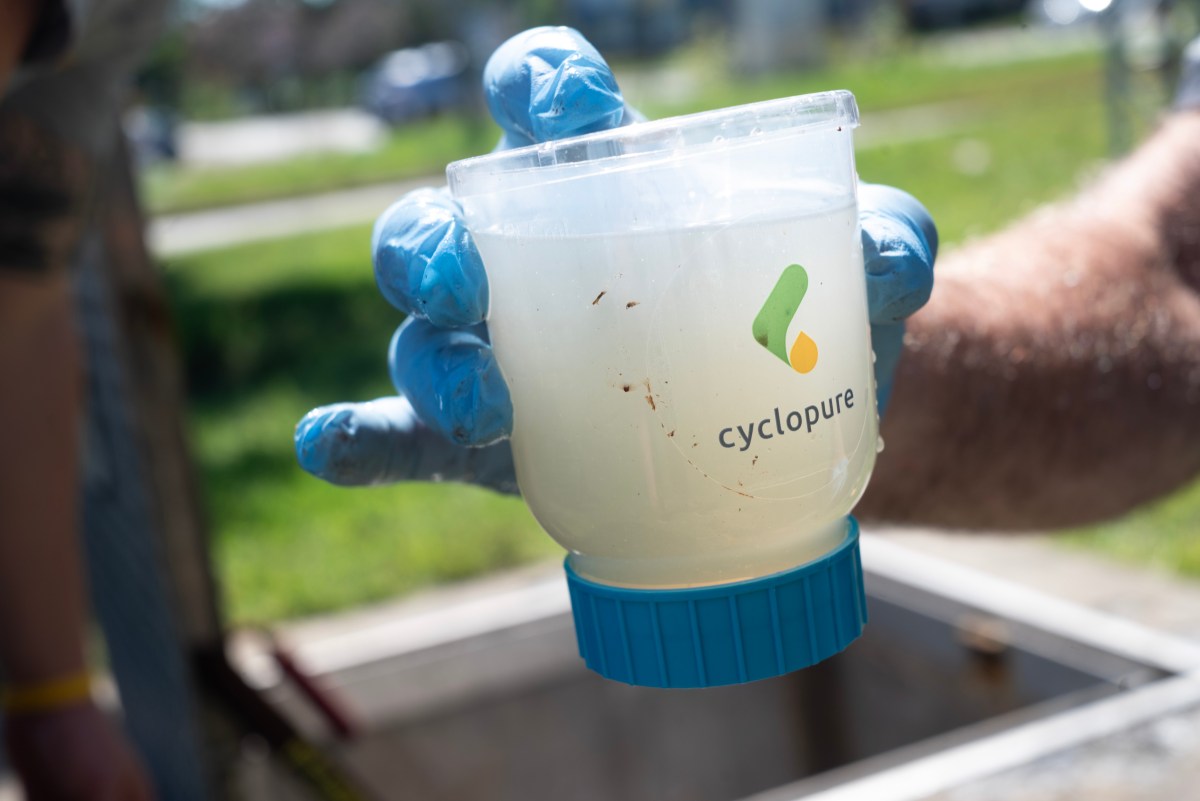
As thousands of Maine homeowners face the daunting cost of testing their wells for forever chemicals, new state research suggests that an affordable mail-in kit may provide a reliable alternative.
Over the last decade, the growing awareness of the local impacts of per- and polyfluoroalkyl substances, known as PFAS, has haunted the Maine countryside, turning the everyday act of pouring a glass of water into a source of anxiety.
The state is providing free water testing and home filtration systems for those who live near known hot spots, including the sludge-fertilized farm fields of central Maine, the firefighting foam spill at Brunswick Executive Airport and aging landfills around the state.
Others who want to know if PFAS are lurking in their private well must pay for their own test, which isn’t cheap. Although prices have come down in recent years, the cost of a professional analysis conducted by a state-accredited lab will run between $250 to $500.
In response to a surge of calls from concerned citizens, the Maine Center for Disease Control and Prevention recently completed a first-of-its-kind study to determine if an $85 home test kit, made by the Illinois-based Cyclopure, can offer cheaper yet trustworthy test results.
The preliminary findings offer a cautious but optimistic green light for homeowners.
State environmental regulators remain steadfast in requiring certified lab tests for any official business, but the CDC’s research indicates the cheaper kits accurately identify and assess the PFAS most closely linked to serious health risks.
“We began to get calls from homeowners wanting to know if they could test for PFAS with this particular water test kit,” said assistant state toxicologist Thomas Simones. “There just wasn’t that data out there for us to look at. That’s why we conducted this study.”
A ‘POLAROID’ OF CONTAMINATION
The technology behind the Cyclopure kit differs from the traditional “bottle and box” method used by professional labs. Instead of shipping heavy boxes of water, a homeowner fills a small collection cup with water, which drains through a filter disc that binds to the PFAS molecules.
The water is then discarded, and only the small, corn-based disc is mailed back to the lab.
Frank Cassou, the CEO of Cyclopure, described the process as taking a “polaroid of the PFAS concentration at the moment of sampling” during an interview with the Times Record in 2024, in the wake of the Brunswick Executive Airport spill.
To test the “polaroid” against the gold standard, Simones and his team tagged along with Maine Department of Environmental Protection staff in 2025 as they sampled 28 houses with known PFAS contamination.
They took side-by-side samples: one for a state-accredited commercial lab using standard EPA methods and one using the $85 Cyclopure kit.
For the “long-chain” chemicals that have dominated public health concerns, such as PFOA and PFOS, the difference between Cyclopure kits and commercial lab findings was less than 30%, a margin that Simones described as “generally acceptable” in the world of toxicological testing.
Forever chemicals have been used since the 1940s in consumer products and industry, including in nonstick pans, food packaging and firefighting foam. Even trace amounts are deemed harmful, linked to a host of health problems that range from immune deficiency to certain cancers.
THE ACCURACY GAP
The study did find a notable weakness in the cheaper kits. For “short-chain” chemicals, such as PFBA, Cyclopure underreported the amounts of forever chemical present. In one case, the lab found levels six times higher than Cyclopure.
However, Maine health officials are less concerned about this discrepancy. These short-chain chemicals are generally considered less toxic, Simones said, and are not included in Maine’s primary drinking water regulatory standards.
“It would have to be quite a bit higher before we’d even think about an issue there,” he said.
Still, the CDC plans to continue its research this summer, investigating whether these smaller chemicals are simply “moving through” the filter rather than being caught by it, Simones said.
Despite the CDC’s findings, state environmental regulators are not ready to embrace Cyclopure.
In a statement, David Madore, the DEP deputy commissioner, said the department cannot accept Cyclopure results for official purposes, like qualifying for a state-funded filter system. By law, the state must use labs formally accredited by Maine.
“Since Cyclopure is not accredited, data quality cannot be guaranteed,” Madore said in an email.
The high price of certified testing is a major hurdle for Mainers unsure if their private well is safe, according to Ed Friedman, chairman of the regional watershed group Friends of Merrymeeting Bay. His group’s own reliability testing found Cyclopure results trustworthy.
Many environmental groups and even some private environmental labs are using Cyclopure to expand their testing abilities, he said. Last year, the Colorado Department of Public Health and Environment provided free Cyclopure kits to residents with private wells.
Friedman is urging the state to adopt the kits as a screening tool to reach more households. The state could purchase about a dozen Cyclopure kits for the price of just two certified lab tests, he noted. That is especially important now that DEP says it is running out of PFAS funds.
THE SCOPE OF THE CRISIS
The scale of the concern in Maine is immense. The DEP has tested at least 4,000 home wells, finding amounts ranging from undetectable to a staggering 10,000 parts per trillion. For context, the new federal health standard for some of these chemicals is just 4 parts per trillion.
The urgency has only increased in places like Brunswick, where a massive firefighting foam spill in August 2024 sent shockwaves through the community. Residents there turned to Cyclopure in such numbers that the company labeled the town a “sales hotspot.”
The question of affordable testing will soon move from a matter of personal choice to a legal requirement for some. A new state law requires Maine landlords to test their well water for PFAS by January of next year and share the results with tenants.
State toxicologist Andy Smith said Maine is currently weighing what role, if any, these $85 kits might play in helping landlords comply with that mandate. “This would obviously be less of a burden on landlords,” Smith said.
LOOKING AHEAD
For now, the Maine CDC’s advice to homeowners is simple: if you are worried and cannot afford a lab-certified test, the $85 kit is a valid place to start.
“This at least provides a first level actionable information for a homeowner,” Simones said.
He cautioned, however, that if a home kit shows “really elevated” levels of the most dangerous chemicals, homeowners should follow up with a certified lab to confirm the findings.
State researchers will return to the field to explore whether the kits can work as well for surface water in Maine’s rivers and streams. They are also expanding their study to include homes with lower levels of contamination to see if the kits remain accurate near the strict new federal limits.
In a state where so many depend on the ground beneath their feet for the water in their taps —more than half of Maine residents get drinking water from private wells and are responsible for their own water testing — the quest for an affordable “polaroid” of safety continues.
“We are really motivated here by private homeowners coming to us trying to decide how to go about self-testing,” Smith said. “Every day, we’re talking to people about arsenic, or uranium, or radon. … This is just an extension of that.”

We invite you to add your comments. We encourage a thoughtful exchange of ideas and information on this website. By joining the conversation, you are agreeing to our commenting policy and terms of use. More information is found on our FAQs. You can update your screen name on the member's center.
Comments are managed by our staff during regular business hours Monday through Friday as well as limited hours on Saturday and Sunday. Comments held for moderation outside of those hours may take longer to approve.
Join the Conversation
Please sign into your CentralMaine.com account to participate in conversations below. If you do not have an account, you can subscribe here. Questions? Please see our FAQs.