

As dew points climb during this hot weather stretch, you’ll likely find yourself feeling pretty uncomfortable. You know the old saying: “It’s not the heat, it’s the humidity.”

Turns out there’s a very interesting reason high humidity makes humans uncomfortable, and it involves physiology and thermodynamics. (“Very interesting” and “thermodynamics” should probably never be used together in a sentence.)
To understand this phenomenon, we have to start with why we sweat.
Although we associate sweating with the hottest days, hardest physical labors or most tense situations, it’s actually a cooling mechanism for our bodies. When our brain senses that our body is overheating, it sends a signal to our sweat glands to produce sweat. You know all that (most likely), but how, exactly, does a layer of salty water cool our body?
This is where we get into the thermodynamics.
That thin layer of water on your skin starts to evaporate into the air around you (remember, your body is presumably above 98 degrees Fahrenheit at this point). The process of turning that water from liquid to gas takes energy; this is known as the enthalpy of vaporization. The source of that energy is your body heat. So as the sweat evaporates into the air around you, your body uses its heat energy to fuel the evaporation and … voila, you cool down!
The same effect occurs on steroids when you get out of a pool — that’s why you run for the towel, unless it’s a crazy hot day (or you have a crazy hot bod, but that’s another discussion).
So back to the original question: Why does high humidity make us so uncomfortable? Well, the energy/heat loss from our skin depends on how efficiently the sweat can evaporate into the air around us. When the air feels humid to us, what it really means is that the air has a high dew point and is nearly saturated with water. Since the air can’t hold much more water, the process of evaporation from our skin is greatly hampered.
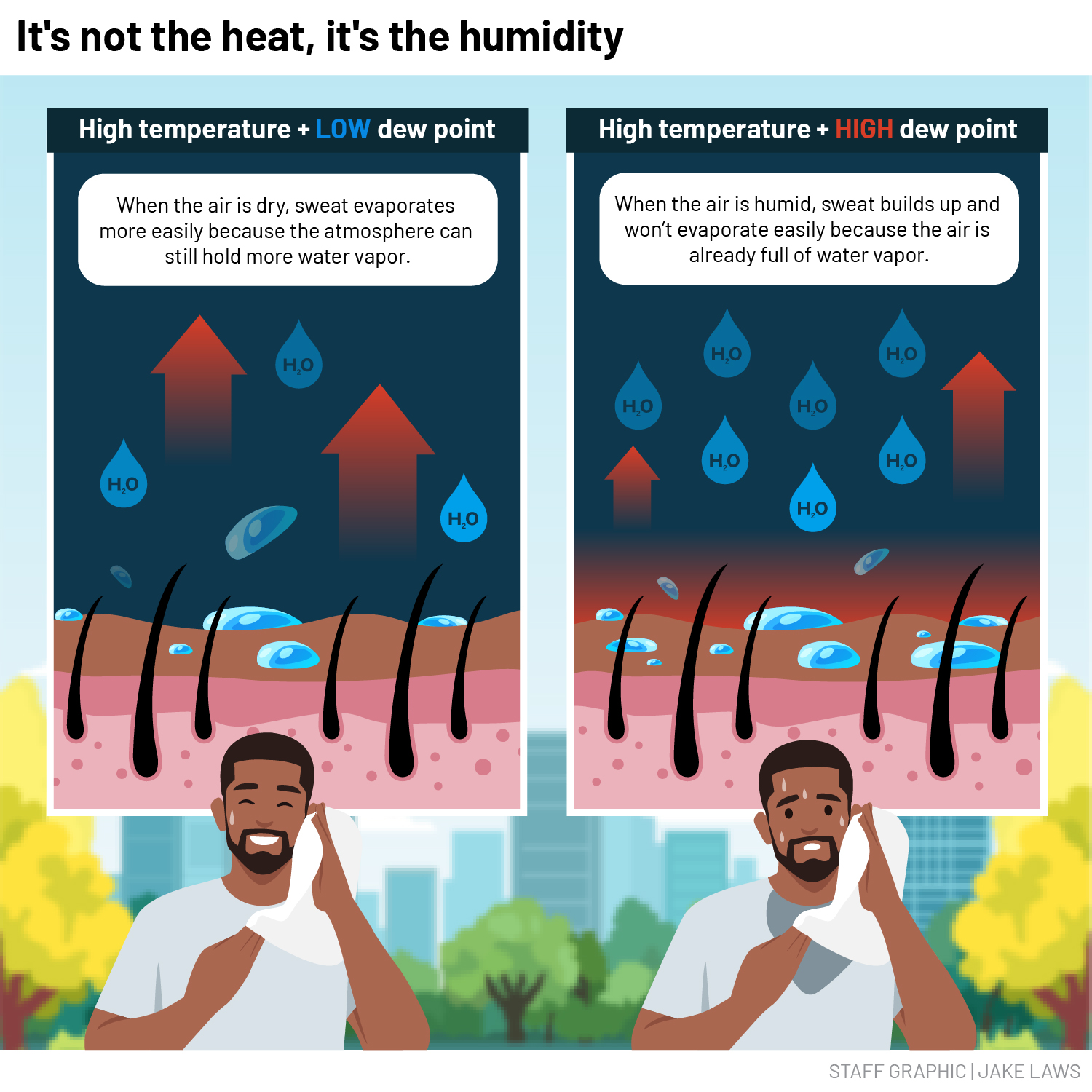
I like to visualize this as how quickly 10 cars could park in a wide-open parking lot compared to how long it would take them to park if the lot was mostly full and there were only 10 spots left. (I had my blinker on, don’t even think about it.)
Less efficient evaporation means less skin-cooling heat transfer — and now our body’s best cooling mechanism has been largely nullified.
So, high humidity stinks, and that’s why we hate it. Actually, it’s the high dew point that matters — high relative humidity expressed as a percentage is completely irrelevant. But that’s a lesson for another day, if they keep letting me write these comedy-laced science stories …
Keith Carson, an award-winning Maine meteorologist previously of News Center Maine and The Weather Channel, is the director of environment & science communications for the Maine Conservation Voters nonprofit. This is the first of his occasional weather articles for the Maine Trust for Local News.
We invite you to add your comments. We encourage a thoughtful exchange of ideas and information on this website. By joining the conversation, you are agreeing to our commenting policy and terms of use. More information is found on our FAQs. You can update your screen name on the member's center.
Comments are managed by our staff during regular business hours Monday through Friday as well as limited hours on Saturday and Sunday. Comments held for moderation outside of those hours may take longer to approve.
Join the Conversation
Please sign into your CentralMaine.com account to participate in conversations below. If you do not have an account, you can subscribe here. Questions? Please see our FAQs.