
A bowl of multicolored local eggs sitting on my counter always makes me smile. But baking with them makes me scratch my head.
Modern recipe-writing standards allow a baker to assume that any egg called for on an ingredient list is Grade A large, unless otherwise specified (which is rare). Baking, as opposed to cooking, requires precision from the person wielding the whisk. So understanding an egg’s size is as important as knowing how many eggs the recipe requires.
This is no problem if you buy your eggs at the grocery store, where they are consistently sized, and the carton is clearly marked medium, large, extra-large or jumbo. According to information on the USDA website, all hens start their egg production by laying small ones and gradually, as the hens grow and eat a protein-rich diet, their eggs get bigger. In most modern breeds, hens are laying large, extra-large or jumbo eggs by 40 weeks of age.
But what if the girls in the local hen house – whether that’s in your backyard or in a trusted farmer’s barnyard down the road – comprise a variety of breeds and sit at different points in their production cycles, making your weekly dozen more catch-as-catch-can than standard?
In that case, a kitchen scale or a measuring cup and a bit of mental math will help you achieve the recipe results you are looking for in egg-centric creations like Chocolate Espresso Kahlua Soufflés (see recipe), custards and angel food cakes.
The USDA sets the weight of a Grade A large egg at just around 2 ounces, with the yolk comprising one-third (about .7 ounces) of the weight and the white taking up two-thirds (about 1.3 ounces). By volume, two large eggs generously fill a 1/3 cup measure; two whites are nearly ¼ cup; and each yolk is just about a tablespoon. Note my “around,” “generous,” “about” and “nearly” qualifiers. Even standard, store-bought eggs vary slightly. The USDA actually measures weight and volume per dozen of eggs in order to average out these small differences.
Your local eggs may or may not line up with the same weights and volumes as the commercial ones. If a custard recipe calls for two large eggs, and the volume of two local ones is too little but three is too much, lightly beat the three eggs in a measuring cup and pour off the amount in excess of 1/3 cup and save it for another use. Likewise, if the cake recipe calls for four egg whites, but the four eggs your hen gave up that morning are of the super jumbo variety, you may need to crack open only three to get to the called for ½ cup of whites.
In sum, when working with local eggs, a baker needs a fl-eggs-ible measuring technique.
Christine Burns Rudalevige is a recipe developer and tester, and cooking teacher in Brunswick. She writes about feeding her family Maine seafood at www.familyfish.net. Contact her at [email protected].
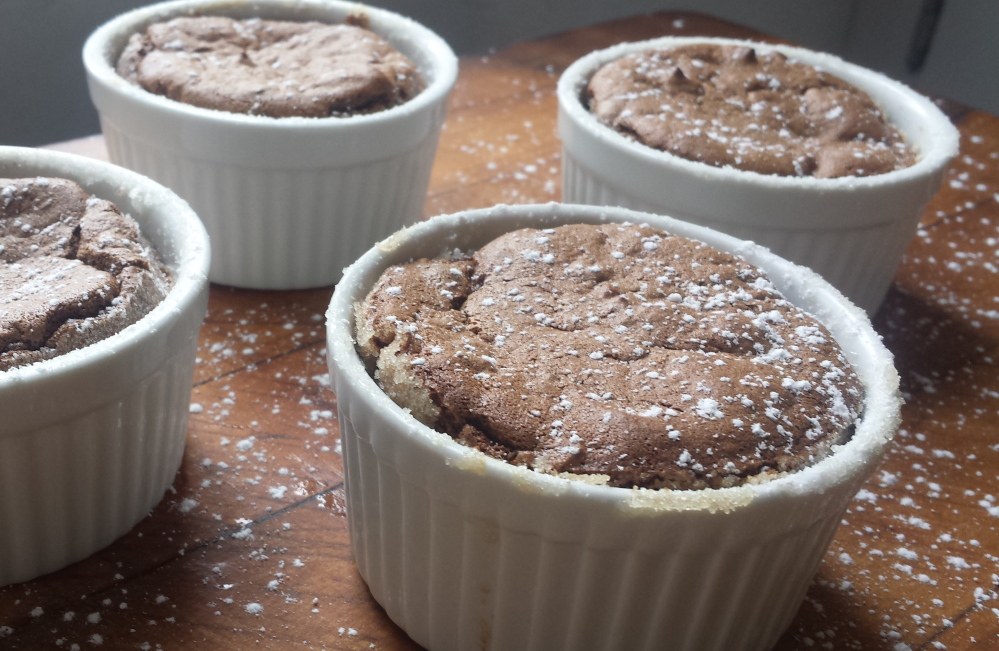
CHOCOLATE ESPRESSO KAHLUA SOUFFLÉS
Michael Ruhlman last year published a cookbook simply called “Egg.” This recipe comes from a chapter on how to use each part of an egg separately to show off its chemical properties (yolks bind, whites lift). The recipe calls for six eggs; if you’re using local ones, the number may vary, so be sure to measure carefully as described in the accompanying article.
Serves 8
Softened butter for coating ramekins
¾ cup granulated sugar, plus more to coat ramekins
¾ cup milk
1 tablespoon espresso powder
1 tablespoon unsweetened cocoa powder
1 teaspoon vanilla extract
6 eggs, separated (¾ cup whites, 1/3 cup yolks if using local, disparately sized eggs)
2 tablespoons flour
2 tablespoons Kahlua
¾ cups semisweet chocolate chips
1 teaspoon fresh lemon juice
Confectioners’ sugar, for dusting
Preheat the oven to 350 degrees F. Coat the insides of eight (4-ounce) ramekins with butter. Toss a little sugar around the insides of each ramekin; pour out the excess.
Combine the milk, espresso powder, cocoa powder, vanilla and salt in a small saucepan and bring mixture to a simmer over medium-high heat.
Separately, whisk the yolks and ¼ cup sugar in a medium bowl till the mixture is uniform and sugar is evenly distributed.
Slowly whisk ½ cup of the simmering milk mixture into the yolk mixture to temper it, then pour the tempered yolk mixture back into the saucepan. Whisk over medium high heat until just before the mixture reaches a simmer. Combine the flour and Kahlua, then whisk it into the mixture on the stove and continue to whisk until the sauce thickens, just as it returns to a simmer, about 30 to 60 seconds.
Remove the pan from the heat and add the chocolate chips, stirring just to cover the chips with the hot milk-egg mixture so they melt.
Whip the egg whites on high speed with an electric mixer. Once they are frothy, add the lemon juice and drizzle in the remaining ½ cup sugar while continuing to whip the whites until they hold peaks.
Transfer the chocolate mixture to a large bowl. Add whipped whites, one third at a time, folding slowly and gently until the whites are fully incorporated. Spoon the mixture into the prepared ramekins, filling them about three-quarters full.
Bake for 30 minutes. Dust with confectioners’ sugar and serve immediately.
Comments are no longer available on this story