
Never having tasted Casu marzu, the infamous (and outlawed) Sardinian cheese studded with maggot larvae that mature as the cheese does, I can honestly say that I’ve never met a cheese I didn’t like. As a matter of fact, I met a new one I liked very much just the other day: Everything Cream Cheese from Springdale Farm. Made from the milk of Guernsey and Jersey cows that live on the farm in Waldo, this spreadable cheese has garlic, onion, salt and poppy and sesame seeds, just like its namesake bagel.
I’ve always been soft on fresh cheeses. I’ve explored the classic types – chevre, feta, fromage blanc, lebneh, paneer, quark and queso fresco – from all over the world. But now, with the growing number of local farms and cheesemakers producing young cheeses and selling them in farmers markets, health food stores and supermarkets near me and learning that, pound for pound, they require about half of the milk and far less energy to produce than their aged brethren, I am becoming unabashedly fond of them. (Specific yields vary depending on the type of milk and the breed of mammal that produced it.)
Please, let me be crystal clear. I am not telling anyone to forgo local aged cheeses in favor of the fresh ones, as that would make me a hypocrite. I fully intend to continue consuming both fresh and aged in equal measure. Rather, I am advocating a higher profile for fresh cheeses from Maine – some that carry the same names as the classics and some new additions, like Balfour Farm’s Bevre (a chevre style made with cow’s milk) – as the far greener option to industrial cream cheese, mascarpone, mozzarella and ricotta.
These young cheeses are made from local milk and/or cream, all of which must be pasteurized according to state and federal food safety regulations. The milk gets heated and curdled with rennet and cultures and is then drained of its liquid whey (which has many tasty culinary uses) for eight to 12 hours. At that point, these cheeses are ready to eat. Soft cheeses don’t need to sit in temperature-controlled caves for six, 12 or 18 months to develop their flavors. They are fresh, clean and a tad tangy from the get-go, then get tarted up with sea salt, dried herbs, alliums, honey and even chilies.
They can be stored in the refrigerator for up to two weeks (the cream cheeses last longer than the ricotta does), as the local cheeses – unlike commercial ones – rarely include stabilizers. They don’t freeze well because they are less creamy when thawed. When mold appears on a soft cheese, it really needs to be composted. Local soft cheeses are use-it-or-lose-it kind of propositions.
Besides the basic slather on a bagel, cracker or the back of a spoon, fresh cheeses work best in cold dishes. Use them as an alternative to mayonnaise on a sandwich, as an ingredient in a dip or as a topping in a hot dish like a bowl of chili or a plate of pasta. Fresh cheeses tend to break when cooked too long in hot sauces, so add them only at the last minute to soups and stews. Also due to the lack of stabilizing agents, local fresh cream cheese are not your best bet for your favorite cheesecake recipes, which often bake an hour or so. But they do well in cookies like rugelach and turnover doughs (see recipe) that need shorter baking times.
The average price of the cream cheese I used for this column was $6 for an 8-ounce tub, compared to $2.50 for the equivalent amount of name-brand commercial stuff. Pricier, I know. But the local producers I spoke with live and work on family farms. Soft cheeses are a value-added product that help keep those farms economically viable.
Give a local fresh cheese a try. I am confident you’ll be surprised how quickly you get to the bottom of its recyclable container.
Christine Burns Rudalevige is a food writer, a recipe developer and tester and a cooking teacher in Brunswick. Contact her at: [email protected].
MUSHROOM TURNOVERS
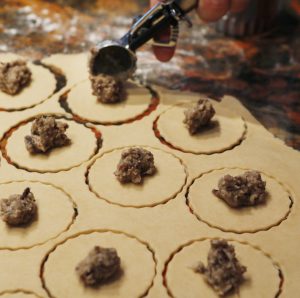
Christine Burns Rudalevige adds mushroom and fresh cheese filling to rounds of turnover dough. Joel Page/Staff Photographer
This is one of my tried and true recipes – turned green. I use Maine-made butter, cream cheese and herbed fromage blanc in place of commercial varieties. The mushrooms are a mix of fresh and dried ones I can find locally.
Makes 60-72 turnovers
For the crust:
8 ounces local cream cheese, room temperature
1 cup local butter, room temperature
1 1/2 cups white whole wheat flour
For the filling:
1/2 ounce dried wild local mushrooms
3/4 pound local fresh mushrooms
1 small onion
2 tablespoons local butter
2 teaspoons all-purpose flour
6 ounces local herbed fresh cheese
Freshly ground black pepper
1 egg, beaten
Flaky sea salt
Combine the cream cheese and butter in the bowl of a food processor, until well blended. Add the flour and process until the mixture forms a ball. Divide the dough in half. Shape each piece into a disk. Wrap and refrigerate while you make the filling.
Combine ½ cup boiling water with the dried mushrooms in a measuring cup. Set aside for 20 minutes. Lift reconstituted mushrooms out of the measuring cup with a slotted spoon. Save the soaking liquid.
Finely chop the reconstituted and fresh mushrooms and onion. I confess I tend to use the unwashed bowl of the food processor that I used to make the dough, but the greener option would be by hand.
Melt the butter in a large skillet over medium high heat. Add the chopped mushrooms and onion. Cook, stirring, until tender, 5-7 minutes. Sprinkle flour over vegetables. Pour the reserved mushroom soaking liquid through a fine-mesh strainer into the pan. Stir and cook until the liquid is reduced by half, 2-3 minutes. Reduce the heat to low and stir in the herbed fresh cheese. Cook this mixture until it just thickens, 3-4 minutes. Remove the pan from the heat. Taste and adjust for seasoning. Cool to room temperature.
On a floured surface, roll out 1 of the dough disks to 1/8-inch thickness. Use a 3-inch biscuit or cookie cutter to cut out as many circles as possible. Place a teaspoon of mushroom mixture in the center of each circle of dough. Fold the dough over and seal each turnover by pressing on its curved edge with the tines of a fork. Place the turnovers on a baking sheet.
Push the excess dough aside and repeat the process with the second dough disk. Combine excess dough, form into a disk, and repeat the process to make more turnovers.
At this point, the turnovers can be frozen or baked. Freeze them on the sheets and combine in sealed container once frozen. To bake immediately, preheat the oven to 450 degrees F. Brush the tops of the turnovers with the beaten egg, prick them with the tip of knife to vent steam and sprinkle with salt. Bake until golden brown, 12-15 minutes. If you are baking them from frozen, allow 20-22 minutes baking time. Serve warm.
Comments are no longer available on this story