

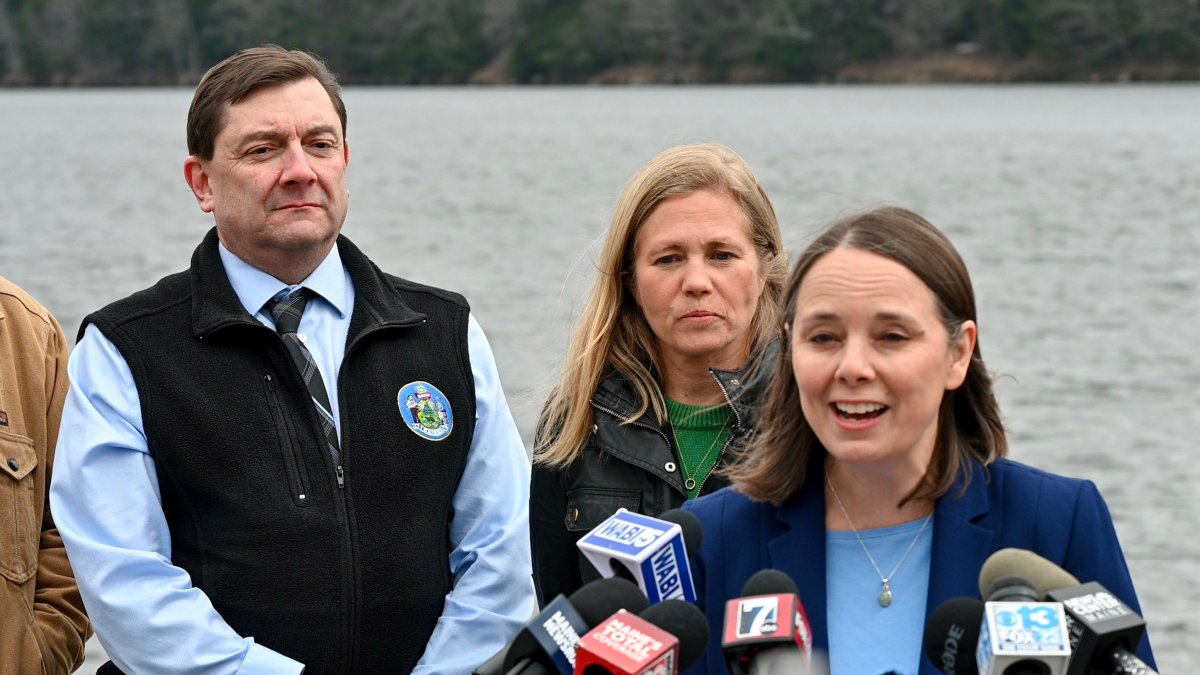
It didn’t take long after Gov. Janet Mills’ abrupt exit from the U.S. Senate race for her fellow Democrats to start discussing her legacy.
On Thursday, the five Democrats running to become Maine’s next governor appeared in their first televised debate ahead of the June 9 primary. The debate, hosted by WMTW, came the same day Mills announced she would be dropping out of the Senate Democratic primary, all but ceding the nomination to progressive newcomer Graham Platner.
With Mills set to leave elected office after a long and historic career, the candidates were asked to describe areas where they agree and disagree with the governor.
Here’s what they had to say.
HANNAH PINGREE
Pingree worked for more than six years as director of the Governor’s Office of Policy Innovation and the Future under Mills. She described the job as a “tremendous opportunity” where they worked on climate issues and housing and started the Office of New Americans.
Pingree said she disagreed, however, with Mills’ recent veto of LD 307, a bill that would have put in place a temporary ban on new data center development.
“If I was governor I would have signed that legislation,” Pingree said. “I think it’s very important that we put guardrails around AI data centers and ensure they are not jacking up the rates of electricity ratepayers.”
SHENNA BELLOWS
Bellows, Maine’s secretary of state, said she worked with Mills on labor issues when Bellows was a state senator. She said they worked on measures related to paid time off and reducing the gender pay gap that both business and labor got behind.
But Bellows said she also would have supported LD 307, which Mills vetoed.
Bellows also said that the Maine Department of Health and Human Services may not be doing enough to protect at-risk children. She said the state should have a Cabinet-level office dedicated to families and children.
“We should be expanding into universal childcare and also going into our communities to keep our children safe,” Bellows said.
ANGUS KING III
King, a renewable energy entrepreneur, said Mills did a great job standing up to President Donald Trump and pushing back on moves by the administration that aren’t good for Maine. Last year, the governor made national news when she got into a tiff with Trump over the rights of transgender athletes, telling the president, “See you in court.”
However, King said he didn’t agree with Mills’ decision to use the state’s budget stabilization fund to send $300 affordability checks to more than 500,000 taxpayers this year.
“The rainy day fund is something we’re absolutely going to need in the future to help cover our budget,” King said.
NIRAV SHAH
Shah, the former director of the Maine Center for Disease Control and Prevention under Mills, praised the governor for her leadership during COVID-19, and for expanding Medicaid.
He said he disagreed with her decision to not sign LD 1971, a bill to limit the ability of local law enforcement to work with federal immigration agents. Mills delayed action on the bill, ultimately deciding last winter to let it become law without her signature.
Shah said he has also disagreed with Mills on gun control issues, including the governor’s opposition to the new red flag law and her veto in 2024 of a bill to ban bump stocks and other rapid fire devices. And he said he would have signed LD 307, the data center bill.
TROY JACKSON
Jackson, a former Maine Senate president, gave Mills credit for expanding Medicaid as one of the first actions of her administration in 2019. But he noted he has disagreed with her plenty.
Jackson said Mills vetoed close to 40 of his bills when he was a lawmaker, including a bill to put price limits on prescription costs.
“She said big pharma was going to sue us,” Jackson said, adding that a similar measure has since been implemented in Colorado. “Big pharma always sues. That’s their business model.”
“I get calls still from constituents that have to limit their prescriptions,” Jackson said. “They’re worried about paying their rent and making healthcare decisions … Those things matter. We need a governor that understands those problems.”

We invite you to add your comments. We encourage a thoughtful exchange of ideas and information on this website. By joining the conversation, you are agreeing to our commenting policy and terms of use. More information is found on our FAQs. You can update your screen name on the member's center.
Comments are managed by our staff during regular business hours Monday through Friday as well as limited hours on Saturday and Sunday. Comments held for moderation outside of those hours may take longer to approve.
Join the Conversation
Please sign into your CentralMaine.com account to participate in conversations below. If you do not have an account, you can subscribe here. Questions? Please see our FAQs.